
Strategize Like a CEO
Understanding strategy opens the door to strategic acumen

When you understand what strategy actually means, every initiative, proposal, priority, and decision (whether made by you or driven from the top) becomes clearer, more powerful and - if it’s yours - more credible
Ask most anyone what strategy means, and they’ll say something about mission, vision, and values. It’s a reasonable answer. It’s also wrong -- at least from where the CEO and board are standing.
And “what you see depends on where you stand” matters enormously here.
For decades, leadership development programs (developed by those who do not stand in the shoes of C-suite executives) have framed strategy as the work of articulating mission, vision, and values. These are meaningful, but not what highly successful executives and boards mean when they talk about strategy.
If we want to develop genuine strategic acumen, we have to let go of this definition entirely.
So What IS Strategy?
The clearest explanation I’ve found comes from Execution by Larry Bossidy and Ram Charan. A properly crafted strategy achieves three goals:
Wins the customer’s preference (CUSTOMER/CONSUMER)
Creates a sustainable competitive advantage (RETURN and GROWTH)
Leaves enough money on the table for shareholders - or, in nonprofit organizations, enough to reinvest and sustain the mission (CASH)
(If those parenthetical labels look unfamiliar, they’re part of the Charan Virtuous Business Cycle - the foundational framework we use throughout the Be Business Savvy course. It’s worth knowing.)
In other words, strategy is a promise. A promise to shareholders, owners (or for nonprofits, the community) that the organization will continue to create and deliver value. Mission, vision, and values may support that promise. They are not the promise itself.
What goes into setting strategy?
Richard Rumelt, in Good Strategy, Bad Strategy, puts it this way:
The core of strategy work is always the same - discovering the critical factors in a situation and designing a way of coordinating and focusing actions to deal with those factors.
Discovering the critical factors
What are those critical factors? In Confronting Reality, Larry Bossidy and Ram Charan identify three fundamental factors that determine a business’s strategy.
The external environment it operates in
The financial targets it needs to meet
The internal capabilities it depends on to meet those targets in that environment
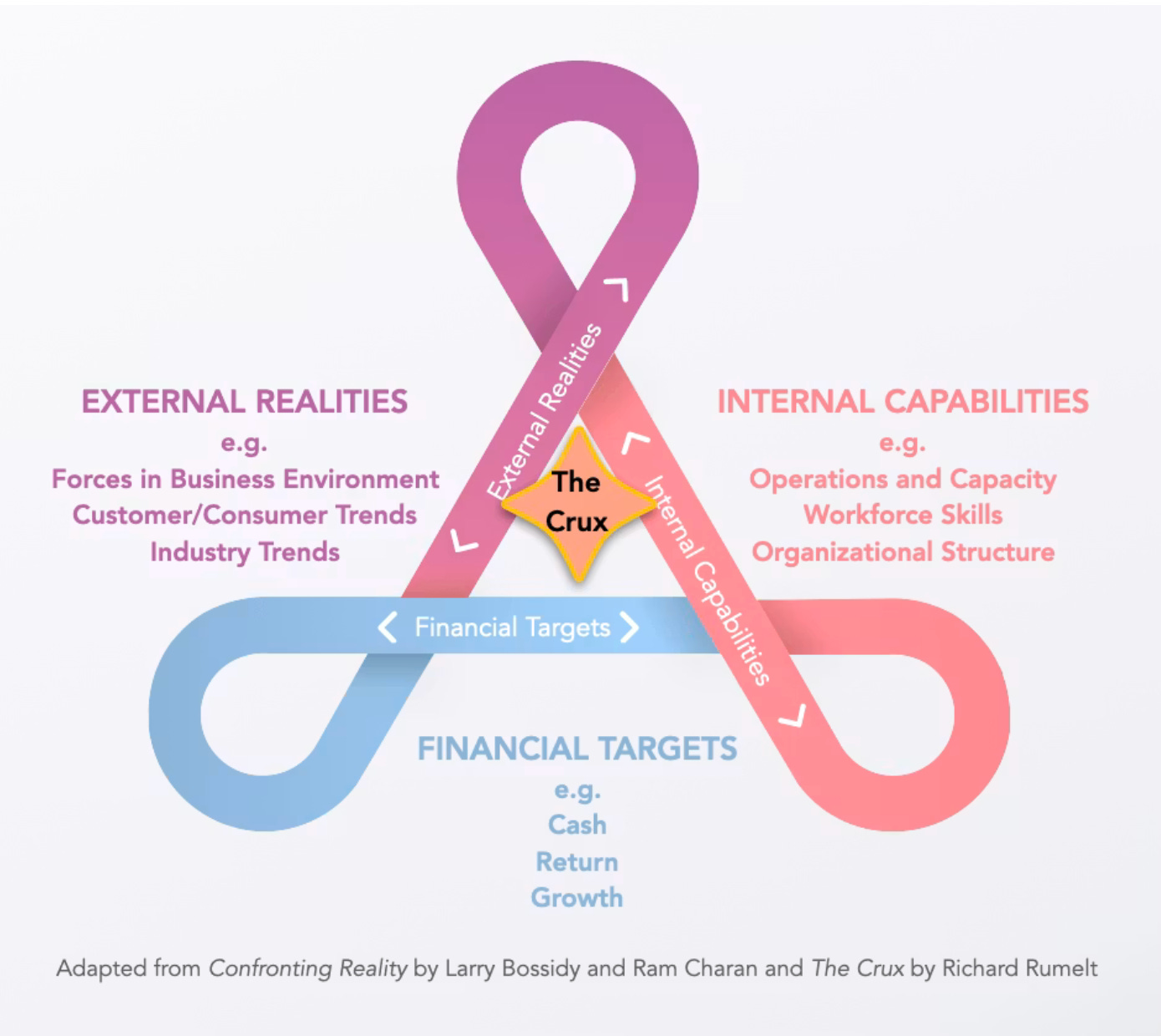
They make the point that these elements work together in an iterative, interdependent, and dynamic process. Not a linear one: And at the heart is The Crux - the strategic initiative(s) chosen from the available options.
In other words, strategy isn’t set once and left alone - especially in today’s turbulent business settings. It’s continuously recalibrated as the environment shifts, financials change, and required internal capabilities evolve.
Coordinating and focusing actions
You’ll also notice “The Crux” at the center of the model. In his book, The Crux, Rumelt tells us that real strategic work requires getting to the “crux of the matter” - choosing from all possible options the “make or break” strategic choices. Determining which have the greatest chance of success given the constraints. Not every opportunity is worth pursuing. Not every threat requires a response. Discernment is the skill. (I save our deeper dive into this for the Be Business Savvy course.)
The crucial hidden message for us
The thing about the concept of strategic acumen is that it has a seductive glamour to it that financial acumen doesn’t. This model tells us: to develop and demonstrate strategic acumen you must have financial acumen. They are interdependent. And frankly, you need financial acumen before you can successfully work on strategic acumen. Otherwise you’re dealing with yet a different Missing 33%.
Why this Matters to You
You may not be setting enterprise-wide strategy today, but understanding what strategy actually is - and what it is not - changes how you engage with it at every level. It changes the questions you ask. It changes what you pay attention to. It changes how you frame proposals, prioritize initiatives, and present ideas to senior leaders.
And it signals something important: that you understand the game that’s actually being played.
That’s a core part of what I call Business Savvy and it’s exactly what separates “she’s great at her job” from “she’s ready for more.”
What’s a Woman to Do?
Find your organization’s strategic goals. Look at the annual report, investor presentations, and earnings call transcripts. Strategic goals generally show up most clearly as financial targets, with commentary about how internal capabilities will change to hit them. Sometimes there’s commentary about what’s happening externally - watch for talk of headwinds and tailwinds. Can you identify: how the organization wins customer preference, how it creates competitive advantage, and how it leaves money on the table? If one seems to be missing from your picture, dig deeper into why.
Scan the external environment. What’s happening with your competitors, in your industry, in financial markets, global forces, workforce trends, customer and consumer behavior, and the actual physical environment? Which forces are having the greatest impact on your organization’s ability to hit its financial targets? Positive forces = tailwinds. Constraining forces = headwinds.
Understand the financial targets. How do they compare with competitors’ financials? How do they compare with predicted industry growth? How do they relate to predicted GDP growth -- they should be higher! What demands do those targets put on your function, BU, or department?
Audit your internal capabilities. How does the organization overall - and your function, BU, or department specifically - need to change to hit the numbers? If major changes are being implemented in the organization, whether or not they directly involve you, use the model to ask why. As I’ve written before, “People who know what will always work for people who know why.”
Evaluate ideas through the three-goal test and the full strategy model. Before presenting your next idea or initiative - or evaluating someone else’s - ask: How does this help win customer preference? How does it strengthen competitive advantage? How does it support leaving cash on the table? Is it reasonable given the external environment? What internal capabilities would need to change? This is how strategic acumen shows up in everyday decisions - and how it becomes visible to those above you.
These are exactly the kinds of analyses the Be Business Savvy course prepares you for.
Strategic acumen starts with a clear definition. Now you have one. In the next article in this series, we’ll look at what strategic acumen actually looks like in action -- and why so many of us are told we lack it without ever being told what “it” actually means.
In the meantime…
Enter the Financial Acumen series here:

Quick Start Business Acumen starts here for paid subscribers.

This is the second article in my Strategic Acumen series. It began here:

Lead ON!
Susan

If you’re looking for content that directly addresses the business, financial and strategic acumen you want more of - the kind of development that complements the presence and relational work you’re already doing - the Be Business Savvy Course is built for exactly this purpose. Self-paced, with coaching support, designed to be accessible even if you didn’t come up through operations, finance or strategy.
I welcome your next step:
❤️ Like, share or restack this post - it’s the best way to help other women find it
📘 Explore the Be Business Savvy Course
Susan