
The Words You Use Create the Ceiling You Hit
Lessons in Leadership - 2

With “gender-scrubbing” we’re seeing a masterclass in the abuse of words - gender-neutral language deployed to obscure what policy shifts actually mean for women. As if changing the language changes reality. It doesn’t.
But here’s what does shift reality: the words we use every day -- in talking to ourselves, in describing our own work and ambitions, in how we frame leadership. The words we choose quietly build or diminish our confidence and our careers. The words you use create the ceiling you hit.
Words Do Matter
In my Part 1, I shared a definition of leadership that women haven’t been told — and the discovery that’s driven my work for decades: that business skills are The Missing 33% in the career success equation for women.
But here’s something I’ve learned from working with leaders at every level: even when women have access to the right definition, the words they use around leadership can still hold us back. Not because language is trivial, but because it isn’t.
Words shape thinking. And imprecise thinking about leadership leads to imprecise — and costly — career decisions.
So before we go further into what leadership actually requires of you, let’s get precise about three ways the word leader gets misused. Because once you’ve cleared these up, everything else clicks into place.
“Leader” is not a synonym for “executive”
This one is everywhere. We talk about “the leadership team” when we mean the executive team. We say someone “has a seat at the leadership table” when we mean they’ve reached a certain organizational level.
The problem? It suggests that leadership is about rank rather than actions. And that is simply not true.
Responsibility for people does not a leader make. Authority over a budget does not a leader make. A title does not a leader make.
Using the definition we established in Part 1 — leadership is using the greatness in you to achieve and sustain extraordinary outcomes by engaging the greatness in others — not every executive qualifies. And many individual contributors already do.
When you conflate leader with executive, you inadvertently tell yourself (and others) that leadership is something you earn through promotion rather than something you practice from wherever you stand today.
It isn’t. Start using the words accordingly.
“Leader” is not a synonym for “entrepreneur” or “inventor”
Someone who builds a business is an entrepreneur. Someone who conceives something new is an inventor. Someone who meets our definition is a leader.
These can overlap — but they don’t automatically. A brilliant inventor may have no interest in engaging others toward shared outcomes. An entrepreneur may build a thriving company without ever inspiring anyone. And a leader may be neither an inventor nor an entrepreneur.
Mixing these up matters because it creates a false picture of what leadership actually requires — and can make people who aren’t building companies or launching products feel like leadership doesn’t quite belong to them.
It does.
The myth that will not die: “leaders” versus “managers”
This is the big one. And it has done more damage to women’s leadership development than perhaps any other idea in the last 40 years.
You’ve seen the framing:
Leaders do the right things. Managers do things right. Leaders inspire hearts and minds. Managers manage results.Leaders are transformational. Managers are transactional.
It sounds compelling. It’s also a myth — and understanding how it became a myth matters.
In the late 1970s and early 1980s, American business was under enormous pressure. Global competition, rapid technological change, deregulation, demographic shifts. Some executives were rising to meet these challenges — reading the environment, setting direction, engaging their people in transformation. Others weren’t. They were maintaining business as usual while the world changed around them.
Researchers and the business press of that era did something understandable but ultimately unhelpful: instead of calling the effective executives highly competent and the ineffective ones less competent, they called the good ones leaders and the struggling ones managers. Two words that carry enormous freight, applied to what was really just a performance difference.
The concept took off. Leadership development programs, succession planning models, CEO selection criteria — all built on the premise that leader and manager sit at opposite ends of a spectrum, with a powerful cultural thumb on the leader side.
And so was born a myth that entire careers have been built on — and derailed by.
Here’s what I know to be true instead
The Xerox turnaround under Anne Mulcahy and then Ursula Burns is one of the most studied examples of successful business leadership in recent decades. What did their leadership actually look like?
They focused on cash and growth and disciplined management of inventory. They engaged employees’ passion and their willingness to do whatever it took. They articulated a vision and drove operational cash flow. They drew on who they were and what they did.
In other words: both/and. Not either/or.
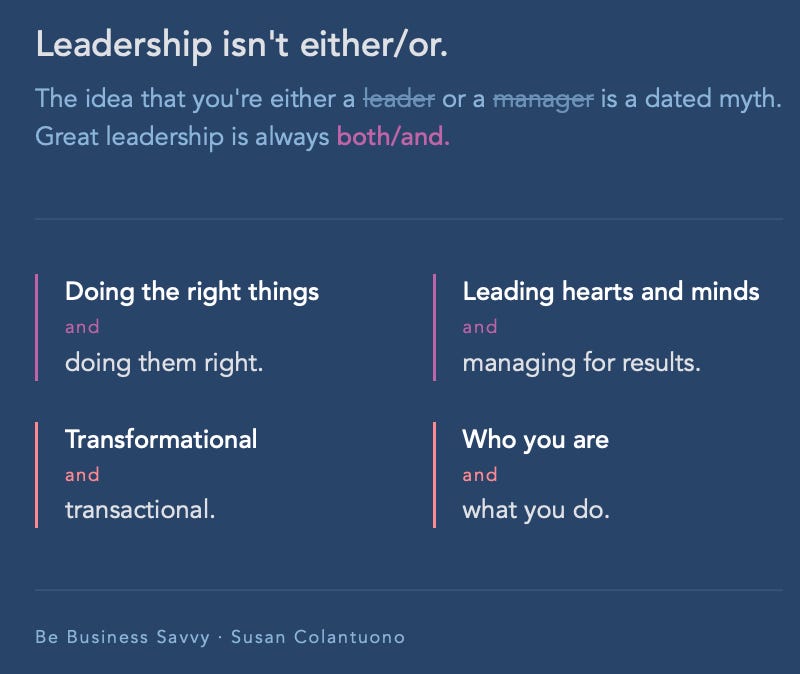
At every level — not just the executive suite — leadership means doing the right thing and doing it right. Leading hearts and minds and managing for results. Transforming and executing. The most effective people I’ve observed throughout my career didn’t choose between these. They did it all. That’s what the definition demands.
When I hear a woman say “I want to be a leader, not a manager,” I understand the impulse. But I want her to understand the cost of that framing. It creates a false hierarchy in her mind and often, a blind spot. Because the corner-office skills that women are most often perceived as lacking? Execution. Financial acumen. Strategic discipline. The very things that get coded as “management” in the old paradigm.
You can’t afford to dismiss those as someone else’s job.
No matter how well put together you are (i.e. how much you pay in “glam tax”), you’ll never be seen as a leader if you don’t fulfill all three parts of the definition.
Leadership is using the greatness in you
to achieve and sustain extraordinary outcomes
by engaging the greatness in others.
Here’s how I use these words and invite you to as well.
Leader: someone who uses personal greatness to achieve and sustain extraordinary outcomes by engaging the greatness in others.
Executive: someone with responsibility for positioning the organization for success and authority over senior teams. An executive may or may not be a leader.
Manager: someone with responsibility and authority over multiple teams or supervisors. A manager may or may not be a leader.
Supervisor: someone with responsibility and authority over a team of individual contributors. May or may not be a leader.
Individual contributor: someone without direct authority over others’ work. May absolutely be a leader.
Precision here isn’t pedantic. It’s protective. It keeps you from waiting for a title to claim leadership - and from dismissing the operational rigor that effective leadership actually requires.
Lessons in Leadership
Reserve the word leader for those who use personal greatness to achieve and sustain extraordinary outcomes by engaging the greatness in others - regardless of level or title.
The idea that you’re either a leader or a manager is a dated myth, born of a specific moment in American business history. It’s a shaky foundation for your development.
Precision in language shapes precision in thinking. The clearer you are about what leadership actually is - and isn’t - the more deliberately you can develop it.
Own your identity as a leader through your self-talk, how you see yourself and how you describe your role. If you think of yourself as “just a manager” or “not quite a leader yet,” you may be creating a ceiling that isn’t even there.
Next in the series: Leadership is Gender Neutral...Perceptions Are Not.

If you’re looking for content that directly addresses leadership and the business, financial and strategic acumen you want more of (the kind of development that complements the presence and relational work you’re probably already doing) Be Business Savvy (specifically the Be Business Savvy course) is built for exactly this purpose. The content is designed to be accessible even if you didn’t come up through finance or strategy, and rigorous enough to make a real difference in how you show up as a viable candidate for opportunity.
I welcome your next step:
❤️ Like, share or restack this post — it’s the best way to help other women find it
📘 Go deeper:
No Ceiling, No Walls (ebook)
No Ceiling, No Walls (softcover)
Make the Most of Mentoring (softcover)
Make the Most of Mentoring (ebook)
Be Business Savvy Course — self-paced, with coaching support
Coaching Executive Women (occasional) (newsletter)
Susan