
What the Heck is Leadership?
Lessons in Leadership Part 1

Lessons in Leadership is a multi-part series to deepen your understanding of what it means to be a leader.
Others Decide Your Trajectory
Here’s something most people don’t talk about openly: the people above you are constantly making decisions about your future. Who gets the stretch assignment. Who gets sponsored for the next level. Who gets the nod when an opportunity opens up.
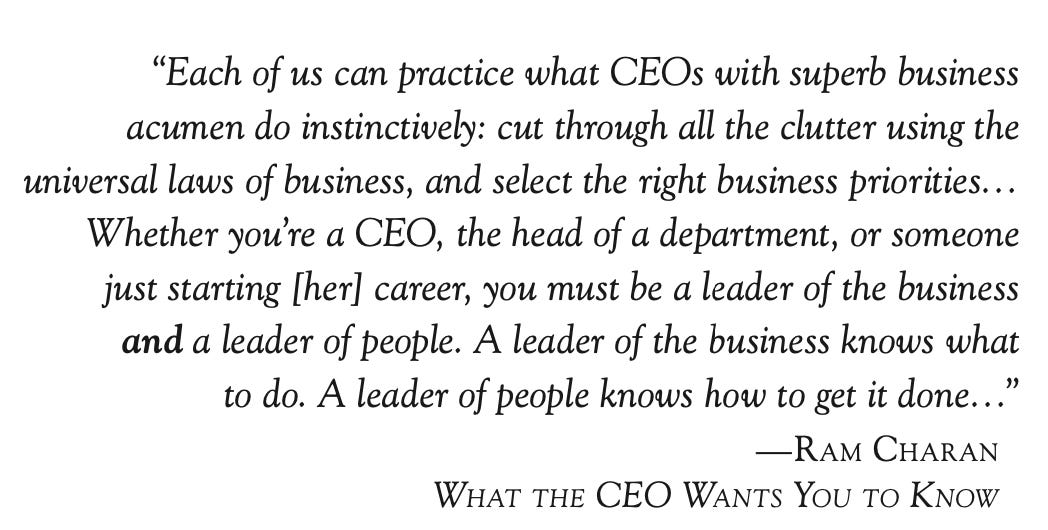
Those decisions rest on two things — your proven performance and their perception of you as a leader. You don’t advance solely because of what you do. You advance because the people with power over your trajectory believe you are a partner in the business — someone who understands where it’s going and can be trusted to help take it there.
Ann McCorvey learned this firsthand when interviewing for the CFO position at Kodak. The board made their criteria explicit:
“The board wanted to know that I had the personal drive to succeed in the role, the skills to navigate new relationships with former colleagues who would now be direct reports, and that I understood the business, where it was heading, and my role in taking it there.”
Personal drive. Relationship skills. Business understanding and direction. The board wasn’t asking about technical competence alone. They were asking: is she a leader?
You want your career decision makers to answer “YES” when they ask that of you. Which means you have to understand leadership. And as it turns out, that’s harder to come by than you’d think.
What the Heck is Leadership?
Early in my career I began building a mental list of people I considered to be leaders — Nelson Mandela, Wangari Maathai, Gandhi, Eleanor Roosevelt, Sojourner Truth, Anne Mulcahy, both Obamas, Melinda Gates and many others. When I looked for what they all had in common, one thing stood out above everything else: they all achieved something. They created change, built organizations, rescued failing ones, won wars, extended rights. Outcomes were the common thread.
That sent me searching for a definition of leadership that captured this. What I found instead was a collection of definitions that — despite coming from smart, respected people — all fell short in one way or another.
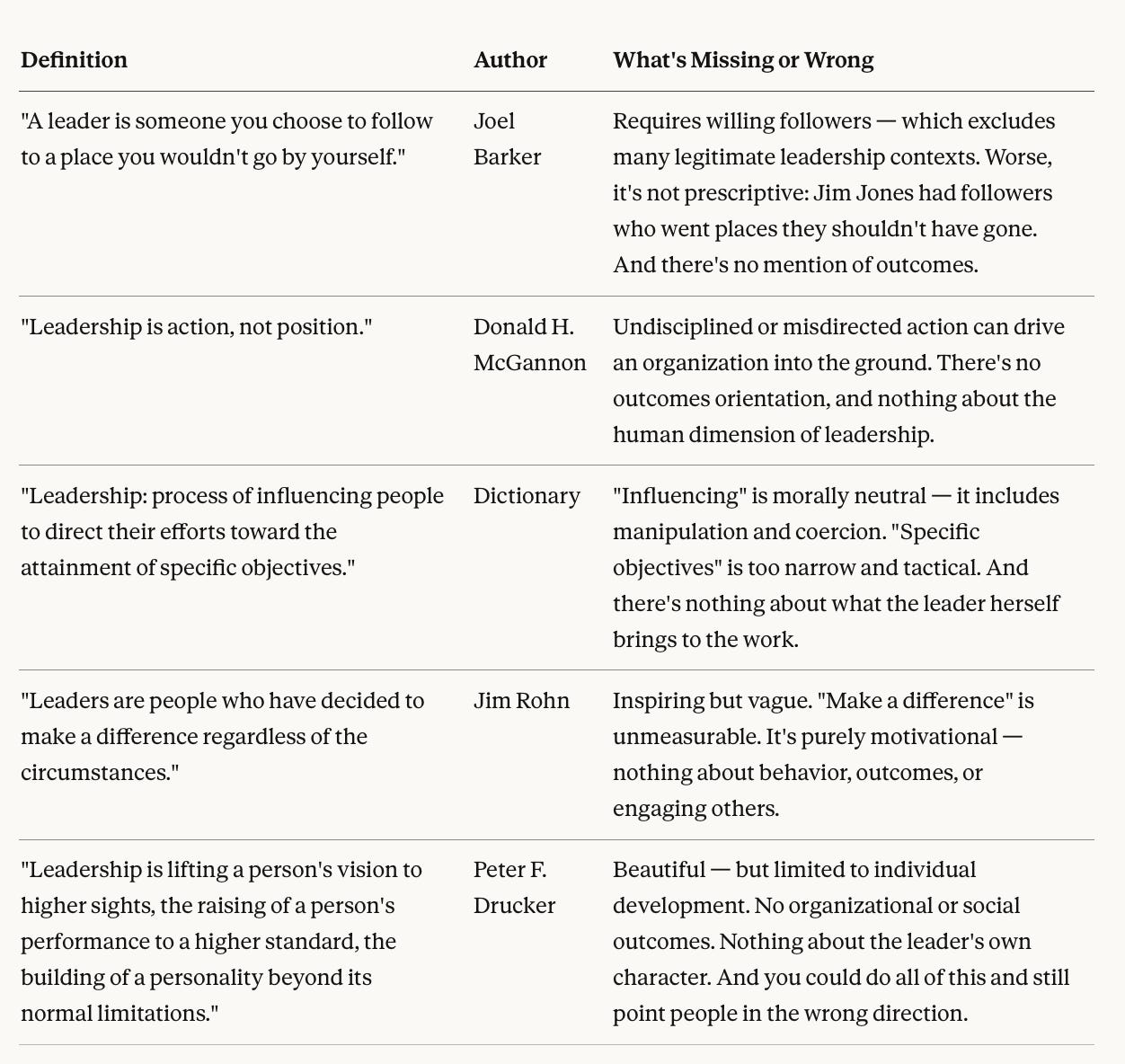
Every one of these definitions has something worth keeping. But not one of them captures the full picture of what leadership actually requires — especially in a business context where outcomes are the scorecard.
My Requirements for a Definition
Before I could accept any definition, it had to pass five tests. It had to be:
Universal — applicable to leaders of all races, genders, and nationalities
Ubiquitous — applicable across corporations, nonprofits, governments, social movements
Prescriptive — defining what a leader should do, ruling out the Jim Joneses — or more recently, Keith Raniere of NXIVM — of the world
Relevant at every level — from individual contributor to C-suite. This requirement is SO important. Career decision makers look for leadership skills in everyone from career start to the top of the organization. And it’s true that leadership manifests at every level.
Useful — something you could actually use to evaluate your own leadership on any given day
None of the definitions in the table passed all five tests. So I built my own.
A Definition Worth Using
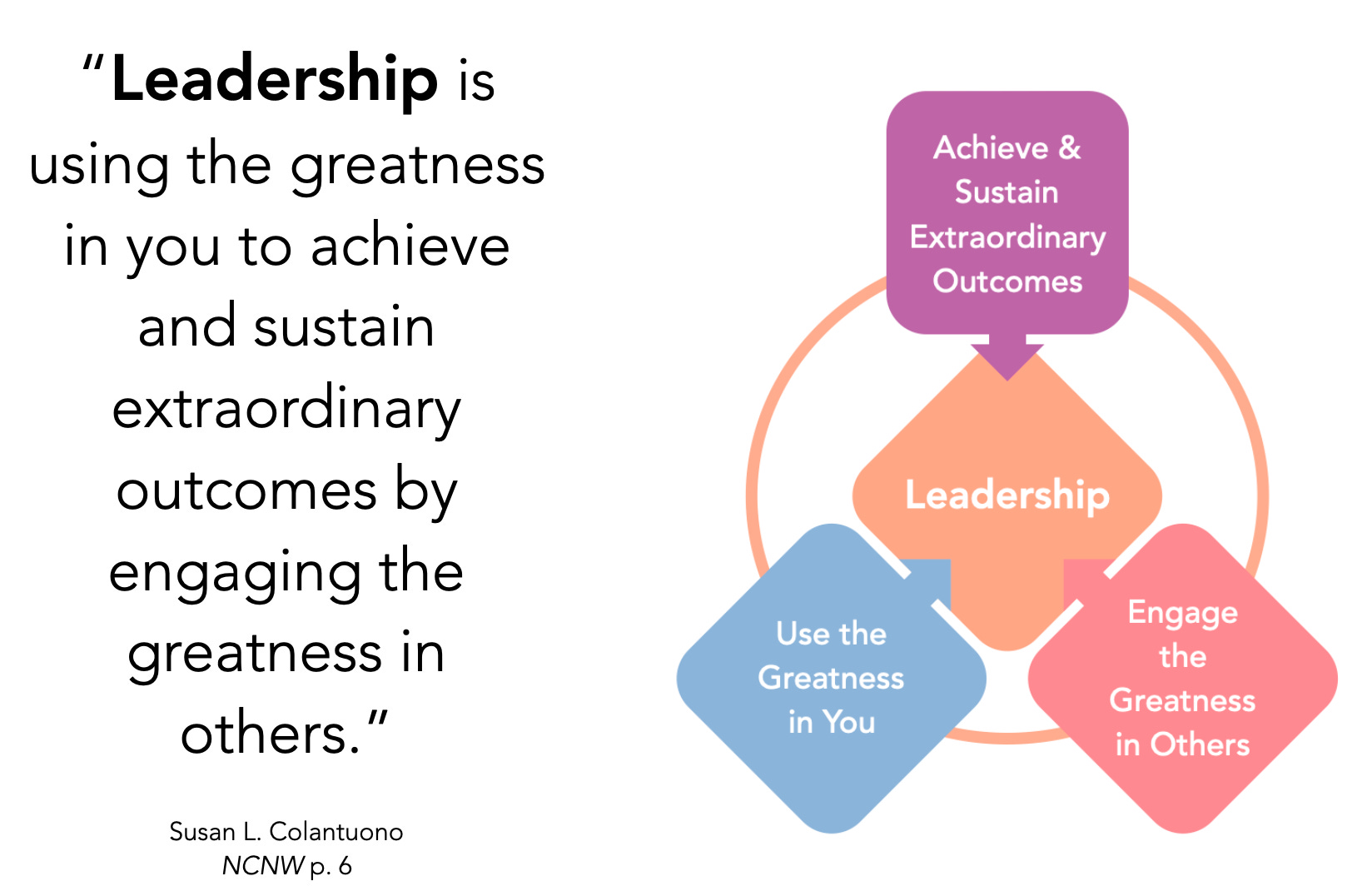
Leadership is using the greatness in you to achieve and sustain extraordinary outcomes by engaging the greatness in others.
Look back at what the Kodak board asked Ann McCorvey. Personal drive to succeed — that’s the greatness in you. Skills to navigate relationships with her team — that’s engaging the greatness in others. Understanding the business and her role in taking it where it needed to go — that’s achieving and sustaining extraordinary outcomes.
The board had it right. And now you have a definition that makes it actionable.
Wear Your Mantle
Queens and kings didn’t just hold power — they wore it. The mantle, the scepter, the crown were outward expressions of an inward identity. Leadership works the same way. You don’t wait until someone hands you a title to think of yourself as a leader. You claim it.
As Herminia Ibarra, Professor of Leadership at INSEAD, puts it:
People become leaders by internalizing a leadership identity and developing a sense of purpose — and that internalization is an iterative process.
Start that process today — concretely:
