
The Maternal Strengths Report Is Good News... and a Warning
It Needs to Be Said

Two decades of research on motherhood and leadership celebrates the same two thirds of leadership and ignoring the third that actually determines who advances.
If the 2026 Maternal Strengths Report has you celebrating your greatness as a mother and a leader - pause.
Not because the findings aren’t real. They are. Not because the research doesn’t matter. It does.
But because we have seen this before. And we know how the story ends.
A Report Two Decades in the Making - and Still Incomplete
In 2005, a book called Mother Leads Best made headlines by arguing that motherhood transforms good leaders into great ones. It profiled 50 senior executive women who credited bearing and raising children with making them more empathetic, more resilient, more adaptive, better at managing chaos and conflict.
The business world nodded. Mothers inside of companies celebrated it. It felt like a breakthrough.
Twenty years later, the 2026 Maternal Strengths Report arrives with survey data from 354 mothers across industries, career levels, and countries, measuring twelve leadership capabilities and finding growth in every single one after women become mothers.
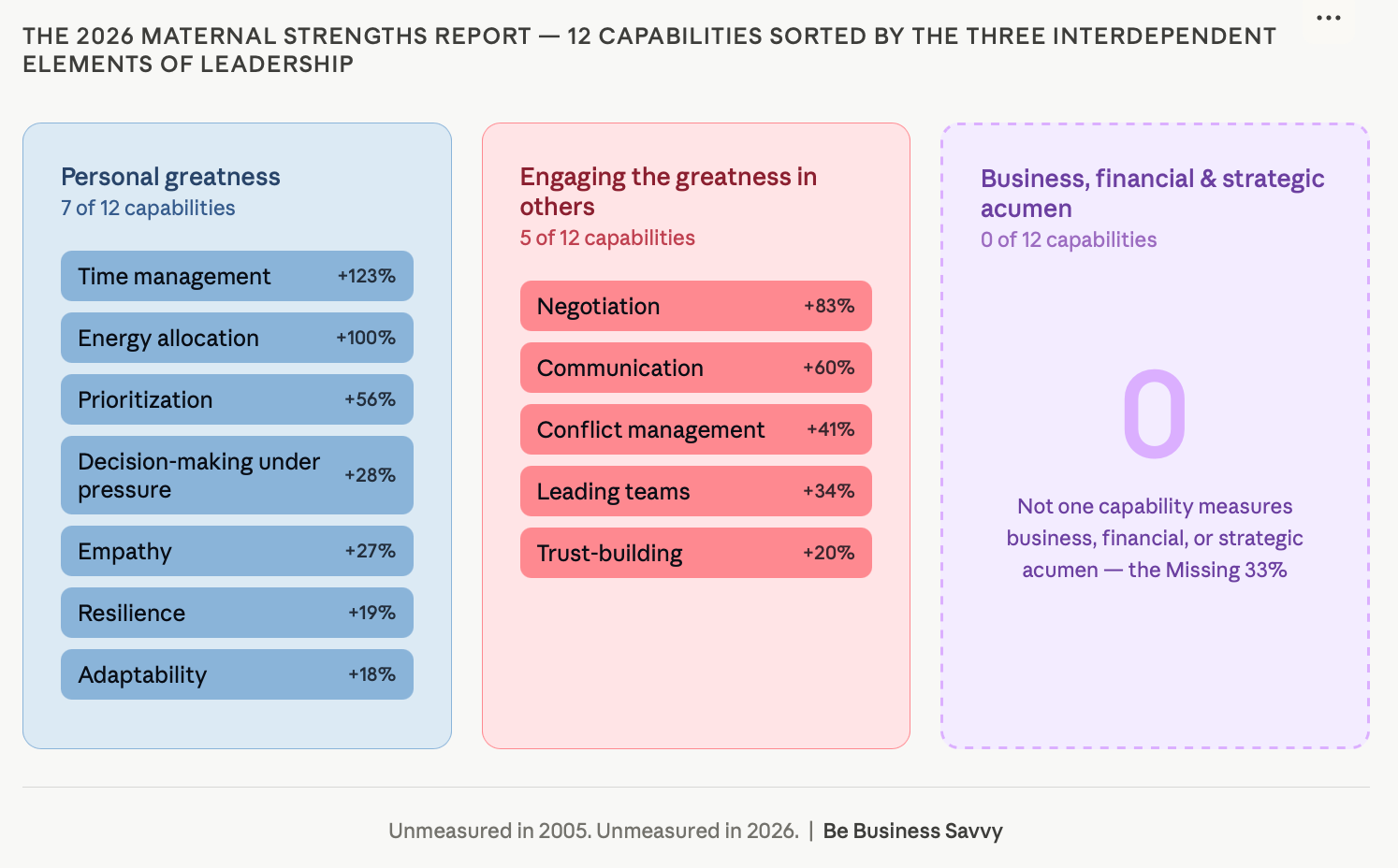
Time management up 123%.
Energy allocation up 100%.
Negotiation up 83%.
Communication up 60%.
The findings are striking, the reach more global, the data more rigorous than anything that came before it.
And the blind spot is identical.
What Neither Measures
Sorted through the lens of what leadership actually requires, the twelve capabilities in the Maternal Strengths Report fall into two categories.
Seven map squarely to Personal Greatness (the attributes, values, mindset that make someone excellent at their work) The 7: time management, energy allocation, prioritization, decision-making under pressure, empathy, resilience, and adaptability.
The remaining five map to Engaging the Greatness in Others (the interpersonal and team skills that make someone effective with the people around them). The 5: negotiation, communication, conflict management, leading teams, and trust-building.
Every capability measured. Twelve out of twelve. And not one touches business, financial, or strategic acumen. To be clear about what that means: business acumen is understanding how your organization creates value, drives revenue, and allocates resources. Strategic acumen is thinking about markets, competition, financial targets and internal capabilities. Financial acumen is reading and acting on what the financial reports tell you. Negotiation, conflict management, communication, prioritization, and leading teams are essential leadership capabilities - but they aren’t these things.
Business Savvy doesn’t replace the capabilities the report measured. It is the operating context that takes those capabilities to the executive level.
Take negotiation for example.
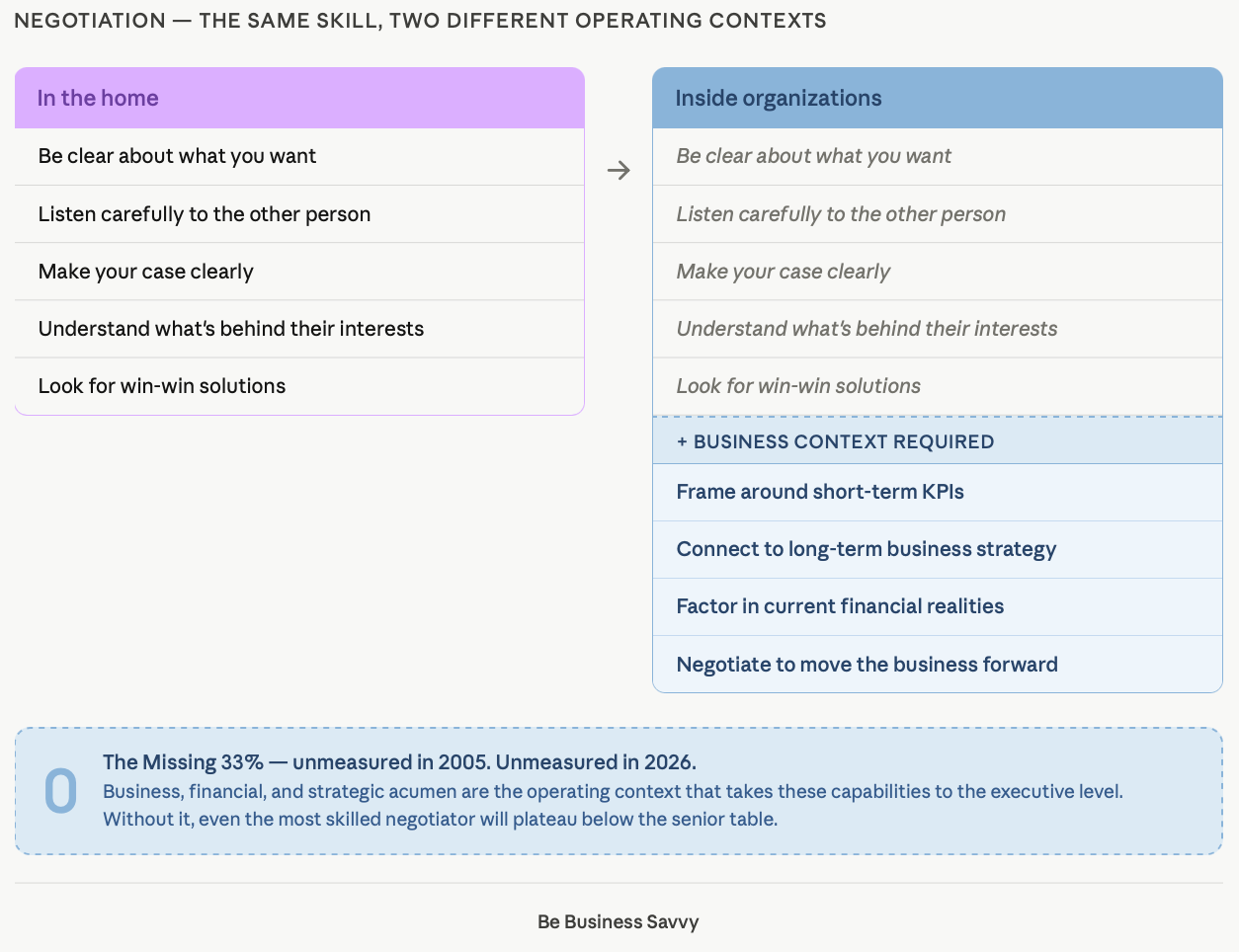
In the home it requires listening carefully, making your case clearly, understanding what's behind the other person's interests, finding win-win solutions.
All of that comes to bear inside organizations too. But executives are looking for something more - people who negotiate to move the business forward, who can negotiate in the context of short-term KPIs, long-term strategy, and current financial realities.
The same is true for conflict management. Without that context, even the most skilled negotiator will plateau below the senior table.
This illustrates why it’s problematic that there are no questions such as: Did becoming a mother sharpen your ability to:
Learn the business performance story from the financial reports?
Understand how your organization creates value for customers/consumers and returns it to shareholders/owners/community?
Think strategically about markets, competition, and resource allocation?
Walk into a room and speak the language of business with authority?
Those are capabilities that determine who gets promoted. Who is offered an operations role. Who gets seen as executive material rather than an excellent middle manager. Who is seen as high potential, not just high performer.
That is Business Savvy (The Missing 33%) - the systematically rarely acknowledged third of the career success equation. And it is absent from this report just as it was absent from Mother Leads Best in 2005.1
Why This Keeps Happening - It Goes Deeper Than You Think
This isn’t an accident, and it isn’t the researchers’ fault. The roots of this blind spot go back further than most people realize — all the way to how leadership theory itself was built.
I was in the leadership development field when the foundational frameworks that still shape our thinking were being constructed. A colleague who was a frontline researcher at Columbia at the time was part of it. The researchers of that era studied executives who were successfully navigating the turbulent organizational transformations of the 1970s and asked: what made them effective?
What they found - and extracted - were the individual traits and engagement skills required to motivate people through transformation: visionary, trustworthy men who could communicate the vision and engage passion for change. These became the foundations of what we’ve come to call leadership.
But those researchers lived outside of the business context itself. The selection criterion - studying successful organizations versus failing ones - was ignored as a factor. The business savvy that distinguished the leaders they studied was baked into the very definition of success they used. It was the water. They didn’t see it. So they didn’t name it. And it never made it into the framework.
For over 50 years, every leadership development program built on that foundation inherited the same blind spot. The 2026 Maternal Strengths Report follows that same foundation - measuring 12 leadership attributes and skills in mothers and finding extraordinary growth across all of them.
And doesn’t ask a single question about business, financial, or strategic acumen.
Notably, the 50 women interviewed for Mother Leads Best were already senior executives at companies like IBM, Xerox, and PepsiCo - meaning they already possessed business, financial, and strategic acumen. It was simply never named. The same invisible water.
This blind spot persists not because researchers are careless. It persists because the definition of leadership that shapes what we measure was built without ever naming the business context. They couldn’t surface the third element of leadership that makes the difference.
So pervasive is this confusion that even researchers studying women’s leadership development conflate personal attributes/capabilities, team and interpersonal skills with business, financial, and strategic acumen - leaving The Missing 33% unnamed and unmeasured.
In the words of one executive when asked about Business Savvy, “That’s a given.”
One More Thing Worth Noting
The Maternal Strengths Report’s methodology deserves a gentle flag. The findings are based on 354 mothers retrospectively rating themselves before and after motherhood on a 1-5 scale. That means participants were asked to recall how capable they felt before a profoundly transformative experience and compare it to how they feel now.
Humans naturally construct growth narratives around transformative experiences.2 The “before” score is almost certainly shaped by the “after.” The report’s authors acknowledge this. They note the findings reflect self-perceived growth, not objective capability measurement.
This doesn’t make the findings meaningless. Confidence and perceived capability matter enormously. But it does mean we should read “mothers reported a 123% increase in time management” as a powerful statement about how motherhood shapes women’s sense of themselves - not as evidence that motherhood literally doubles time management skill.
The distinction matters. Because it means the story this report tells is ultimately about identity and confidence which are genuinely important. But they are not the same as the business, financial, and strategic acumen that determines advancement.
What’s a Woman To Do?
So to all us mothers, celebrate the personal greatness and engagement skills these findings reflect and then further develop the capabilities that will actually take you where you want to go.
Start with one question this week: do you know how your organization makes money? Not your department - the whole business. If the answer is fuzzy, that is exactly where to start.
And then further develop the capabilities that will actually take you where you want to go.
Learn to read your organization’s financials.
Understand its business model.
Know how your work connects to growth, to customer value, to the bottom line.
Develop the language of strategy and use it in the rooms where decisions are made.
Because organizations don’t promote on the basis of Personal Greatness and Engaging others alone. They promote on the full picture - and Business Savvy is the part of that picture we are rarely told we need.
This is what needs to be said.
Lead ON!
Susan
It Needs to Be Said’ Series

Next in the series: [coming soon] →

If you’re looking for content that directly addresses the business, financial and strategic acumen you want more of - the kind of development that complements the personal character and engagement skills you’re likely known for - the Be Business Savvy Course is built for exactly this purpose. Self-paced, with coaching support, designed to be accessible even if you didn’t come up through operations, finance or strategy.
I welcome your next step:
❤️ Like, share or restack this post - it’s the best way to help other women find it
📘 Explore the Be Business Savvy Course
Susan
The traits Grzelakowski outlines in Mothers Lead Best are exclusively personal and relational: sensitivity, warmth, patience, full attentiveness, adaptability, tolerance, compassion. The book focuses on nurturing, managing conflict, and networking as the skills contributing to women's success. Even broken down by stage of motherhood, the capabilities named are empathy, sensitivity, compassion, warmth, and patience.
¹ Schwarz, N. (2007). Retrospective and Concurrent Self-Reports: The Rationale for Real-Time Data Capture. This well-documented bias — sometimes called “theory-driven inference” — is particularly pronounced when context suggests growth should have occurred, as is the case with major life transitions like motherhood.
This is an interesting observation...although I'm curious - what do you think drives the gap in business savvy by gender?
There was an era when it might have been education. When I did my MBA, 21 years ago, we were just 18% women. - But I know that was a blip — it's more like 35% today and in fact had been a chunk higher around the turn of the millenium.
For those who lack formal business education, are you suggesting that men are self-educating more than women (or perhaps better mentored?)?