
“Top” Women’s Leadership Programs Are Lacking. Can You Guess Why?
Research update on The Missing 33%

Someone recently sent me a link to an article titled — Top 9 Women’s Leadership Development Programs — and I did what I always do when I see a list like that.
I got curious. And then I got busy.
Working with Claude.ai, I mapped nine top-ranked curricula against three pillars of leadership I’ve spent my career writing and speaking about:
Personal Greatness (who you are as a leader),
Engaging Others (how you bring out the best in the people around you), and what I call
Business Savvy — business, financial, and strategic acumen.
The nine programs: Harvard DCE, Oxford Saïd, Wharton, eCornell, ISB, IIM Bangalore, INSEAD, Edstellar, and the American Management Association. All legitimate. All well-resourced. All marketed as pathways to the top.
What’s Missing?
Here’s what their content actually delivers:
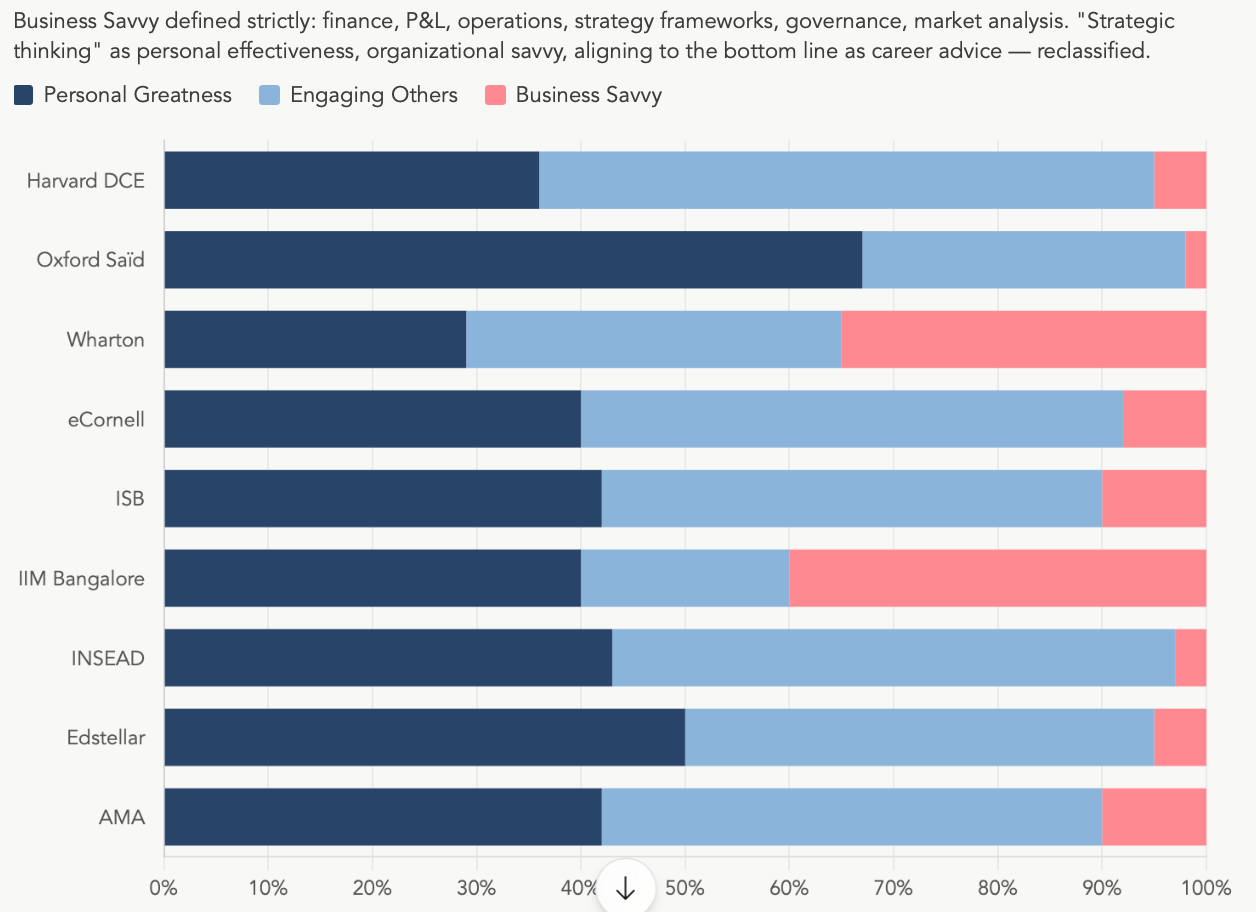
A first glance at these programs might suggest a different story. Words like “strategic thinking,” “organizational savvy,” and “business acumen” appear in many of the curricula — and if you take them at face value, the picture looks more balanced. But when you apply a strict filter — when you ask whether the content actually covers topics such as financial analysis, P&L, strategy frameworks, operations, governance, or business performance — seven of the nine programs drop to 10% or below on genuine Business Savvy content.
The median across all nine: roughly 8% business, financial, and strategic acumen in programs considered the best women’s leadership development available.
Thirteen percent.
Let that sink in. In other words, only 13 cents on the dollar for the very skill set women are seen most lacking.
I’ve been saying before and since my TED Talk — now over 4.6 million views — that women are being under-developed on the Outcomes/Missing 33% element of leadership. That the advice we get focuses heavily on confidence, presence, communication, and relationships, while the business, financial and strategic acumen that actually drives advancement gets a paragraph, if it gets anything at all.
That’s why this analysis doesn’t surprise me. But seeing it mapped across programs from Harvard, Oxford, Wharton, and INSEAD in a single visual made even me pause.
Because these aren’t fringe offerings. These are the programs companies fund, HR leaders recommend, and ambitious women invest thousands of dollars and dozens of hours to complete.
The two exceptions worth noting: Wharton at 35% and IIM Bangalore’s Tanmatra program at 40% — both explicitly covering finance, operations, and governance. If business savvy is your primary objective, those are the programs where you’ll actually find it. For the other seven, it’s largely decorative language around what are otherwise strong personal development and relational skills programs.
Why Care?
Which brings me to the question that matters:
If we keep developing the first two-thirds of leadership and calling it complete, why are we surprised when the gap at the top doesn’t close? Why are we surprised when we seem to plateau?
Catch you next time,
Susan
It Needs to Be Said Series Next: →
The Maternal Strengths Report is Good News…and a Warning

If you’re looking for content that directly addresses the business, financial and strategic acumen you want more of — the kind of development that complements the presence and relational work you’re already doing — Be Business Savvy (specifically the Be Business Savvy course) is built for exactly this purpose. The content is designed to be accessible even if you didn’t come up through finance or strategy, and rigorous enough to make a real difference in how you show up as a viable candidate for opportunity.
I welcome your next step:
❤️ Like or restack this post — it’s the best way to help other women find it
📘 Go deeper:
No Ceiling, No Walls (ebook)
No Ceiling, No Walls (softcover)
Make the Most of Mentoring (softcover)
Make the Most of Mentoring (ebook)
Be Business Savvy Course — self-paced, with coaching support
Coaching Executive Women (occasional) (newsletter)
Susan