
Part 1: She's in the Room, Not the Conversation
What happens when technical mastery drags you down instead of giving you wings?

She’s an engineer who has risen rapidly — from a major consumer products company to an executive role at one of the most recognized brands in the world. By any measure, she has made it. (Let’s call her Graciela.)
And she said something I haven’t been able to stop thinking about.
“Technical work is my comfort zone. I know my business, but I don’t have the business language or mindset. They see me as a technical person. We’re going through strategy work and my manager — who is very business savvy — keeps telling me he wants me to speak up more. But I’m not seeing the world the way they’re speaking about it.”
She isn’t struggling. She isn’t in crisis. She isn’t being passed over.
She’s in the room. She has the seniority. She has a manager who is actively pulling for her.
And she is watching the strategy conversation happen in a language she doesn’t yet have.
This is the Fluency Gap
Not the glass ceiling — the one we all know about. This is something different, and it’s specific to women who rise on the strength of deep technical expertise.
If you are among them (looking at you women in STEM), you get there because you are excellent at your craft. You solved hard problems. You delivered results. You earned your seat at the table by being the best in the room at what you do.
And somewhere along the way, that mastery became your identity — in your own eyes and in everyone else’s.
“She’s technical.”
It’s meant as a compliment. It reflects real achievement. And it is also, if you’re not careful, a ceiling.
Because the higher you go, the less the room needs your technical answer. They need your business judgment. Your strategic read. Your ability to speak the language of the organization — not the language of your discipline.
The language of return, cash, growth, customers and consumers.
The language of trade-offs and market position and what the numbers are actually saying about where this company is headed.
That’s not the language of engineering or chemistry or IT. It’s the language of business. And knowing your field deeply does not make you fluent in it.
I Call this “Getting Lost in Your Letters”
Your degrees. Your certifications. Your technical credentials. It’s the tendency to rest on the identity that got you where you are. But, as she realizes, your identity must change.
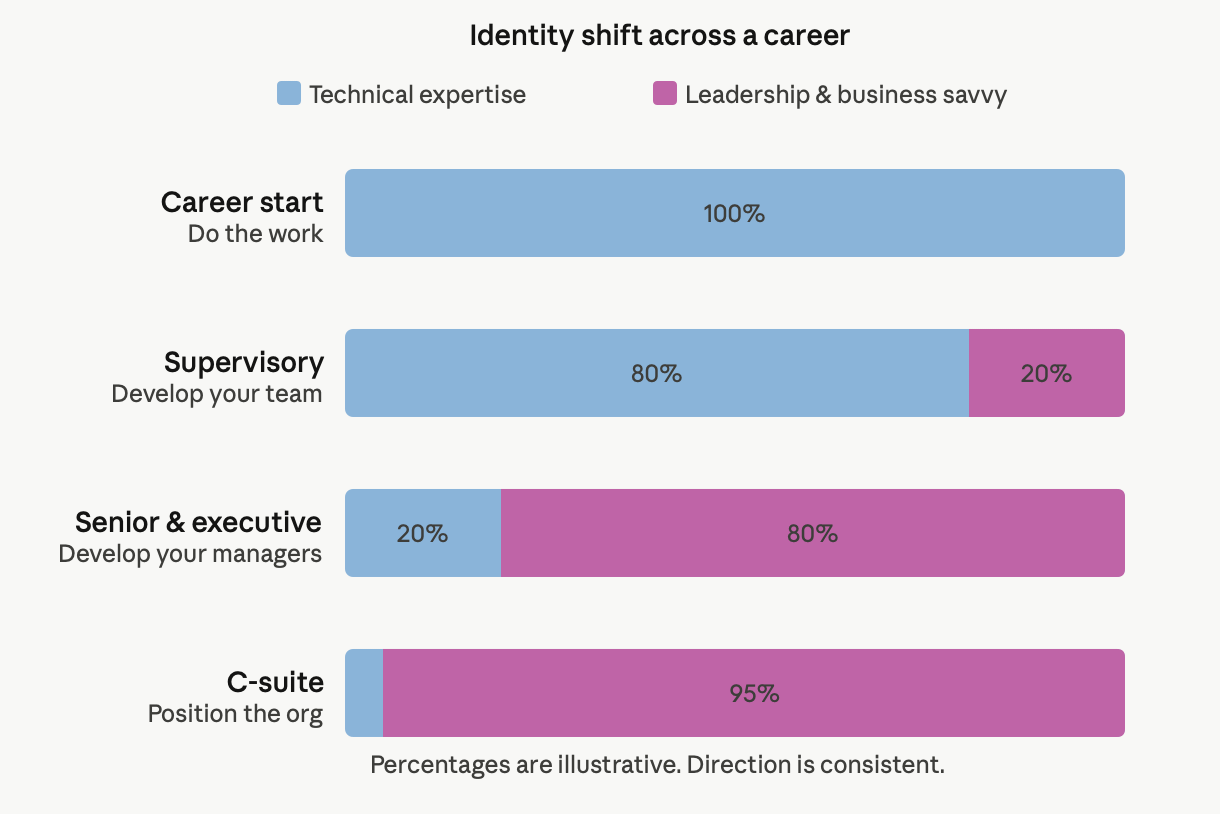
Here’s what that identity shift actually looks like across a career:
At career start, your identity is close to 100% tied to your technical expertise. You earned those credentials. They opened the door. Your primary role: do the work.
At supervisory and team lead levels, the ratio begins to shift — roughly 80% technical, 20% leadership. And leadership here means all three dimensions: personal greatness, engaging others, and Business Savvy. Your primary role shifts too: from doing the work to developing your team members to do it.
At senior and executive levels, it flips: 80% leadership, 20% technical. Your role shifts again: from developing team members to developing the managers who build that capability in others.
At the C-suite, as much as 95% of your impact comes from Business Savvy — strategic vision, business judgment, and the ability to position the organization in its external environment.
(These percentages are illustrative. The exact ratio depends on your industry and organization. The direction, however, is consistent.)
The trap isn’t that technical skills stop mattering — they don’t. But when your technical identity becomes the whole story, it can drag on your advancement like an anchor. Two things happen:
Others stop imagining you in the business conversation
You stop pushing yourself to enter it
Graciela named this perfectly: “They see me as a technical person.” She didn’t say it with bitterness. She said it as a fact she’s ready to change.
That self-awareness is the beginning of everything.
The Missing 33% of the Career Success Equation
I’ve spent my career studying the career success equation for women. It has 3 parts based on what’s expected of leaders in organizations.
Personal Greatness - who you are as a person and a professional. ✅ Technical women have this in abundance.
Engaging Others - your ability to lead, communicate, influence. ✅ Most senior technical women have developed this considerably.
Business Savvy - business acumen, financial acumen, and strategic acumen. The ability to understand your organization as a business, speak the language of its performance, and think strategically about where it’s going.
This is the part that’s missing. Not because technical women aren’t capable — they are exceptionally capable. But because no one in their development path ever made it non-optional.
In our conversation, Graciela said she wants Business Savvy “not just for this role, but for my future.”
That’s exactly right. This isn’t about surviving the current strategy cycle. It’s about who you intend to become.
If any part of this resonated — if you recognized yourself in that strategy room, watching the conversation happen in a language you’re still learning — you’re in the right place.
Business Savvy isn’t optional. And the fluency gap is entirely closeable.
Part 2 of this series is breaks down exactly what “business language and mindset” means in practice — and the three moments where the fluency gap shows up most painfully. Plus your “What’s a Woman to Do?” actions.

❤️ Know a woman in STEM who’s ready to stop watching the conversation and start speaking up? Send this her way.
Lead ON!
Susan

If you’re looking for content that directly addresses the business, financial and strategic acumen you want more of - the kind of development that complements the presence and relational work you’re doing - the Be Business Savvy Course is built for exactly this purpose. Self-paced, with coaching support, designed to be accessible even if you didn’t come up through finance or strategy.
I welcome your next step:
❤️ Like, share or restack this post - it’s the best way to help other women find it
📘 Explore the Be Business Savvy Course
Susan
This left a smile on my face because I’ve experienced it in reverse. I had always been the business person on the side of Tech. I had the MBA, led the strategy development. Decades of business experience to senior levels in large corporations.
But when I joined the deep techs as a cofounder at a startup, my ideas were inferior. I talked too many business acronyms — but above all, I wasn’t credible because I couldn’t do the deep techie talk 🤷♀️