
Leadership is Gender Neutral. Our Odds Are Not.
Lessons in Leadership, Part 3

You can excel at two-thirds of what leadership requires and still be consistently overlooked because no one told you how advancement decisions are actually made.
There’s a question I’ve heard from women throughout my career - in coaching sessions, in workshops, in the hallway after a keynote:
“If women are so good at interpersonal and team skills, why aren’t more of us in senior positions?”
It’s a fair question. The answer is one of the most important things I can share with you.
Start With What’s True
The definition of leadership we’ve been working with in this series is gender neutral.
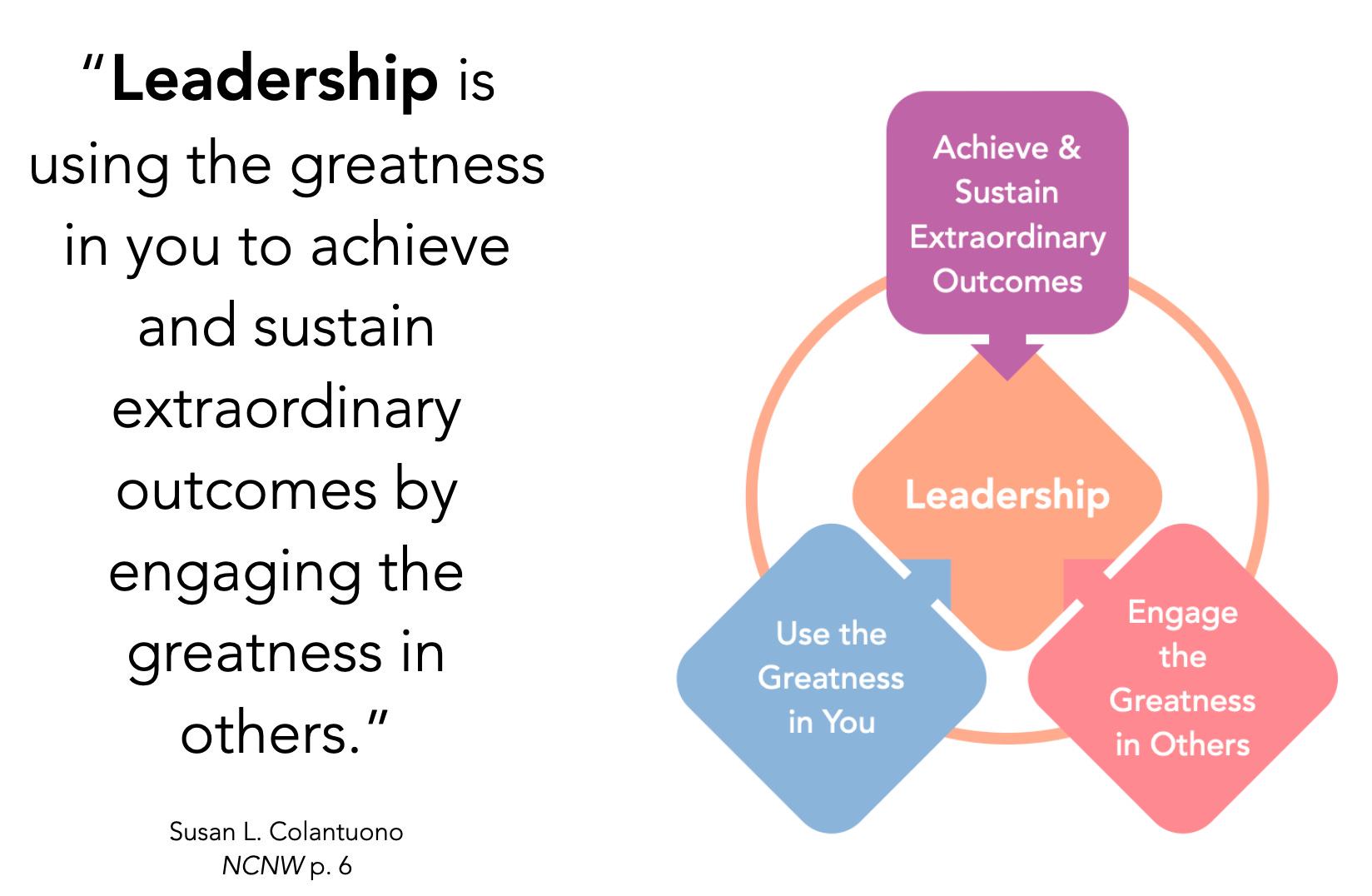
Leadership is using the greatness in you to achieve and sustain extraordinary outcomes by engaging the greatness in others.
Nothing in that definition belongs to men. Nothing in it is beyond women. We see proof everywhere: Mary Barra at General Motors, Jane Fraser at Citigroup -- the first woman to head a major U.S. bank -- Carol Tomé at UPS. The practice of leadership transcends gender, race, nationality, physical ability. It always has.
But here’s what doesn’t transcend gender: the perception of who is leadership material.
Where We’re Seen to Excel
Study after study confirms that women are viewed by managers as outperforming men on:
Engaging the greatness in others: interpersonal and team skills. We are seen as: , listening, working across difference, developing people, building relationships, giving feedback, creating team cohesion.
Using our personal greatness: attributes, values, world view, etc. We are seen as diligent, achievement-oriented, high-expectation leaders who follow through.
Put that against our definition and it maps squarely to only 66% of what it takes to be a true leader in organizational settings (as differentiated from political movements for example.)
We own those areas of strength. Convincingly.
What Gets Us Seen as Candidates for Opportunity
Here’s where the story gets uncomfortable.
When executives and boards assess leadership potential, the weight they place on each element of leadership tells a very different story than our training calendars do.
Business Savvy (business, financial and strategic acumen) - key elements of the outcomes element - accounts for roughly 50% of skills and experiences sought in candidates for advancement. Engaging others accounts for about 26%. Personal greatness, the remaining 24%.
The one element where men are perceived as stronger - and where women are consistently underestimated? Worth 50%.
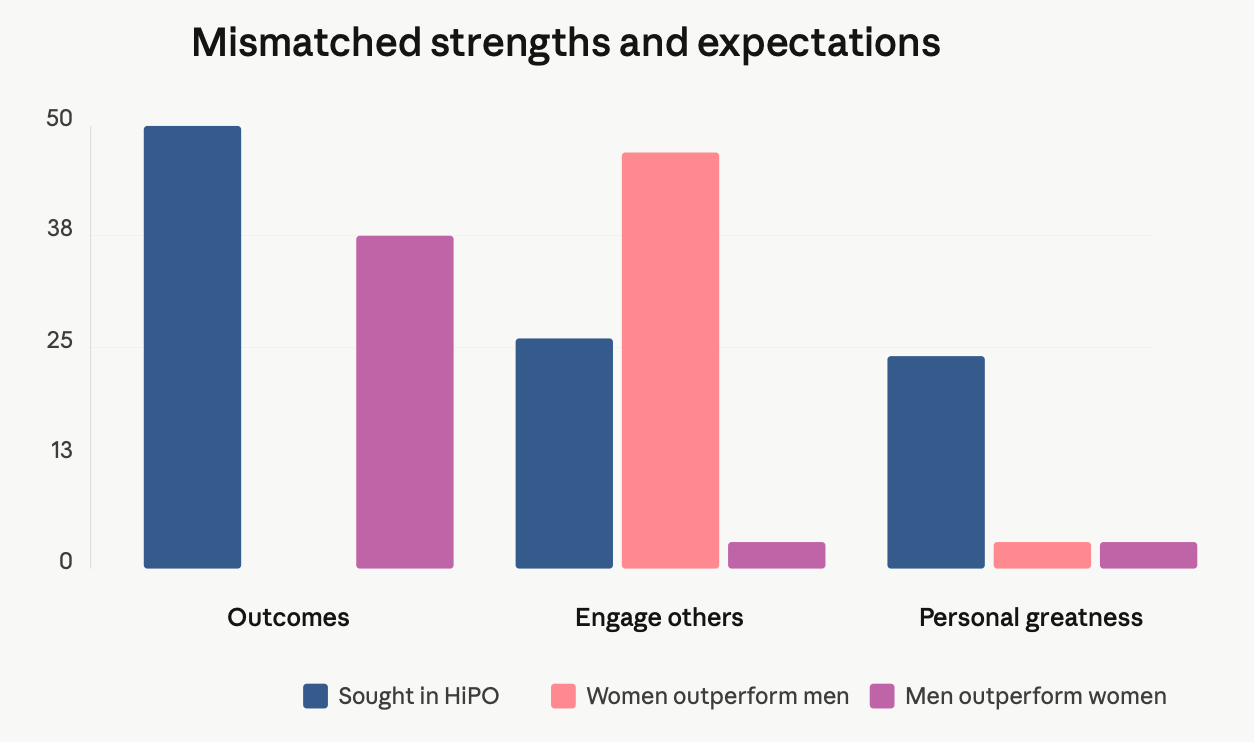
The elements where women are most strongly perceived as capable? Worth only 50% of what is factored into the decision. As a matter of fact, based on conversations I’ve had with executives, actual achievements and demonstrated Business Savvy open the door for advancement, the other two elements differentiate candidates when decisions are made.
This is The Missing 33% of the career success equation in action. And here’s what makes it most worrisome: I’ve been tracking this perception gap since 2000. By 2023, the outcomes/Business Savvy perception gap had barely moved.
More than two decades. Nearly unchanged.
Leadership Programs Haven’t Solved the Problem
Most leadership development programs aimed at women - and there have been many since the 1970s - were built on research about male executives who successfully navigated that era’s turmoil. They transformed their organizations to deal with competition from Japan, the rising use of computer technology and the changing workforce. What made those men stand out was their ability to engage the greatness in others to accelerate the transformations.
So the programs taught what the research highlighted. Team and interpersonal skills, the ability to capture the hearts and minds of their workforces. But researchers ignored that they had to:
see the external threat,
determine how to respond,
motivate the workforce with a clear vision,
restructure the business to address the external threats,
determine appropriate financial targets to remain viable
and take many more actions that drew on their business, financial and strategic acumen.
NONE of these became part of the programs because they were assumed to be part of leadership. As a matter of fact, even today so-called top leadership programs for women are lacking.
As a consequence, we who are already strong in the team and interpersonal skills those programs emphasize, walk out with our existing strengths affirmed - and no closer to the corner office.
Companies say they want collaborative leaders. But they still hold deep-seated beliefs about what a viable top candidate looks like - and those beliefs run on the outcomes channel, not the engagement channel.
What Actually Works
Organizations that have made real progress toward gender equity share one characteristic: they moved away from subjective, perception-based assessments of potential and toward quantitative measures of outcomes achieved.
When the question becomes what has she delivered rather than does she seem like a leader, the perception bias loses its grip. Women excel in the neutral practice of leadership. We just need the playing field that surfaces it.
Until that playing field is universal - and we’re not there yet - you have a choice.
Armed with the knowledge that perceptions are not neutral, you can be deliberate about which skills you develop, which experiences you seek, and what you make visible about your work.
Leading for outcomes isn’t just good leadership. On the path to the corner office, it’s the highest-leverage move available to you.
And now we’re back to that question: if women are so good at interpersonal skills, why aren’t more of us in senior positions?
You now know the answer. The question is never about our engagement skills. It is always about what we’ve not been told to develop - and what we can choose to do about it today.
As I often hear from women at every level:
“I wish someone had told me this years ago.”
Consider this your telling.
Lessons in Leadership
The practice of leadership is absolutely gender neutral. The perception of women and men as leaders is not.
The interpersonal and team skills women are credited with - as real and as valuable as they are - account for roughly 26% of advancement decisions. Business, financial and strategic acumen accounts for 50%.
Leading for outcomes trumps interpersonal skills on the path to opportunity. Seek the experiences that let you develop and demonstrate your skills there.
Perceptions shift when organizations measure what’s actually been delivered -- and when we make our business results visible and undeniable.
Lead ON!
Susan
Next in the series: Anyone at Any Level Can Wear the Mantle of Leadership.
The Lessons in Leadership series starts here:


You now know what’s been missing. The Be Business Savvy course is built to develop exactly that -- the business, financial and strategic acumen that accounts for 50% of advancement decisions. Founding member pricing is the best you’ll ever see, and it won’t be available much longer.
I welcome your next step:
❤️ Like, share or restack this post - it’s the best way to help other women find it
📘 Explore the Be Business Savvy Course
Lead ON!
Susan