
Anyone at Any Level Can Wear the Mantle of Leadership
Lessons in Leadership, Part 4

If you're waiting for a promotion to start leading, you may be waiting for something that only comes to those who already have.
I’ve heard it at the end of nearly every keynote I’ve given, in the hallway, just before women head back to their lives: “I don’t think of myself as a leader.”
It does. Here’s why.
For seven years, Helen raised her hand.
Seven years of meetings, seven years of being thanked and redirected, seven years of watching a problem go unaddressed. Helen wasn’t the vice president of the cancer clinic where she worked. She wasn’t a director or a manager or a supervisor. She was an administrative professional. And she was trying to tell anyone who would listen that they had too many open billing codes.
An open billing code is a procedure or medication that the clinic performs but doesn’t get paid for.
In the first month after the problem was finally fixed -- in no small part because Helen refused to stop raising it -- an additional $250,000 of revenue came into the clinic.
Seven years. One administrative professional. A quarter of a million dollars. That is leadership.
You don’t have to wait for someone to hand you the mantle
Traditionally, when a queen is crowned, she dons the mantle and takes the staff of royalty. They are symbols of elevated responsibility. The good news for you is this: you don’t have to wait for a crowning moment. You can put on the mantle yourself. Today. From wherever you stand.
Most of us were told, implicitly or explicitly, that leadership is something you grow into. That it arrives with a title, a direct report, a seat at a certain table.
But as we established in Part 1 of this series: leadership is using the greatness in you to achieve and sustain extraordinary outcomes by engaging the greatness in others. There is nothing in that definition that requires a title. Nothing that requires a level. Nothing that requires anyone’s permission.
Herminia Ibarra, professor of leadership at INSEAD, has studied exactly how this shift happens. Her research shows that people become leaders by internalizing a leadership identity through purposeful action - not by waiting for a title or a crowning moment. You assert leadership, others respond, and those interactions shape your growing sense of yourself as a leader. It’s iterative. Which means it starts whenever you decide to start. I call this, “donning your mantle of leadership.”
Helen donned hers at the individual contributor level, in a meeting she hadn’t called, on a topic that wasn’t on anyone’s agenda. She decided to be a leader before anyone called her one.
Being for the business
Wearing the mantle in an organizational setting means something specific: you are for the company and by extension for its customers/consumers (if it has them). Not just for your team, your department, your function. For the business.
Helen understood this. She wasn’t responsible for billing. She wasn’t asked to monitor revenue. She was an administrative professional on a process improvement project. And yet she understood that open billing codes were a problem for the clinic and she would not let it go.
That is what “being for the business” looks like at the individual contributor level. It’s not grand strategy. It’s looking beyond your job description toward organizational outcomes, and having the courage to act on what you see.
This orientation is what separates people who do a job from people who wear the mantle. And it’s available to everyone.
Looking at Helen through the lens of our definition.
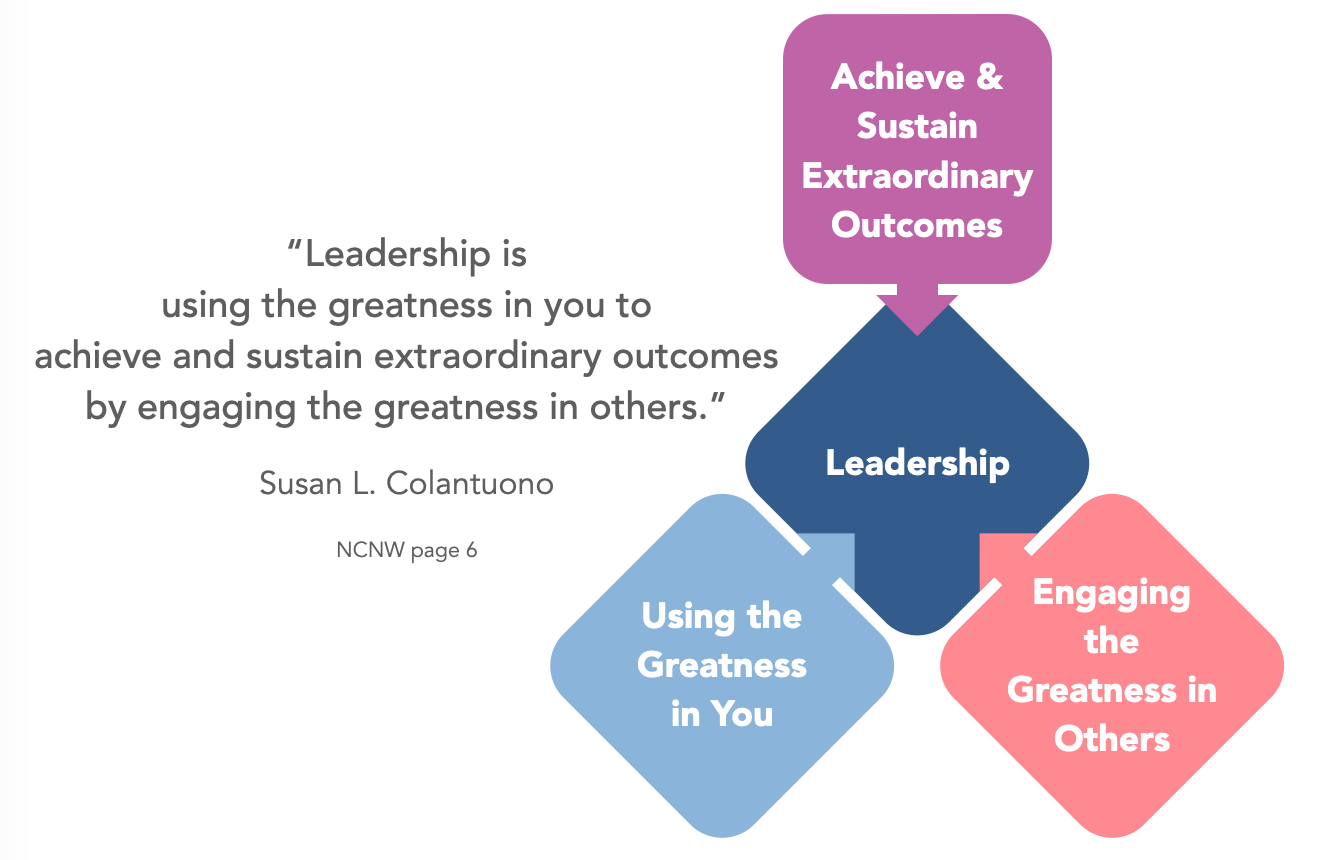
Using the greatness in you: Helen drew on business acumen, analytical ability, courage and personal resilience. She persisted for seven years against indifference. That is personal greatness in action.
Achieve and sustain extraordinary outcomes: Helen was focused -- more than her manager, perhaps more than the vice president -- on the financial health of the clinic. She understood the relationship between billing codes and revenue when others around her didn’t see it or didn’t act.
By engaging the greatness in others: Helen knew which people to enlist to solve the problem. When her own organization didn’t respond, she seized a new opportunity - a consultant working on an unrelated project - and made her case again.
She wasn’t waiting for a promotion or for permission. She was leading.
And in doing so, she out-led everyone above her on the org chart: the vice president, the director and the managers. Title and level hadn't made any of them leaders. Helen's actions did.
What donning the mantle looks like in practice.
Helen’s story is exceptional in that the financial impact of her action was measured. The leadership? Women are doing it at every level, every day - most of the time without a dollar figure to show for it. The behaviors that drove it are available to any of us, at any level:
If you see a problem, don’t just surface it -b ring a potential solution and engage others in fixing it.
Treat the organization as if you own it. Your goals exist in service of something larger. Know what that something is.
Lead for outcomes, not just activities. The question isn’t “did I do my job?” It’s “what changed because I showed up?”
Think of yourself as a leader - and behave accordingly. Others are always watching.
The shift that makes advancement possible.
Beyond a certain point, career progression is no longer about individual performance. You cannot promote yourself out of individual contributor status by being a better individual contributor. At some point, the only path forward is the mantle.
The shift is from doing the work through your own competence to achieving outcomes by leading others. From “here is what I did” to “here is what we built.”
It’s a shift that can start long before you have anyone reporting to you. Helen never had a direct report. She engaged the greatness in others around her. She was leading anyway.
And now, back to that hallway after the keynote.
I’ve heard it from nurses and engineers, from financial analysts and project managers, from women in their first roles and women two steps from the C-suite:
“I don’t think of myself as a leader.”
You are. Or can be. The mantle is yours to put on.
Lessons in Leadership
You don’t need a title to lead. The mantle of leadership is available to anyone, at any level, from the moment they decide to put it on.
Being for the business means orienting yourself toward organizational outcomes -not just your own goals or your team’s goals - but the health of the whole. This is a choice, not a job description.
The shift from individual contributor to leader is not a promotion. It’s a decision to don your mantle of leadership. You make it before anyone else recognizes it.
Your leadership is most visible not when you do your job well, but when you see beyond it.
This is part 4 in the series.

Start the series here:

Next in the series: Leadership Differs by Level (coming soon)
Quick reminder: Be Business Savvy pricing moves to $8/month and $80/year on July 1st. If you’ve been thinking about subscribing, now is a good moment.

If this sparked something for you...
You’re reading Be Business Savvy - where women get the tools to develop and demonstrate the business, financial, and strategic acumen that turn “she’s great at her job” into “she’s ready for more.” It’s what I call The Missing 33% of the career success equation and the subject of my TED Talk watched by millions.
Take a next step:
❤️ Like, share or restack this post — it’s the best way to help other women find it
Explore the Be Business Savvy Course — self-paced, with coaching support
Susan