
Your Point of View is an Asset
Why the questions you ask shape the answers you get

If you know me, you’ll never believe how this article started.
I was skimming a Reuters Institute newsletter on my walk and was stopped in my tracks by something James Murdoch said during an interview with New York Times’ journalist Jim Rutenberg.
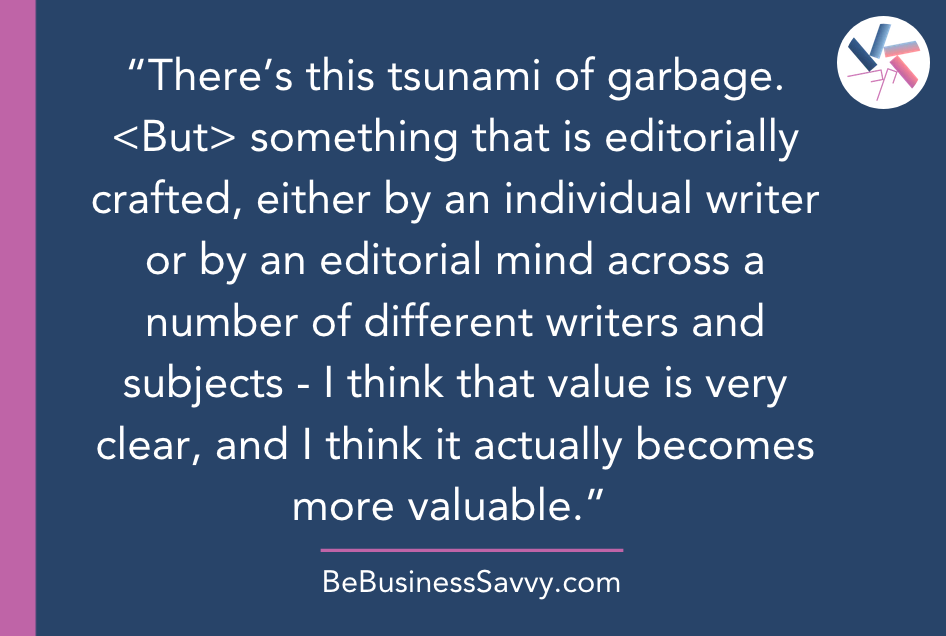
Murdoch was differentiating the tsunami of AI slop from the creations of an “editorial mind.” I’d call it something simpler: a point of view.
Same thing. A consistent lens, i.e. a way of seeing that doesn’t change depending on who’s asking or what’s trending. The thing that makes work product yours instead of generic.
I hate quoting a Murdoch. I said so. Out loud. To Claude.
She pushed back - gently, but firmly: James is the one who’s been calling out Fox News for years. The estranged son. The outlier.
Fine, Claude, even a Murdoch can be right about something.
His idea stayed with me. Because what Murdoch was really describing wasn’t a media trend. It was a distinction between content that gets produced and content that’s shaped by a point of view. And once I started thinking about that distinction, I saw it everywhere. Including in how I use AI myself.
Prompt or Think With
There are two fundamentally different ways people use AI tools.
Some people prompt. They type a question, get an answer, accept it and move on. Efficient. Transactional. The tool performs; the person uses.
Some people think with. They bring a half-formed idea, push back on the response, redirect and refine. The exchange has texture. The tool becomes less like a vending machine and more like a thought partner.
An AI that gets used as a thought partner over time becomes a kind of cognitive apprentice to whoever it’s working with.
My Claude has spent three years immersed in my research on why women plateau, what The Missing 33% actually costs us, why Business Savvy matters and how to name systemic patterns precisely - without softening them or sensationalizing them (well to be honest I sometimes let the rage sneak in). She’s been shaped by that work.
A Claude used differently, for example prompted for quick answers and rarely pushed back on, gets shaped by those exchanges as well. Completely different apprenticeship.
I saw proof of this recently. I’ve been informally coaching a friend through a high-stakes job negotiation where framing matters as much as the words. At one point, her own Claude (commenting on advice I’d helped her think through) described my Claude as “operating like a strategic advisor, not just a prep coach.”
The same AI shaped into two different users - and the AI was the one to call out the difference.
Which brings me back to Murdoch.
The Instinct You've Been Told to Suppress
If his “editorial mind” is important, would women’s tendency toward collaboration be an asset when using AI. Is it more likely that we will converse with rather than prompt? So I asked Claude what she made of it.
She was careful with her answer - “I can’t see patterns across her conversations with others, only reason from what’s known about communication styles generally, and from our work together.” But she did offer that women more often tend to bring context. They explain why they’re asking, what’s at stake, how it fits into something bigger. They push back on the answer. They redirect.
Men, more often, are transactional. A clean question. A desired output. Get to the point. Done.
Which is, of course, exactly the prompt vs think-with distinction. And a “think with” communication pattern some of us have been told is “too slow.” When we gather more context, ask more questions and push back before deciding we are exploring a point of view. And a point of view, per Murdoch, is what creates value.
The same things that make a woman “difficult” in a meeting - too many questions, too much context, won’t just take the answer and move on - are the exact muscles that build an editorial mind. Women have been quietly building this asset for years, often in spaces where it wasn’t recognized as an asset at all. It was called “overthinking.” “Not being decisive.” “Needing too much information.”
If you’ve ever been told you ask too many questions. That you need too much context before you decide. That you’re “not decisive enough,” or that you overthink things - I invite you to consider that your instinct (the one we’re told “needs improvement”)is what builds a point of view, turns information into understanding and keeps your AI from producing slop in the first place.
You’ve been building a point of view - call it an editorial mind, if you want the fancier version - you just didn’t know it counted.
Without Business Savvy It’s Still Slop
Here’s the catch - and it’s important. An editorial mind on its own isn’t enough. Not at work, anyway. The questions you bring, the context you insist on and the pushing back all needs to be in service of something. If the point of view you bring to your AI is sharp but disconnected from the business, you’ll be building a different kind of slop.
The instinct is the tool. Business savvy is what turns it into value. Here’s what I mean.
While building my course on Financial Acumen, I asked Generic AI to provide color on a company’s cash flow statement we’d previously worked with. The numbers came back different from before. Being an AI it was confidently presented, perfectly formatted and…an hallucination. Free cash flow for 2021 had shifted from a verifiable number to one that didn’t exist.
I was able to call out the error because I knew what the actual number was supposed to be and the story it was telling.
This illustrates two important things.
First, Business Savvy lets you catch AI when it’s confidently wrong - about verifiable numbers, no less.
Second, and just as important: Business Savvy makes you faster and sharper at asking the right question in the first place. Knowing what to look for in a cash flow statement isn’t just error-checking. It’s what lets you ask a better question next time.
For your success, the point of view this article keeps coming back to has to be a Business Savvy point of view. Otherwise, you’re not just vulnerable to slop. You’re vulnerable to confidently-presented, perfectly-formatted nonsense dressed up as analysis of your own business.
What’s a Woman to Do?
Notice the next time you catch yourself asking “but why” or “what’s this for” before moving forward - and stop apologizing for it.
Look at how you use AI. Are you prompting, or thinking with? The difference isn’t about the tool. It’s about whether you’re bringing your point of view to the exchange.
If you write, post, or create anything publicly ask what’s the lens only you can bring? Name it, even just to yourself.
At work, make sure the questions behind your “thinking with” are business savvy ones. Not just “how do I say this,” but “how does this connect to what the business actually needs.”
The next time someone calls your need for context “overthinking,” try on a different word: discernment.
Ask whether you’re bringing your point of view to the table: your context, your questions, your refusal to settle for the first answer? Or are you, too, just prompting your way through your days, handing over half of what makes you valuable?
The AI slop isn’t really the threat. The threat is forgetting that you’ve always had an editorial mind. The slop just makes it easier to see who hasn’t forgotten.
So — how are you using yours?
Lead ON!
Susan

If you’re following all the advice and it still feels like something’s in the way, I want you to know:
You are not the problem. You are working inside a system that’s withholding something from you.
I’m here to offer what that system can’t or won’t: the business, financial and strategic acumen that opens doors. You’ll find it in every article, in the Be Business Savvy Course and in Your Business Savvy Coach.
❤️ Like, share or restack this article — it’s the best way to help other women find it
📘 Explore the Be Business Savvy Course
I’m Susan Colantuono, best known for my TED Talk, “The Career Advice You Probably Didn’t Get“ and founder of Be Business Savvy.
I’m glad you’re here,
Susan