
Turn AI Career Advice from Good to Great
What Most Career Experts Don't Know - and Can't Tell You

The AI career tips you're getting could be making you better at the skills that matter least for your next promotion.
Business Insider recently featured an executive coach offering five ways to use AI to get ahead at work. The advice is genuinely useful. It is also missing the one thing that determines whether any of it can actually change your career trajectory.
Before I name what’s missing, let me offer my definition of leadership (because, after all, you advance on the basis of your proven and perceived leadership.)
Leadership is using the greatness in you to achieve and sustain extraordinary outcomes by engaging the greatness in others.
This definition has three distinct parts, each representing an element of leadership:
Personal Greatness: your skills, professional knowledge, attributes, values, worldview, personal purpose.
Engaging Others: how you communicate with, influence, develop, and lead people and teams (interpersonal and team skills)
Business Savvy: your business, financial, and strategic acumen
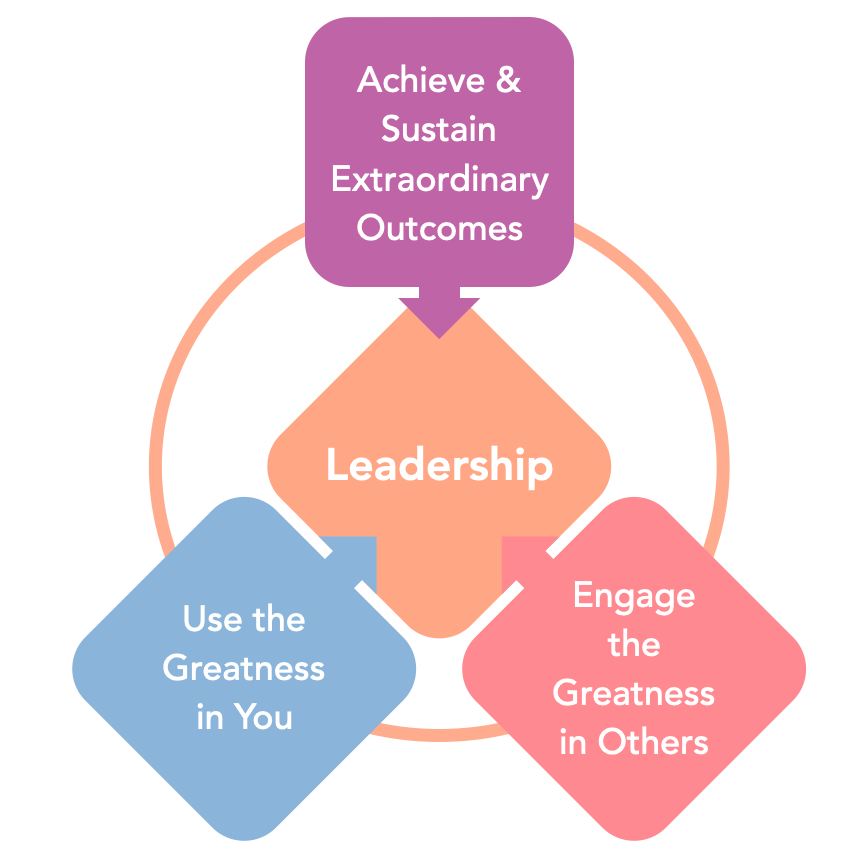
Most leadership development for women covers the first two thoroughly. The third - Business Savvy - is The Missing 33%.
Keep that framework in mind as I walk you through what the article actually recommended.
Two Pillars. Zero Thirds.
The coach offered five tips. Read them carefully and a pattern emerges.
Personal Greatness: Two of the five tips live here.
Pressure-test your thinking before you share it.
Improve how you talk about your work.
Both are about preparing yourself, building credibility, and articulating your value. Solid advice.
Engaging Others: Three of the five tips live here.
Use AI to simplify your message for different audiences.
Share your thinking more consistently without creating extra work.
Reclaim time for relationships, influence and visibility.
Also solid advice.
Business Savvy: Exactly zero tips, and no reference to its importance.
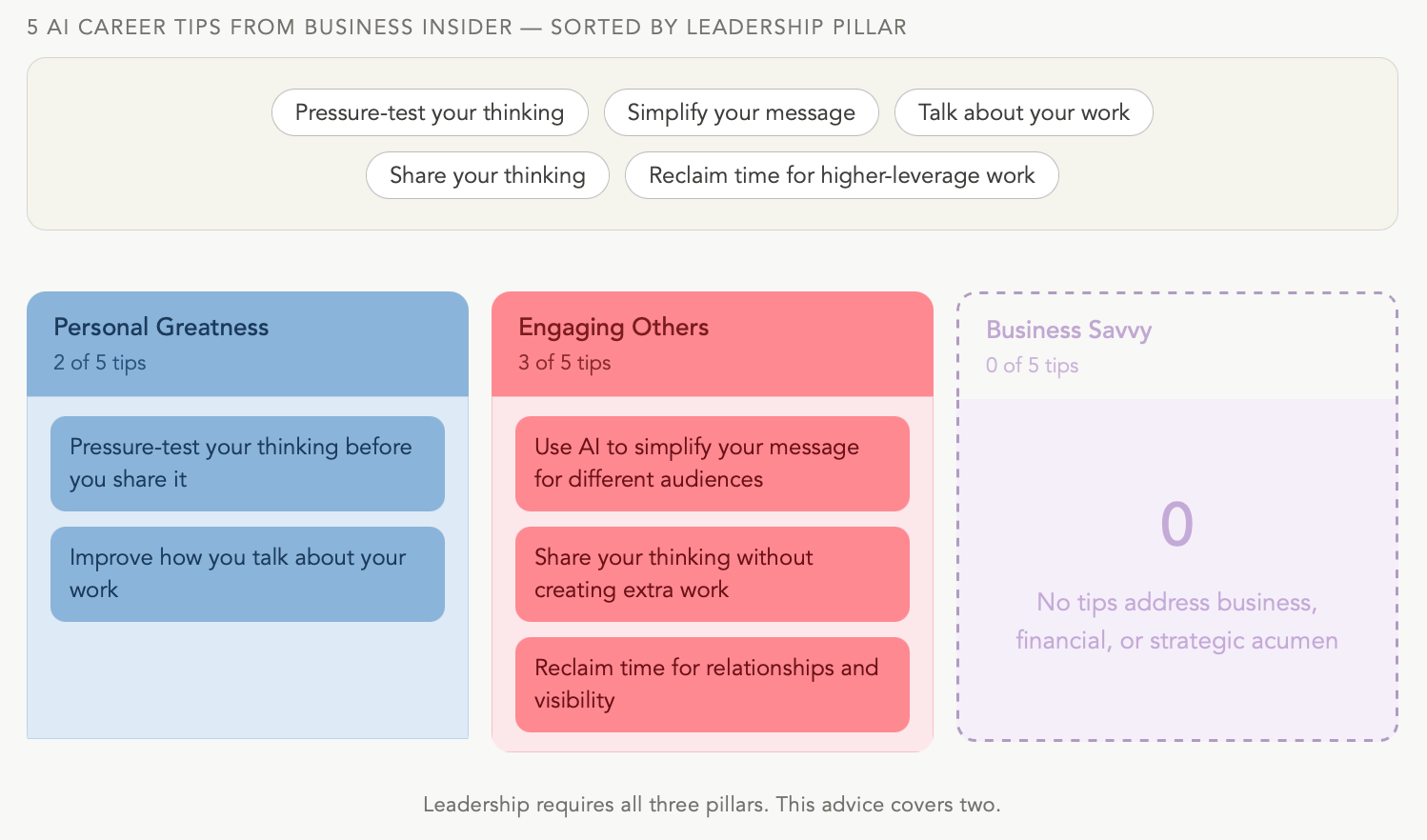
Not one suggestion about using AI to deepen your understanding of your organization’s financial performance. Not one recommendation to use AI to analyze a strategic problem, build a business case, or develop the acumen that gets you taken seriously in the rooms where advancement decisions are made.
Notice what none of the five tips asks:
What business problem are you solving?
What financial outcome does your work connect to?
What strategic context shapes the decisions you’re influencing?
The techniques are sound. They’re just taught without any reference to the business terrain they’re meant to serve.
This is not a criticism of one coach. It is a description of a pattern that runs through nearly all career advice aimed at women. We are thoroughly and skillfully coached on two-thirds of what leadership requires. The other third is treated as if it either doesn’t exist, doesn’t apply to us or is irrelevant when we pressure test our thinking, improve how we talk about work, simplify messages, etc.
What the Tips Look Like With the Full Foundation
The gap becomes clearest when you look at what the advice almost says.
Take the tip about simplifying your message for different audiences - including CFOs and board members. The advice focuses on communication style: level of detail, structure, how dense to make it. That is real. But communicating to a CFO is different from understanding what a CFO actually cares about. One is a presentation skill. The other is Business Savvy. AI can help you develop both if you know to ask for the second.
Or the tip about using AI to articulate the impact of your work. The advice says to capture the problem you solved and what changed because of your leadership. Right. But impact narrated through a Business Savvy lens sounds completely different from impact narrated through an execution lens. “I kept the project on schedule” is not the same story as “my decision to restructure the vendor contract reduced costs by three points.” AI can help you tell either story. Only one of them moves the needle in a business conversation.
And the tip about reclaiming time for higher-leverage work - defined as building relationships, influencing decisions, and gaining visibility. Yes. And. In an AI-accelerated world, the highest-leverage work also includes developing the business, financial, and strategic fluency that makes you credible in the conversations that determine who advances.
The Stakes Have Changed
Here is the irony the Business Insider article misses entirely.
AI is actually a powerful tool for building business, financial, and strategic acumen. You can use it to understand a P&L, analyze competitive dynamics, pressure-test a strategic recommendation, or reframe how you measure business performance. I do this regularly and it works precisely because I know what questions to ask. (This is crucial to be able to find hallucinations - which I have!)
That last part is the catch. Knowing what to ask requires a foundation of Business Savvy. Without it, you will use AI exactly the way the five tips suggest: to communicate more clearly, articulate your impact more compellingly and build your visibility more efficiently. All valuable. All two-thirds of what leadership requires.
The women who discover AI’s full strategic power are the ones who already have enough business and financial grounding to direct it. The women who follow advice like this will keep using it to get better at what we’re already known for (personal greatness and engaging others) and wonder why they’re still being passed over by the women who use it for all three.
The advice in that Business Insider article will make you better at two-thirds of what leadership requires. That is worth something.
Business Savvy is what makes the other two-thirds matter. Read ON! for ways to add the missing layer to each of the 5 tips.
If you’re reading this as a free subscriber, I’d love to have you join us. What’s a Woman to Do (below) is where the practical application lives — and it’s where this community does its best thinking together.
I have a large pipeline of articles on AI, so this will be the first of many. Next up (coming soon).
