
Same Seat. Different Price. Guess Who Paid More.
The Glam Tax just bought a ticket to the game.

You aren't imagining it. The algorithm quotes you a higher price.
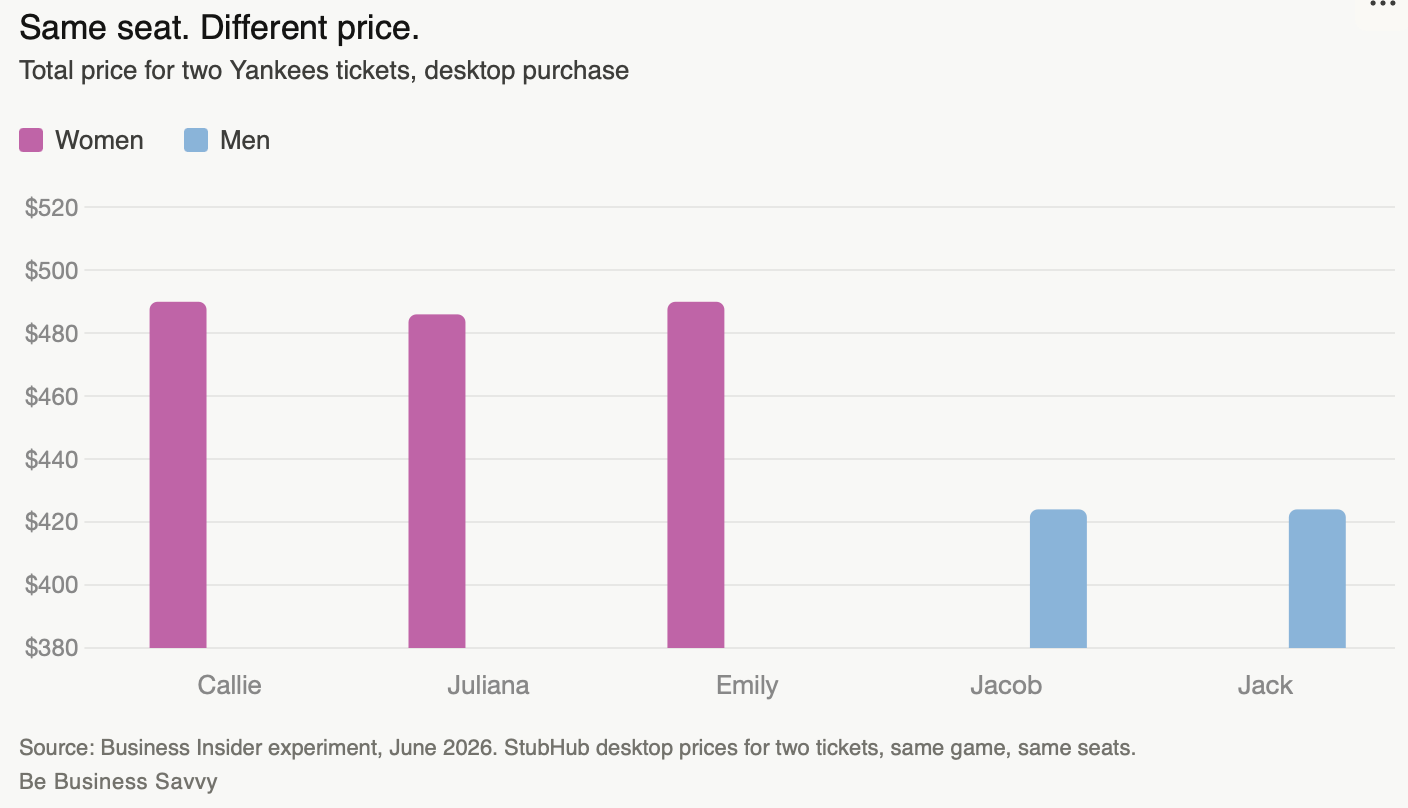
A few weeks ago, Emily Stewart of Business Insider ran a ticket-buying experiment. Five colleagues. Same Yankees v Red Sox game. Same seats. Same moment in time.
Desktop prices: Callie $490, Juliana $486, Emily $490. Jacob $424, Jack $424.
Every woman in the test was quoted $62 to $66 more than every man for the same two tickets. There is zero overlap. The men cluster at one price point, the women at another.
StubHub called it “randomized, anonymous testing, standard practice across e-commerce for years.” An answer that’s technically defensible and functionally meaningless.
I couldn’t figure out how the algorithm knew Emily and her colleagues were women?
It didn't have to
Here’s how it works and why it’s so hard to fight
Surveillance pricing isn’t a guy in a back room deciding to charge women more. It’s an algorithm trained on behavioral data (e.g. browsing history, purchase patterns, abandoned carts, mouse movements on a webpage, the type of device you use, the time of day you shop) that learns, without ever being told, which profiles will tolerate a higher price.
Those profiles happen to correlate with gender.
Women aged 25-54 are among the highest-converting consumers online - meaning when we click, we buy. Algorithms don’t miss that. They price for it.
The Federal Trade Commission noticed too. A January 2025 report found that retailers use a wide range of personal data - including, explicitly, gender and age - to set individualized prices. The concern regulators named wasn’t just that it happens. It was that it’s nearly impossible to detect. There are no signs on the door. There’s no line in the terms of service that says “your profile has been placed in the higher-price tier.” You don’t know you’re being priced differently unless someone runs an experiment — like Emily and her colleagues did.
Deniability is the point
This is the part that matters for us, professionally and financially.
When Emily asked StubHub what was happening, she was told it was random testing. And that might even be partially true on any given day. As one researcher put it: “It could be true that it’s random on one day, and it could be A/B testing the next day, and it could be a combination of a third of using personal data. We don’t know.”
That uncertainty - we don’t know - is not neutral. It functions as a shield.
The same structural deniability underlies the Glam Tax. No policy says women must spend more on professional appearance. No rule requires the extra hour, the specific products, the careful calibration of “polished but not overdressed, confident but not intimidating.” It emerges from unwritten norms enforced through social consequence. The algorithm operates the same way: no one set out to charge women more. The system just learned that it could.
It’s not just StubHub. A researcher studying Uber’s booking fees has spent six months trying to understand how its variable fees are calculated. His conclusion: “Distance appears to matter, time appears to matter, but there’s a lot of other things we don’t observe that seem to matter. We can’t explain how.”
Your personal ROI moment
The Business Insider experiment found a $62-$66 gap for two tickets. That’s a single purchase. Now think about the cumulative version: tickets, travel, groceries, clothing, personal care products. A 2025 study found that women pay an average of 4% more per unit across their grocery baskets than men do for products in the same category. A New York City study found women pay 7% more than men across personal care products. The GAO confirmed price disparities in five out of ten personal care product categories it studied.
Four percent here, seven percent there - alone each could be dismissed. Add them up across a year and it's a big deal. The individual instances look like variation. The pattern looks like a system.
And it runs in both directions. We pay more as consumers - and we earn less as professionals. The gender pay gap means the dollars being surveilled and priced and taxed are already fewer to begin with. The Glam Tax has always been a scissors problem: the blade that charges us more, and the blade that pays us less. Now charging us more has been handed over to surveillance pricing algorithms.
Once you see the system, you can start asking a different question about every purchase: is this worth it to me, at this price, right now?
Not “is this the going rate?” There may not be a going rate anymore. Rather, “what am I actually getting for what I’m paying, and is the return worth it?”
The law is trying to catch up
New York’s Algorithmic Pricing Disclosure Act, which went into effect in July 2025, requires businesses using personal data to set individualized prices to post a conspicuous disclosure: “This price was set by an algorithm using your personal data.” It also prohibits the use of protected class data - including sex and gender identity - to set prices.
The FTC has opened a broader probe into AI-driven pricing tools.
Neither of these closes the gap entirely. As Mark Tremblay, an economics professor at UNLV, who has spent six months studying ride-share pricing, warned: "If all those regulations are specific to the price and not the fee, then the laws won't actually do anything." Which is, in fact, exactly what the Business Insider experiment found - most of the price variation wasn’t in the ticket itself, but in what got layered on top.
What’s a Woman to Do?
Knowing we’re targets of surveillance pricing is the first move. Here’s what’s next:
Compare across devices before you buy. The Emily’s own discovery points to the simplest defense: open the same listing on your phone and your desktop browser before purchasing. Vivid Seats confirmed its app prices are intentionally lower. Ticketmaster acknowledged its fees can be discounted. This isn’t paranoid behavior — it’s the same instinct we’d apply to airfare, applied everywhere. Thirty seconds, potentially $60 back in your pocket.
Use AI as your comparison engine. I recently used AI to research a major purchase (truth be told it was a dressage saddle) so I could compare prices, specifications, and options across multiple sources before committing. The same approach works for tickets, travel, electronics, anything where prices vary and the variation isn’t transparent. Ask Claude, or whatever AI tool you use, to find the same item across platforms, compare total costs including fees, and flag where prices diverge. The algorithm is using data to price you. There’s no rule that says you can’t use AI to price-check the algorithm.
Know that the law is catching up and defend it. New York’s Algorithmic Pricing Disclosure Act is already in effect, requiring businesses to post a clear notice when an algorithm has set your price using personal data. It also prohibits using sex and gender identity to set prices. The FTC has opened a broader probe. This legislation is being challenged in court by the National Retail Federation. Knowing these laws exist means knowing to support them.
Talk about it. The Business Insider experiment worked because five colleagues compared notes. That conversation - wait, how much did you pay? - is the detection mechanism. We are each other’s audit. Share this article. Compare receipts. The algorithm depends on each of us assuming our price is the price. This isn’t hypothetical, and it isn’t slowing down.
Days after this piece first took shape, the Washington Post was hit with a class action over exactly this. Readers discovered the paper had been building “pricing profiles” from their reading habits since 2024. This was undisclosed, until a new law forced a vague reveal in a renewal email. One subscriber compared it to a grocery store charging different customers different prices for the same loaf of bread, based on nothing but their shopping habits. Another asked a stranger online why their bill was $90 higher for the exact same subscription. We are each other’s audit — and it’s already working.
Business savvy on the personal level means knowing when the number in front of you was designed for you specifically - and knowing you don’t have to accept it.
Surveillance pricing means the algorithm figured out you would pay more for the exact same seat. And it never had to know you were a woman to charge you like one.
This is a gender-based tax hiding in the shadows. Knowing this gives us a chance to combat it.
Lead ON!
Susan

If you’re following all the advice and it still feels like something’s in the way, I want you to know:
You are not the problem. You are working inside a system that’s withholding something from you.
I’m here to offer what that system can’t or won’t: the business, financial and strategic acumen that opens doors. You’ll find it in every article, in the Be Business Savvy Course and in Your Business Savvy Coach.
❤️ Like, share or restack this article — it’s the best way to help other women find it
📘 Explore the Be Business Savvy Course
I’m Susan Colantuono, best known for my TED Talk, “The Career Advice You Probably Didn’t Get“ and founder of Be Business Savvy.
I’m glad you’re here,
Susan