
New Series: Engaging the Greatness in Others
Leadership lessons with a helping of dressage, starting Tuesday

I was watching my 14-year-old grandson at soccer practice when five boys, maybe 9 years old, sat down near me during lunch break. For the next ten minutes, they pontificated.
“This team sucks.”
“That team isn’t going anywhere.”
“This player is a ball hog.”
Not a single question. Not one “why do you think that?” No engagement, just proclamation after proclamation delivered with the certainty of experts defending dissertations - despite knowing virtually nothing about what they were saying.
They were learning early: assert, don’t ask. Tell, don’t listen. Dominate the conversation, don’t build it. This is how they were being trained for the command and control style of management, not the collaborative style. The result of command and control is compliance. The result of collaboration is engagement.
Women Are Already Good at Engagement
Here’s what research tells us: Women significantly outperform men on nearly every skill related to engaging others. Communication. Listening. Developing people. Building talent. Empathy. Inspiring confidence. Getting people enthusiastic.
In study after study, managers rate women as stronger than men at engaging the greatness in others. Out of dozens of engagement-related competencies, men are seen as outperforming women in exactly two: using networks to advance the business and negotiation skills.
So what’s the problem?
The Disconnect
In my research I’ve explored what skills, experience and attributes boards and executives actually seek in executive and high-potential candidates. Let’s take a look at the blue bars:
Outcomes dominates - with 50% of the sought skills, experiences and attributes
Engaging Others - with only 26 %
Personal Greatness - with 24%
Now let’s take a look at what my 2 decades of research shows about managers’ perceptions of women and men (watermelon and magenta respectively).
Managers rate women as outperforming men on Engaging Others (47 competencies vs 3).
Managers rate men as outperforming women on Achieving and Sustaining Extraordinary Outcomes (including business, financial and strategic acumen) - 38 competencies vs 0.
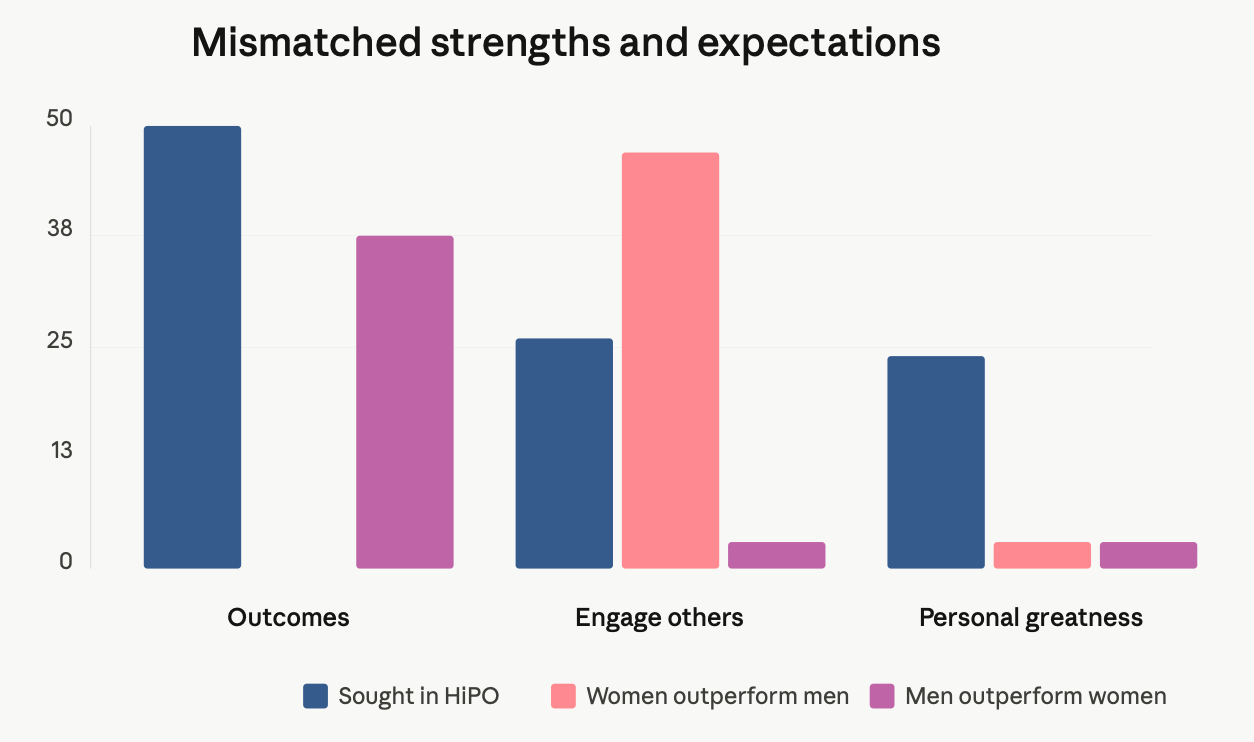
We’re excelling at a skill set that gets a LOT of lip service, but in the final analysis is valued less for advancement. We’re underperforming on what’s valued most. This is The Missing 33% problem in visual form and why enhancing and demonstrating Business Savvy is so important.
Why This Series Exists
So, given the importance of Business Savvy and women’s perceived excellence at Engaging Others, why am I writing a series on Engaging the greatness in others? Two reasons:
First, strength doesn’t mean excellence. We can always refine our skills. I certainly can. Even though I’ve spent decades teaching leadership including engagement skills, I still catch myself abdicating when I delegate. I hand off work without enough context or follow-up because I trust everyone even when they need more structure and guidance and/or because it just takes too long to engage. I can also be overly direct when a lighter touch would work better. Dressage has taught me what I should have already known from leadership: you use as little pressure as it takes to get the response, but all that it takes. Not more, not less. I’m still learning to modulate my approach with horses and people, you might have room to grow, too.
Second, and more importantly: the purpose of engaging others is to advance the organization. As much as our engagement skills reward us, feeling good about team cohesion or our communication effectiveness is not the point, it’s the process. Engaging others without maintaining focus on organizational outcomes creates happy sailors on sinking ship. So, don’t let this become your only focus. (I certainly won’t. You’ll still receive many new articles on Business Savvy.) If you over-invest here while neglecting Business Savvy (the actual Missing 33%), you’ll be excellent at something that won’t get you promoted. I call this “polishing the diamond” rather than “strengthening its setting.”
Consider this series a refinement of existing strengths and a call to focus your engagement skills on the right things.
Why Dressage?
Dressage is teaching me powerful lessons about the difference between compliance and true engagement. These are lessons that apply directly to leadership and deepen capabilities we already have.
You cannot proclaim at a horse. You cannot command and control your way to partnership. A horse that’s being told what to do without genuine engagement will comply mechanically at best, resist at worst. True partnership—the kind where horse and rider move as one—requires something deeper than command and control.
In dressage, I’m learning the difference between contact (akin to capturing the effort of a person’s hands) and connection (whole-body engagement where the horse willingly brings his power forward - akin to capturing the person’s heart and mind). I’m learning that force creates resistance, while “feel” creates responsiveness. I’m discovering how to support the energy coming from the horse’s own motivation and engagement—not from pulling with my hands.
I’m not using dressage as a cute metaphor. The lessons have direct parallels to leadership. The principles that create willing partnership with a 1,200-pound animal who could easily overpower you are the same principles that create genuine engagement in organizations.
If you don’t understand exactly what I’m saying, here you can see these principles in action. Invasor ridden by my trainer in Spain, Rafael Soto. Notice how joyfully they both perform.
Over the coming weeks, I’ll share what dressage has taught me about engagement—from understanding contact vs. connection, to developing multiple ways of asking for what you need, to building straightness so energy flows where you point it. Each article will draw on a dressage concept in real riding experience and connect it to concrete leadership applications you can use immediately.
This is about sharpening skills you already have while staying clear-eyed about where else you might want to focus. Because engaged teams matter. But engaged teams pursuing the wrong outcomes, or teams where you’re the only one who understands the business strategy, won’t get you where you want to go.
Next up: "Contact vs. Connection: Why Compliance Isn't Enough." We'll explore the difference between contact (command and control) and connection (capturing hearts, minds, and efforts) - and why most leaders stop at contact.

All subscribers receive the full leadership lessons from each article. Paid subscribers also get the 'What's a Woman to Do?' section with specific action steps you can implement this week.
Remember those 9-year-old boys proclaiming at soccer practice? They're learning a broken pattern—command without collaboration. But there's another trap just as limiting: collaboration without full focus on the business. The question isn't whether you can engage others—the data shows you probably already excel at it. The question is whether you're using that capability to advance outcomes that matter, or just to keep everyone comfortable. This series is about avoiding both traps—using your engagement strengths strategically, not just reflexively, to advance what actually matters.
Lead ON!
Susan
PS Let me be a little cheeky and mention that what those 9 year old boys were learning also serves as the basis of mansplaining. UGH!

If you’re looking for content that directly addresses the business, financial and strategic acumen you want more of — the kind of development that complements the presence and relational work you’re already doing — Be Business Savvy (specifically the Be Business Savvy course) is built for exactly this purpose. The content is designed to be accessible even if you didn’t come up through finance or strategy, and rigorous enough to make a real difference in how you show up as a viable candidate for opportunity.
I welcome your next step:
❤️ Like, or restack this post — it’s the best way to help other women find it
📘 Go deeper:
No Ceiling, No Walls (ebook)
No Ceiling, No Walls (softcover)
Make the Most of Mentoring (softcover)
Make the Most of Mentoring (ebook)
Be Business Savvy Course — self-paced, with coaching support
Coaching Executive Women (occasional) (newsletter)
Susan