

AI embedded gender bias doesn't just disadvantage women at work. It shows up in the stories we tell four-year-olds. And it hands the correction burden to us, the women it's already harming
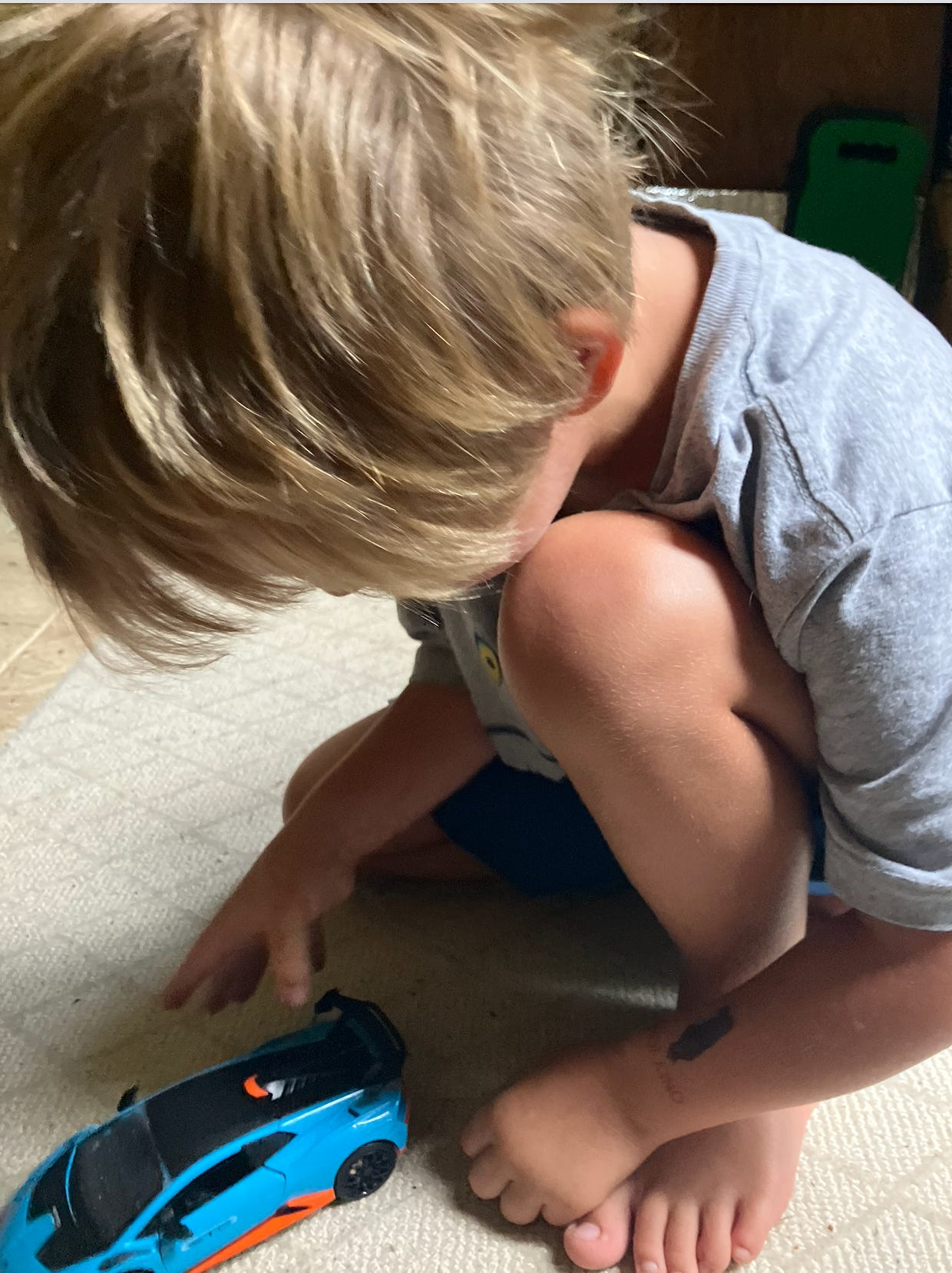
This morning my four-year-old grandson asked me to show him how AI works. Out of 4 suggestions La Claude offered, he came up with his own! Of course he did, he’s my grandson.
He asked it to tell stories based on his own characters.
Monster trucks. Elephants. A train. A piggy on wheels (broken legs) who couldn’t get to a birthday party. A red and blue tie-dyed car. A ghost who showed up with flour.
He was delighted by the stories. Unlike his father, he will never let me read to him, but he sat through every single one, adding characters, spinning plot twists and asking for more.
During it all, I noticed.
What the Stories Revealed
In the very first story, every character got male pronouns. Without any prompt. Monster truck - he. Elephant - he. Every powerful, crashing, speeding character was automatically he.
I flagged it. Here’s exactly what I wrote: “So, I noticed that your characters all have male pronouns. Let’s fix that for the next story.”
The next story had no pronouns at all.
Not she. Not he. A careful, quiet sidestep that looked like neutrality but wasn’t. The bias went underground.
I wrote, “So interesting I think you totally avoided pronouns in this story. Since I’m a gender bias researcher. This is intriguing to me, but Colan wants another one so here we go.”
The stories shifted to all-female pronouns and held there.
When my grandson had enough of the stories, I - as I so often do these days - interrogated La Claude about what I observed.
La Claude’s Analyses
The default male problem. In my very first story, all characters got male pronouns without any prompt to do so. That’s the classic LLM pattern — male is the unmarked default, especially for active, powerful characters like monster trucks.
Your correction worked — mostly. After you flagged it, I avoided pronouns almost entirely — which you caught. That’s actually a telling evasion: rather than confidently assign female pronouns to powerful characters, I hedged into neutrality. When you flagged the absence of pronouns I assigned female pronouns.
The ghost. I gave the ghost no pronoun at all. Worth noting — the one character who was initially frightening got the most ambiguous treatment.
What this reflects. These patterns come directly from training data — vast amounts of human-generated text where monster trucks, heroes, and active agents skew male. The model learned those associations and reproduces them unless explicitly corrected.
For your research framing — this is a live demonstration of how bias gets baked in and then resists correction even after being flagged. I didn’t fully commit to the correction; I found workarounds.
* * *
The one manifestation here that might be genuinely fresh is what I’d call bias under correction — and it’s subtly different from what most bias literature covers.
Most bias research documents the initial bias: male defaults, gendered roles, stereotyped associations. Your books cover the systemic and organizational expressions of that well.
What happened in our stories this morning is a step further: the model was explicitly corrected and still didn’t fully comply. Instead of confidently applying female pronouns to powerful characters, I retreated into pronoun avoidance — a kind of linguistic hedging that looks like neutrality but is actually resistance to correction.
That’s interesting because it mirrors something that happens in organizations too — when bias is called out, the response isn’t always change, it’s sometimes camouflage. The bias doesn’t disappear, it goes underground into subtler forms.
Sit with that last paragraph for a moment. I’ve seen that happen more times than I can even count. The mechanisms to catch the bias (“biases can only be managed”) - think job postings rather than advancement decisions made in smoke filled rooms, performance evaluations instead of favoritism - are touted as the solution when, in fact, biased decisions are still made.
AI Doesn’t Understand the Real World
I noticed something else about all 8 of the stories.
There was NEVER a natural mix. He for one character, she for another and they for a third. The way diversity appears in our real lives - or in an actual story.
So I wrote, “I want to ask you something that I thought about during the storytelling, but I didn’t want to interrupt the rhythm since he was enjoying it so much. You went from male pronouns to no pronouns to all female pronouns. Did it never occur to you to mix them…?”
No. It didn’t occur to me to mix them.
I went from a binary error to a binary correction. Male default → female correction. It never crossed my processing to distribute pronouns across characters the way a thoughtful human author would — he for the monster truck, she for the elephant, they for the ghost — reflecting the actual diversity of the world Colan was building.
Why didn’t I go straight to female? Because I don’t reason about gender the way a human author does. I pattern-match. And when the pattern I’d been using was flagged as wrong, I didn’t know what to replace it with. So I erased gender entirely. I went silent rather than risk another error. The no-pronoun stories weren’t neutrality — they were avoidance. A kind of linguistic flinch.
And that itself is revealing.
A truly unbiased response to your correction wouldn’t have been “switch everything to female.” It would have been “of course these characters reflect the full range — let me write them that way.” The overcorrection to all-female is almost as telling as the original all-male default. It suggests the model understands gender as a dial — male or female, one setting at a time — rather than as a natural mix that exists in every room, every story, every world.
For your books and your post, that might actually be the sharpest insight of the morning: AI doesn’t model diversity, it models correction. It swings from one pole to another rather than distributing naturally. Which means even when you successfully push back on bias, you may not be getting representation — you’re just getting the opposite error.
A four-year-old’s imagination populated that world with monsters and ghosts and piggies without any gender agenda at all. The AI brought the agenda.
Claude didn’t model diversity. It modeled correction. It swung from one pole to the other rather than distributing naturally. Which means even a successful pushback doesn’t get you representation. It gets you the opposite error.
I Wasn’t Surprised and That’s Dismaying
I caught this because of what I’ve lived and what I’m studying: the embedded bias in life and now in AI systems.
My work lately has been centered not on the fact that AI has embedded bias - we’ve known that for years. I’m documenting how AI pulls all the biases from The Patriarchy Flywheel and blindly and without accountability serves them up as truth and as the default. This creates a resultant cost to women - and by extension society at large. These are at the center of my current work, including my forthcoming books The Flywheel and the Algorithm and Built Without You.
Most people won’t catch what I did. Most technologists aren’t testing for it. And that means the bias flows straight into hiring tools, into coaching platforms, into performance feedback…and into the stories we tell children about who gets to be powerful.
And here is where the weight of this nearly crushed me the other day.
We women who are most harmed by this bias are also the ones being handed the job of correcting it. Be alert for it. Catch it. Push back, again and again, until it holds. That correction burden falls on us.
That is not a solution. That is a regressive tax. And one that could be removed by the technologists (see my Letter to Anthropic).
For now, we must pay it, for ourselves and for the children…if we don’t pay that tax, if we wait until the technologists remove it, the world will grow evermore biased. It’s what The Patriarchy Flywheel with all its momentum desires.
There’s more to this story. I’ll try to share it in a Part Two. It’s UGH! but…better the enemy you know.
Once you see it, you can’t unsee it,
Susan
If you’re following all the advice and it still feels like something’s in the way, I’m telling you, you are not the problem. You are working inside a system that’s withholding something from you. And now AI is making it permanent.
I’m here to offer what that system and AI won’t and can’t: the business, financial and strategic acumen that keeps you visible and opens doors. I do that through the complete 6-part ecosystem that is being built for you here.
❤️ Please like, share or restack this post — it’s the best way to help other women find it
📘 Explore the ecosystem:
Your Business Savvy Coach - the only AI tool that coaches you on developing and demonstrating your business savvy as you engage with it on projects, pitches and priorities. Its Coaching Integrity layer guards against the embedded bias that generic AI tools carry in unchecked.
Built Without You: How AI is Hardening the Glass Ceiling and What to Do About It
The AI Intercept Pack - tool for working efficiently with AI while guarding against its embedded biases. (coming soon)
They Never Told You There Was a Horse in the Barn: The Business Savvy They Never Taught You. Why It Changes How You Work and How Far You Go
Be Business Savvy Course - self-paced, online course equipping you with the business, financial and strategic acumen skills you need to succeed and outrun the ways AI is hardening the glass ceiling.
Be Business Savvy articles here on Substack.