

Here’s a question nobody in the beauty industry wants you to ask:
What if everything you spent this morning getting ready - on specific products, specific brands, specific level of polish - were invisible to the people whose good opinion you seek?
Not invisible as in unimportant. Invisible as in: they’re responding to an overall impression of polish — not the specific choices that cost us thousands to achieve.
Because the research suggests that’s exactly what’s happening.
What Decision-Makers Actually Notice
Studies on appearance and workplace advancement consistently show that grooming matters. Particularly for women, being perceived as “polished” does correlate with higher salaries and better opportunities. That part of the glam tax argument holds.
But here’s what the research also shows: career decision-makers (many of whom are still men) notice the overall impression of grooming. Not the specifics.
They notice polished versus not polished.
It’s safe to assume that most male decision-makers do not notice:
Designer versus non-designer
Gel nails versus plain
The $170 blowout versus the $40 haircut
Whether it’s the same outfit as last Tuesday
Whether the moisturizer cost $12 or $120
Through their eyes the threshold for “professional appearance” is far lower and far less detailed than the standard most of us run ourselves ragged to meet.
We are paying a luxury tax to clear a bar that only requires showing up.
Who Do We Actually Dress For?
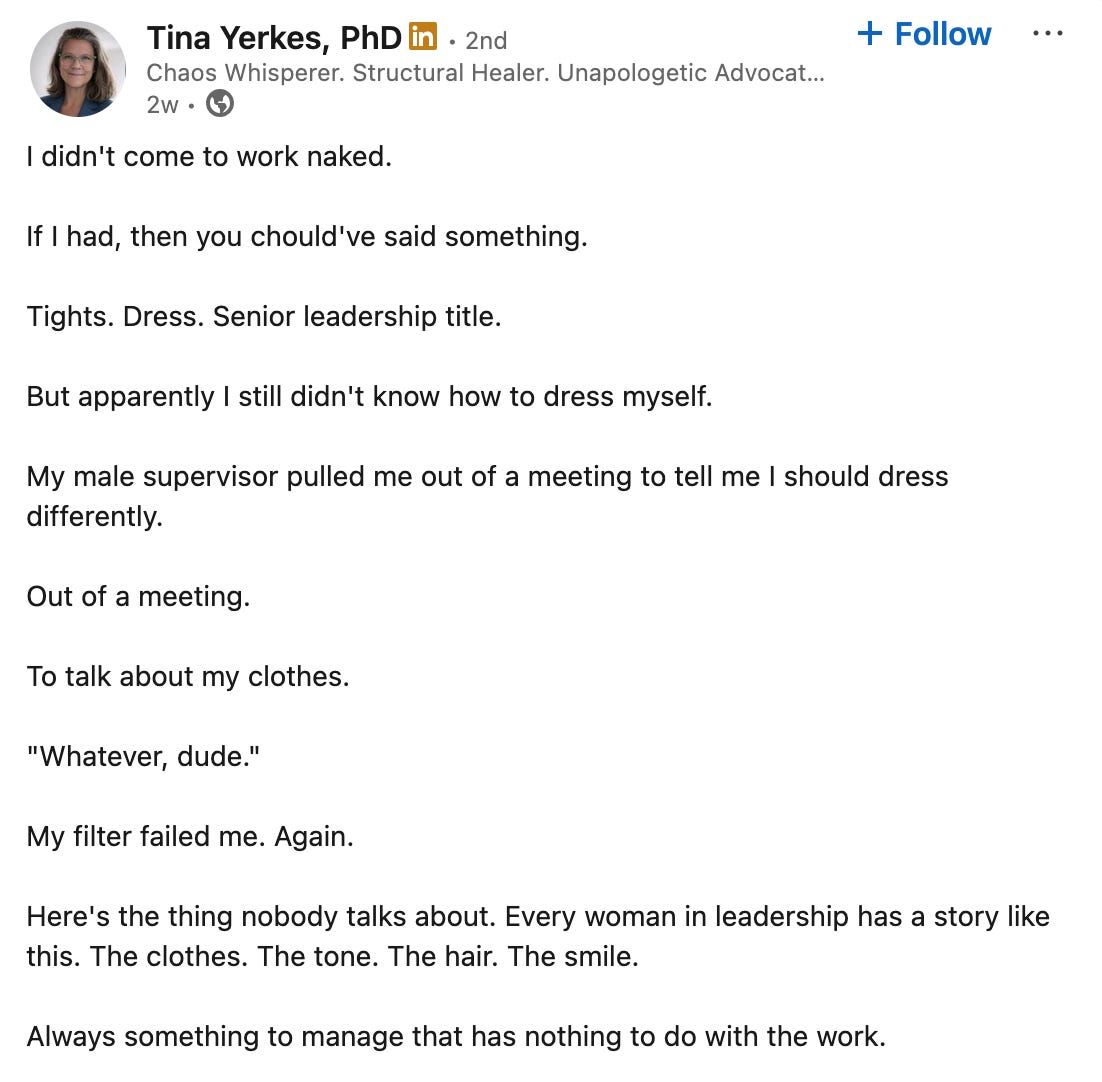
To be clear: men do sometimes police women’s appearance at work — as Tina Yerkes, PhD discovered when her male supervisor pulled her out of a meeting to critique her clothing. But notice what he was responding to: a perceived deviation from an unspoken standard, not the specific details of what she’d spent to get dressed that morning. The male gaze in the workplace is blunt. It notices compliance or non-compliance. The exquisitely detailed scrutiny — the chipped nail, the wrong heel height, the slightly-too-casual Friday — that’s coming from somewhere else entirely.
There is one exception worth naming. Men do notice - with remarkable precision - whether a woman deploys her body in ways that serve their comfort or desire. As multiple women in Tina’s comments attested, a managing partner will suggest you show more cleavage to win clients, a female project manager will tell you that covering up makes you seem “defensive.” The standard men enforce isn’t about polish or professionalism. It’s about availability. Which tells you everything about what the standard was always actually for.
If the men making career decisions about us can’t perceive the difference between a $33,000 facelift and a good night’s sleep — and the research strongly suggests they can’t — then the question becomes:
Who can?
And the answers are:
Other women.
And ourselves.
The glam tax isn’t primarily enforced by male gatekeepers scrutinizing our nail polish. It’s enforced by the women around us, who have internalized the same standards we have and apply them - consciously or not - to each other. A raised eyebrow at chipped polish. A comparison that happens in a glance. The subtle social cost of visibly opting out.
And the burden isn’t equally distributed. For women of color, the glam tax carries an additional layer - the pressure to code-switch in appearance as well as language, to navigate standards that were built around whiteness, and to manage bias that has nothing to do with polish and everything to do with race. The tax is real for all of us. For some of us, it’s compounded.
Capitalists in the patriarchal beauty and beauty adjacent industries build the standard. Women help maintain it.
Which is, of course, exactly how the most elegant traps work.
And if we’re honest, the subtler enforcer is the one who lives inside us.
Long before a colleague notices our chipped polish, we’ve already noticed it ourselves. Long before anyone compares our outfit to a competitor’s, we’ve made the comparison internally. The external scrutiny is real. The internal standard can sit deeper, activate faster and never turn off.
That voice — the one that says not enough, not polished enough, not thin enough, not young enough — didn’t arise from our beings. It was embedded by the same industries that defines the standards through decades of advertising, media, and subtle messaging that began before most of us were old enough to push back.
The most effective enforcers are the ones we can’t see. And our inner enforcer is both the hardest to name and the most important to name.
The Invisible Cost We Don’t Count
There’s a dimension of the glam tax that doesn’t show up in any spending total.
It’s the mental load - what my brilliant colleague Michelle Redfern memorably calls “the internal administration of looking like I’ve got it all together.” The constant low-level hum of: Do I look right? Is this enough? Am I measuring up?
It runs in the background of meetings, presentations and networking events. It costs nothing we can itemize and everything we can’t. It never appears on a leadership development agenda. It rarely comes up in a performance review.
And it is exhausting in a way that quietly accumulates. It drains our mental and emotional resources leaving fewer that could be directed toward work that actually advances careers.
We’re not just paying in dollars and hours. We’re paying in bandwidth.
The Time Cost Made Visible
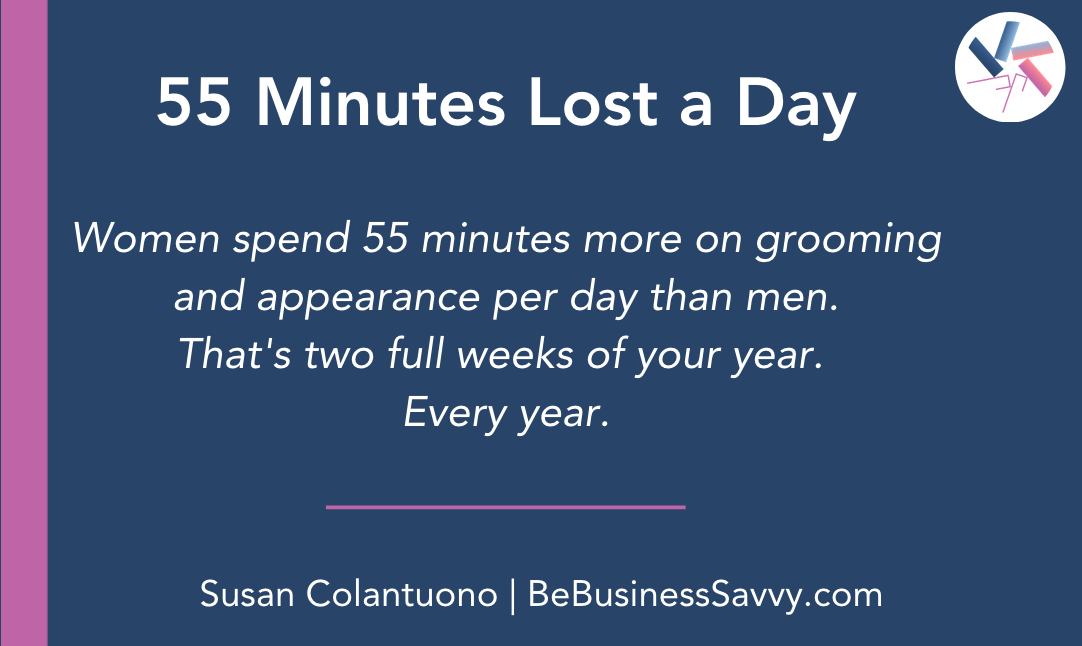
In Western professional culture, women spend an average of 55 minutes more per day than men on grooming and appearance preparation. That’s two weeks of calendar time — or the equivalent of eight weeks of working hours — every single year.
Two weeks of working hours spent not on developing business savvy, not on building strategic relationships, not on deepening organizational savvy. We’re spending them on meeting a standard that the people with promotion authority largely cannot distinguish from a much simpler, cheaper, faster, version of itself.
Two weeks that men spend on other things - man of which fuel their career success. Time spent reading about the industry, making strategic contacts, developing skills, advocating on their own behalf, spending time with mentors, cultivating achievements that earn sponsorship, and on and on.
So What?
If the previous 2 articles in my “glam tax” series made you angry at the system, I hope that this one make you something more useful: skeptical of the standard.
The next time you reach for the more expensive option, the more elaborate routine, the more demanding standard ask not just “Is this for me?” but three harder questions:
Who told me this was necessary?
In my heart of hearts, do I believe them? and
Can the people I’m trying to impress actually tell the difference?
More often than not, the honest answers are:
The beauty industry told you — and it profits from your anxiety.
In your heart of hearts, you may not be sure.
And no, they probably can’t tell the difference.
The standard is less visible to decision-makers than we’ve been led to believe. The enforcement is coming from inside the house — from each other, and from the internalized voice of an industry that needs us to keep spending.
Seeing that clearly doesn’t mean abandoning every ritual that brings you genuine pleasure. It means the ones that don’t deserve a second look.
That’s not revolt. That’s just arithmetic.
The revolt comes next.
This is part 3 of my It Needs to Be Said series on the Glam Tax.
Here’s part 1:

Here’s part 2:

Before signing off, I want to give you something more useful than simply reading about this.
I built a Glam Tax Calculator - dollars, hours and the emotional load that never shows up on any spending report. It takes about 10 minutes. It produces insights that are truly meaningful.
It’s a resource for paid subscribers (link below the paywall).
If you’ve been reading this series, I think you’ll find it revealing.
Lead ON!
Susan
