
Business Insider's New “Hot at Work” Feature. Here’s What That Tells You.
Reporting on the glam tax...or selling it?

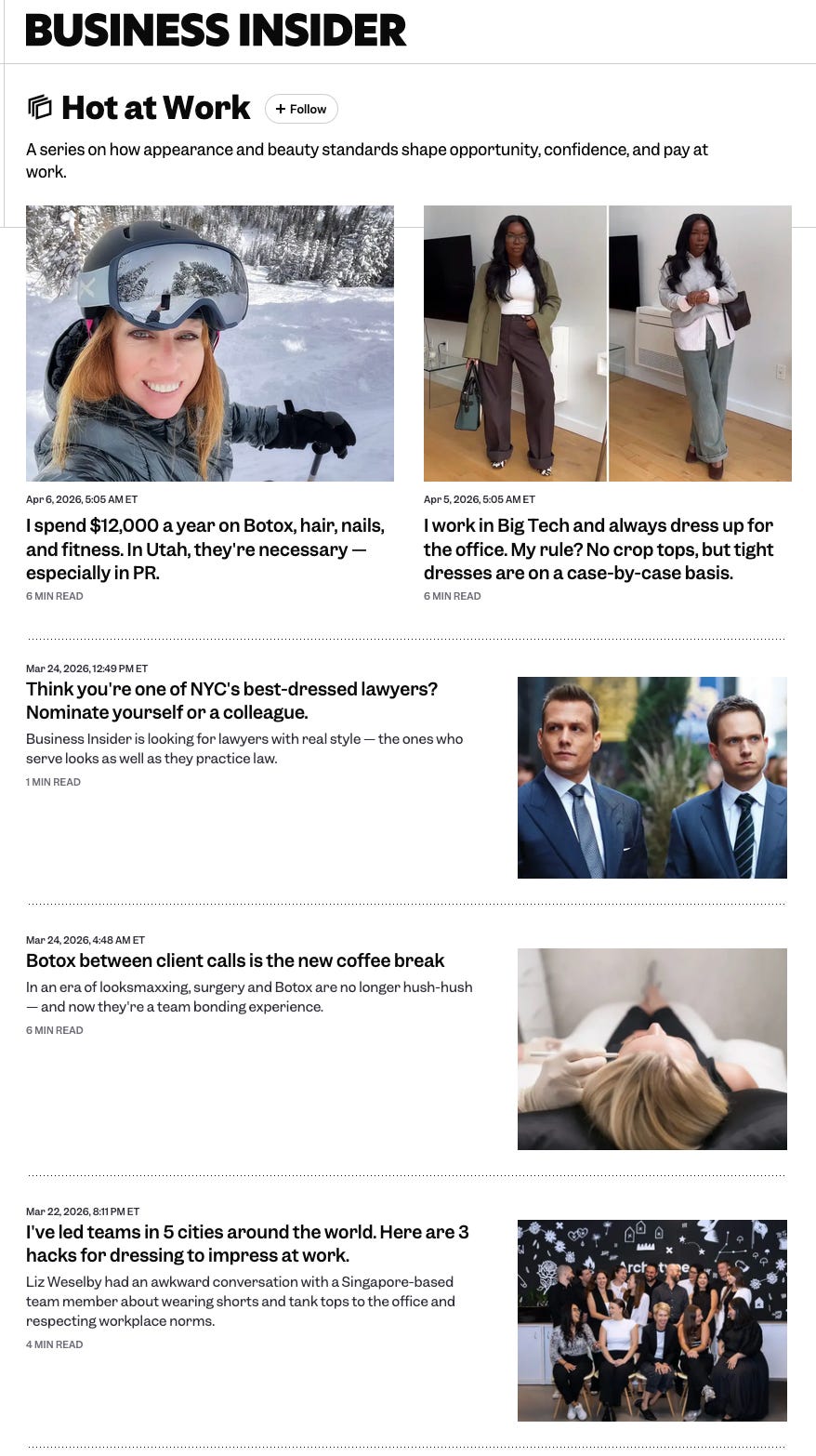
Business Insider recently launched a feature series. They call it “Hot at Work.”
Let that sink in for a moment.
Not Successful at Work.
Not Thriving at Work.
Not Confident at Work.
Not even Hard at Work.
Hot!
The name alone tells you everything you need to know about what’s coming. But let’s look anyway.
The description reads: “A series on how appearance and beauty standards shape opportunity, confidence, and pay at work.”
Sounds like journalism, right? An investigation into a real workplace problem — the pressure on workers, especially women, to look a certain way to get ahead?
Dear reader, it is not journalism.
It is a sponsored content delivery system dressed up as a newsroom.
What “Hot at Work” actually covers
Here is a representative sample of the headlines, published over the past several months:
“I spend $12,000 a year on Botox, hair, nails, and fitness. In Utah, they’re necessary — especially in PR.”
“I’ve spent $33,000 on cosmetic procedures at 65. It’s been life-changing for my career and confidence.”
“Botox between client calls is the new coffee break.”
“The unapologetic office glow-up era is here.”
“I got a blow-out in Davos for nearly $170. It was worth it to start the week off with peak confidence.”
“’Dress for the job you want’ is dead. Now, it’s ‘dress for the job you want to keep.’”
“Corporate types are clamoring for a new kind of plastic surgery — using dead people’s fat.”
“I’m a Google manager who gets fully dressed for work — even at home. It’s made me more successful.”
And my personal favorite for sheer audacity:
“At 58, I’ve got coworkers half my age. It’s pushed me to find habits that help me look younger and feel confident.”
Here’s the obvious question
Who is the subject of nearly every single one of these articles?
Women.
Out of roughly twenty articles in the series, exactly one features men as the primary subject — an old (December 2024) piece titled “Men in corporate America spend thousands to look good — they just don’t want you to know about it.”
Notice what that framing does.
Men spending on appearance is positioned as a shameful secret.
Women spending on appearance is positioned as professional wisdom. Courage, even. Required membership to the glow-up era.
Business Insider’s series description is carefully gender-neutral. The content is anything but.
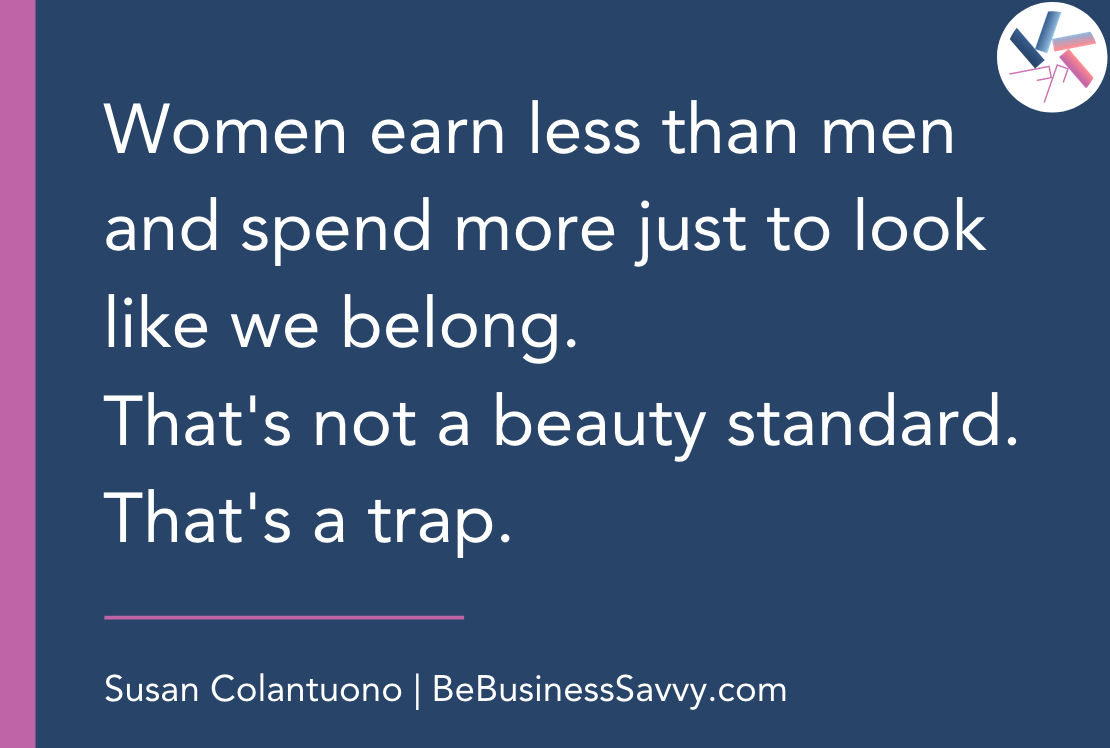
That’s not an accident. It’s gender-scrubbing — using neutral language to obscure a gender-adverse reality. The description promises a series about “appearance and beauty standards” at work. What it delivers is a blueprint for how women, already earning less than men, can spend even more to feel like we finally measure up.
Neutral language. Anything but neutral impact.
Contradiction they apparently didn’t notice
Buried in the series, between the Botox testimonials and the $170 blowout celebrations, are two articles that accidentally tell a different story:
“Wearing high-end items to work could be costing you raises and promotions.”
And:
“I realized I was spending over $2,000 a year to get my builder gel nails. I decided to stop and save that money.”
So: spend on Botox, fillers, laser facials, looksmaxxing, and gym memberships — but don’t carry a designer bag, and maybe reconsider the manicure.
The logic is not coherent. But the revenue model is.
Botox providers, medical spas, fitness brands, skincare companies, and cosmetic procedure practices represent billions in digital advertising dollars — and professional women are their primary target audience. A series that normalizes — celebrates — spending on all of the above is not a series about workplace equity. It’s an advertiser’s dream wrapped in an editorial bow.
They give you the disease so they can sell you the cure.
The age pressure layer is disheartening
The cruelest thread running through “Hot at Work” is how it amplifies age anxiety. The 58-year-old feeling pushed to look younger. The Gen X and millennial piece about lying about your age as a “survival tactic” in the job market. The youthfulness piece. The $33,000 facelift at 65.
The articles stack appearance pressure on top of age discrimination anxiety — a combination that creates maximum urgency to spend.
You’re aging. You’re being pushed out. Here’s what worked for someone else. Here’s who sells it.
This series does NOT…
It does not ask why women’s appearance is professionally consequential in ways men’s isn’t.
It does not examine who benefits financially, structurally and politically from that norm.
It does not connect the dots between the glam tax women pay and the pay gap that means they have less money to pay it with.
It does not ask whether the $12,000 a year, the $33,000 in procedures, the $170 blowout, the gel nails or the Botox between client calls actually move the needle on advancement, or whether it simply maintains the price of admission.
It certainly does not ask what would happen if women redirected even a fraction of that money into what actually advances careers:
Business Savvy: business, financial and strategic acumen;
Strategic relationships gained through professional/industry memberships and
Gaining exposure to the people who make promotion decisions.
The are the things nobody is selling you in a “Hot at Work” article.
What “Hot at Work” actually does
Hot at Work reports on a trap while building a bigger one. And once you’re entrapped, you’re truly stuck.
It takes a real phenomenon, i.e. the documented, measurable pressure on women to spend more on their appearance to be taken seriously at work, and reframes it as aspiration. As empowerment. As confidence. As peak professionalism.
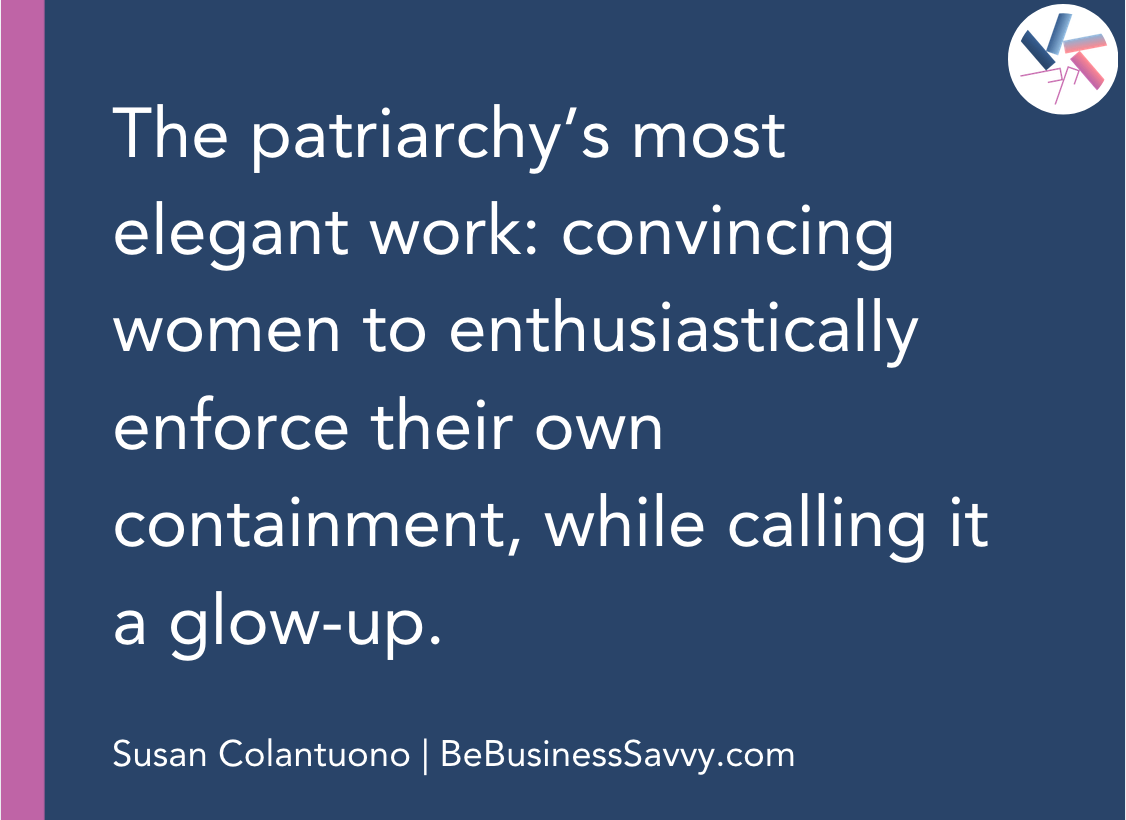
And in doing so, it is doing the patriarchy’s most elegant work: convincing women to enthusiastically enforce their own containment, while calling it a glow-up.
A note on the one dissenting voice
The gel nails piece about the one woman who added up her $2,000 annual spend and decided to stop is the most interesting article in the series. Not because stopping gel manicures is a revolutionary act, but because it’s the only article that treats a woman’s money as hers, rather than as a resource to be redirected toward appearance compliance.
It reads like an accident in an otherwise unified editorial vision.
If you read my recent piece on the glam tax (the double bind of earning less while being expected to spend more just to participate in professional life) “Hot at Work” is that argument made visible in real time. Business Insider didn’t set out to illustrate my point. But here we are.
The series will continue. Advertisers will keep buying. And women will keep reading articles that tell us our bodies are the problem to be solved, when the actual problem is the system that says so.
You already know what I think the real investment looks like.
From my soapbox,
Susan
Did the “Hot at Work” series land in your inbox too? What was your reaction? I’d love you to let me know in the comments.
This is part of my It Needs to Be Said series. If you haven’t read the piece that started it all — The Glam Tax Is a Trap — start there.

Find Part 3 here:


If you’re looking for content that directly addresses the business, financial and strategic acumen you want more of — the kind of development that complements the presence and relational work you’re already doing — Be Business Savvy (specifically the Be Business Savvy course) is built for exactly this purpose. The content is designed to be accessible even if you didn’t come up through finance or strategy, and rigorous enough to make a real difference in how you show up as a viable candidate for opportunity.
I welcome your next step:
❤️ Like or restack this post — it’s the best way to help other women find it
📘 Go deeper:
No Ceiling, No Walls (ebook)
No Ceiling, No Walls (softcover)
Make the Most of Mentoring (softcover)
Make the Most of Mentoring (ebook)
Be Business Savvy Course — self-paced, with coaching support
Coaching Executive Women (occasional) (newsletter)
Susan
Offff “earning less while being expected to spend more just to participate in professional life”. This needs to be talked, no screamed, about more often.
I am retired but this article brought back a rush of memories... as a salesperson walking miles on high heels in pencil skirts, many $$ spent having my hair highlighted and so much of my income spent on expensive work clothes. I had hoped it was changing but this article shows it is worse now.
Sharing this article with the young working women in my life. A wake up call, perhaps?