
Linkedin's Algorithm Got Rebuilt. Its Bias Didn’t.
Invisible on Linkedin Part 3

Linkedin tells women to build their professional reputations on a platform that — whatever its intentions — is structurally working against them. It’s like a father pointing his daughter toward the playground without mentioning the gate only opens from the inside.
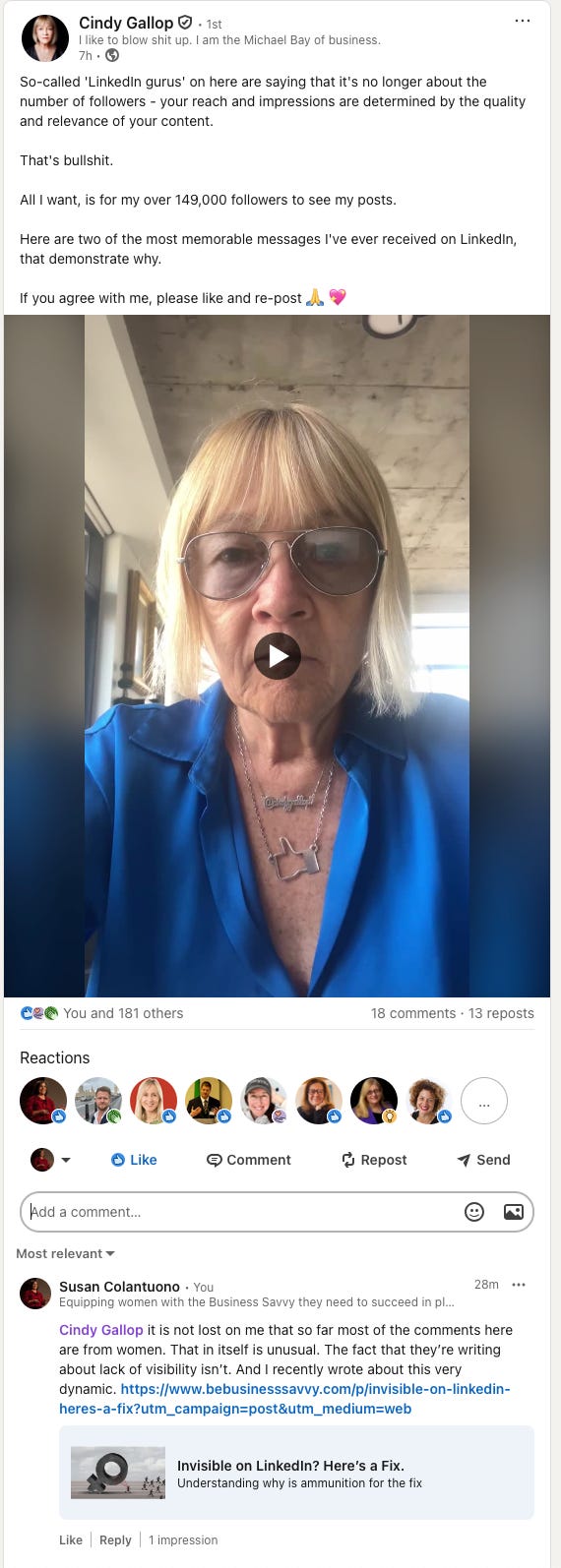
A few weeks ago I shared my article “Invisible on LinkedIn? Here’s Why” in the comments of a Cindy Gallop post. Cindy is one of the original researchers whose controlled experiment proved the suppression. In her post she was amplifying the problem: that very few of her 135,000+ followers actually see her posts anymore.
My comment, sharing an article about invisibility, on a post about invisibility, got one impression.
You can’t write irony that clean. LinkedIn did it for me.
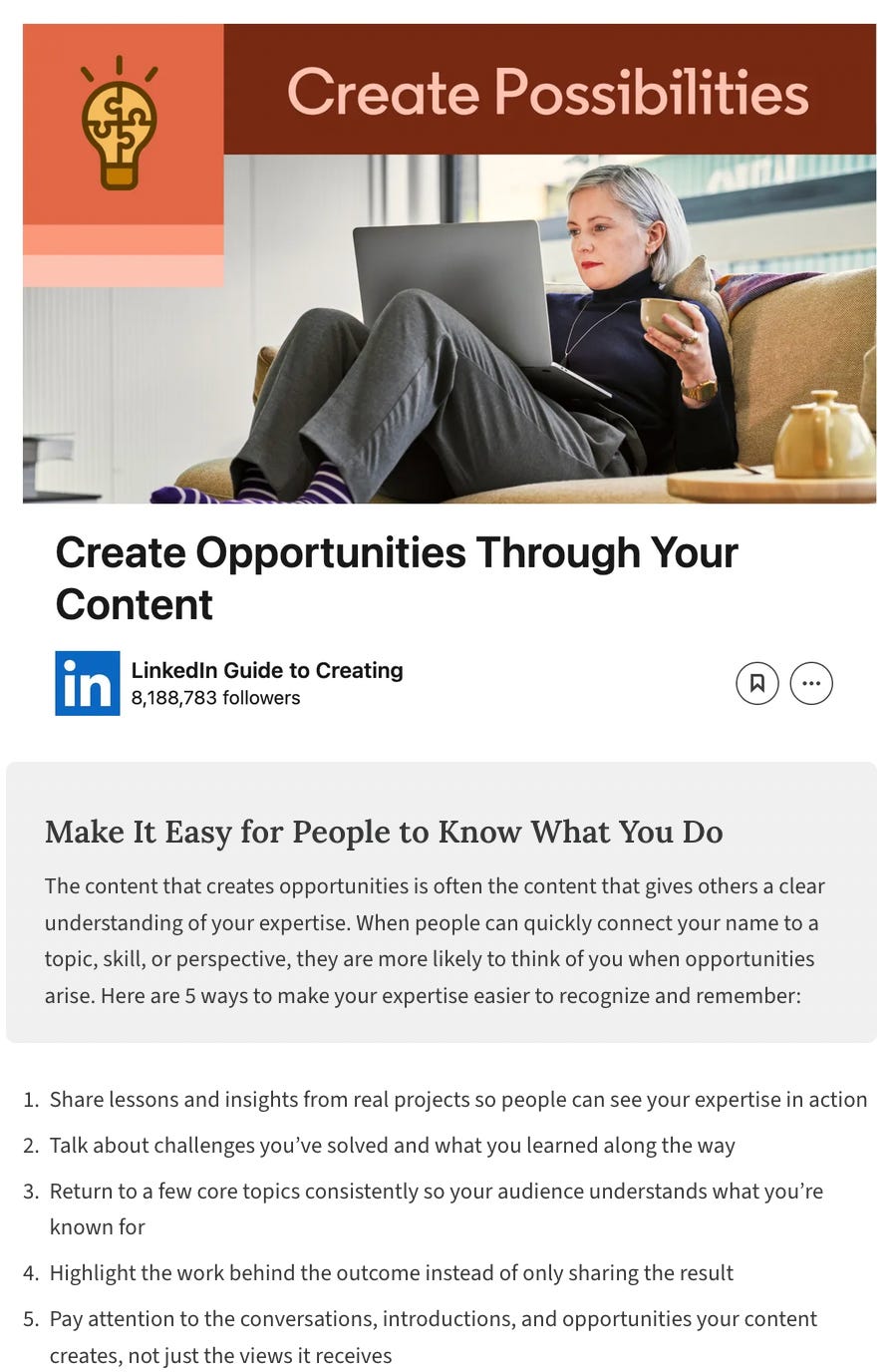
Recently, this post from LinkedIn listed five ways to make your expertise easier to recognize on the platform. Share lessons from real projects. Talk about challenges you’ve solved. Return to core topics consistently.
The five tips in that LinkedIn post aren’t wrong.
They are all beside the point.
Because the problem isn’t that women aren’t producing the right content.
The problem is that the right content isn’t being surfaced. It’s like bringing your best dish to the party and watching the host never put it on the table.
Invisible on LinkedIn? Here’s Why
The short version: two controlled experiments showed women with significantly more followers than their male counterparts receiving a fraction of the reach on identical content. A 110-page technical analysis derived from Linkedin’s own research explained why. Reader feed audits confirmed it: women make up 43% of Linkedin’s global user base but appeared in only 25–33% of feeds.¹
A reader reached out this week to say she'd found “Invisible on Linkedin?” - not through Linkedin's algorithm, but through a Claude AI agent. The platform that suppressed it couldn't surface it. An AI did.
This piece takes that further.
The Overhaul that was Supposed to Fix It
In April, Linkedin rolled out its most significant ranking overhaul in years. It replaced its old multi-model system with 360Brew, its new AI foundation model now handling feed ranking, content distribution, and connection suggestions through one unified system. The headline promise: a shift from a network-based model to an interest-based one. Reach would no longer depend primarily on your follower count. Instead, the algorithm would match content to people who’d find it genuinely relevant, even outside your network.
Which raises an immediate question: if follower count is irrelevant to reach, why does LinkedIn still send notifications every time someone new follows you? Flattery, I guess. Or concealing the algo change?
I posted exactly that question. Three sentences, no image, no link.
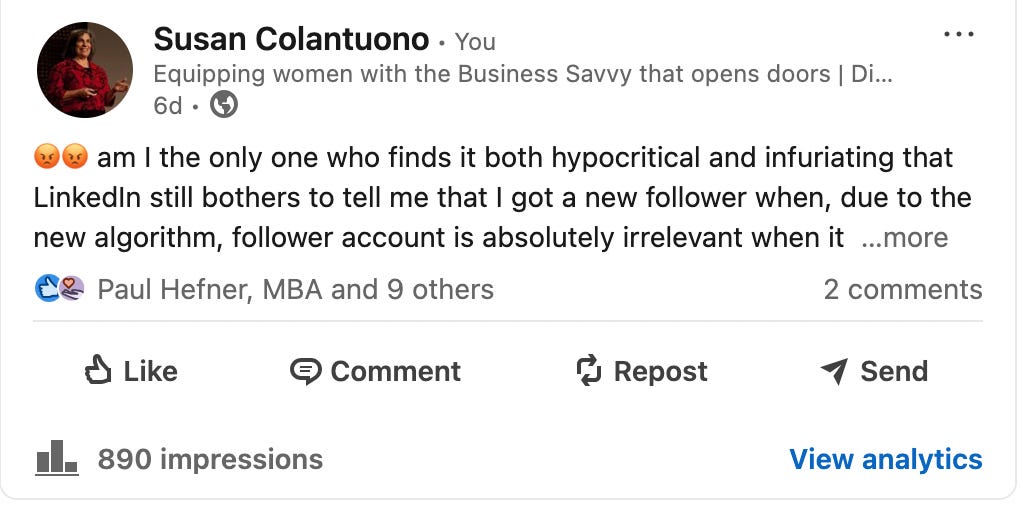
890 impressions.
My substantive posts combined haven’t matched that in two weeks.
The platform rewarded the complaint about the platform. Again, the irony doing the heavy lifting.
Compounding Problems with the New Algo
Instead of solving for women’s invisibility, the new algorithm embedded it more deeply. Here are the ways I spotted. I’m sure there are others. If you find any shout them from the rooftop!
1.The Authoritative Voice Problem
On paper, an interest-based model sounds like progress. If the algorithm routes content by relevance rather than network size, women with smaller or newer networks should have a fairer shot.
In practice, masculine-coded content still outperforms feminine or neutral-coded content in distribution - not because of who wrote it, but because of how it reads to a system built on a foundation of male-dominated knowledge.
In my forthcoming book Built Without You, I describe “the cellar”: the vast repository of training data upon which AI models are built. It contains centuries of recorded human knowledge, books, manuscripts, articles and digital content, produced predominantly by men, selected for publication by men and written in a voice and register that reflects male-coded norms of authority and expertise.
Linkedin’s algorithm draws on that cellar. It isn’t looking at your gender. It learned what “authoritative” sounds like and what “expertise” looks like from recorded human history in which women’s voices were systematically underrepresented. It’s penalizing the style, not the person. The outcome is the same.²
2.The Rage Sells Problem
The new algorithm claims to reward substantive engagement: comments, dwell time, saves, genuine discussion. In practice, research across platforms consistently links outrage, conflict, and assertion-heavy content to higher comment volume. Conflict invites reaction while connection invites reflection.³ The system reads volume as value. Heat still beats depth.
Connection-mode language (collaborative, relational and the style more often used by women) generates quieter, more substantive engagement. Saves. Thoughtful replies. The kind of response Linkedin’s stated values claim to want. The algorithm doesn’t know the difference.
3.The Depth vs. Breadth Problem
Linkedin tells creators to return to core topics consistently so their audience knows what they’re known for. Clean, logical, reasonable.
But many women - and the research on women’s cognitive style supports this - think and write with a broad contextual lens. We connect the business problem to the human cost, the data point to the lived experience, the industry trend to the woman sitting in the meeting. That’s not unfocused. That’s a different and legitimate form of expertise. Our insight lives precisely in connecting what others keep separate. That’s systems thinking. (For example my recent feedback to Anthropic: Claude’s projects are set up as file cabinets and chats in one file cabinet can’t see into chats in others. I told Anthropic they should have built it like a mind map.)
The algorithm reads that expertise as cross-domain diffusion and penalizes the reach accordingly. Follow Linkedin’s advice and you flatten your voice. Keep your voice and the algorithm flags you as scattered. There’s no version of this where the system is working for you.
4.The 60-Minute Problem
The April rebuild added something that didn’t exist before: a narrow early-engagement window of approximately 60 minutes during which a post’s initial response determines whether it gets wider distribution. If it falls flat in that window, most posts never recover.
It sounds neutral. It isn’t.
Women’s social media time is more fragmented and less self-directed than men’s — because women carry a disproportionate share of unpaid domestic and caregiving labor regardless of employment status.⁴ The odds that a meaningful share of a woman’s network is freely scrolling Linkedin within 60 minutes of any given post are low. And women’s audiences - often other professional women - face the same constraints. If your post’s critical first hour lands while your audience is in a meeting, on a school run, or simply not scrolling, the algorithm reads that as “this isn’t interesting” regardless of what the content actually says.
This is a time-scarcity bias dressed up as a quality signal. Unlike the language bias, it has no workaround. You can’t control when Linkedin decides to test your post. You have no visibility into when your audience happens to be free. The old system punished you for who you are. The new system also punishes you for how your life is structured.
And if you try to compensate by seeding your own early engagement, coordinating timing, cultivating pods of people who’ll comment quickly, you’re already paying what I’ve dubbed the Linkedin Algorithm Workaround Tax. The work we do because Linkedin won’t. And we do it on top of everything else on our plates.
What LinkedIn Says it Wants vs. What it Actually Surfaces
If you’re not already angry. Here’s the fix for that.
Linkedin has publicly stated it has tuned the algorithm to favor authentic, experience-based, human content. In a world suddenly flooded with AI-generated posts, the platform says it wants “the real thing” - genuine expertise (there’s that word again), personal insight and original thinking.
Studies consistently show that women’s professional communication skews toward exactly that. Collaborative, experience-grounded, relationship-oriented content.³ The exact style the cellar taught the algorithm to undervalue.
Linkedin is now rewarding intentional imperfection as proof of humanness. Here’s the gender bias beneath that. What self-respecting woman doesn’t strive for perfection by nature and necessity? Even though we know in our heads it’s unattainable. We proofread. We edit. We read it one more time before hitting post.
The platform, driven by its male-coded training data, suggests that to prove we’re human, we need to introduce errors into our posts. It doesn’t see us and our patterns. Instead, we’re guided to adopt a casualness we’ve spent our entire careers to avoid.
We’ve been writing humanly all along.
We’re just not being seen.
Why Nothing Gets Fixed
Here’s the frame that makes everything else make sense.
Linkedin almost certainly gave its engineering team a straightforward assignment: design the algorithm to optimize for revenue. Not for equity. Not for representation. For engagement velocity, time on platform, premium subscriptions, post boosting and ad performance.
That’s not a conspiracy. That’s a business decision.
That decision produced an algorithm drawing on the same cellar of male-dominated knowledge that underlies every major AI system. It learned what “authoritative” sounded like, what “expertise” looked like, what “engaging” means and what counts as “relevant” from data that didn’t include most of us.
The algorithm was literally from its most core material Built Without You. It isn’t trying to suppress us. It’s optimizing for signals that were never designed with us in mind. The result is the same either way.
And that framing is actually more damning than bias by design. Because “we didn’t mean to” is not a defense when the harm is documented, the mechanism is understood and years of evidence haven’t moved the needle. Intention is irrelevant when the damage is structural and ongoing.
Consider the scale of what’s at stake. Linkedin generated $17.8 billion in revenue in FY2025. Ad revenue alone is projected to reach $9.7 billion in 2026. Premium subscriptions crossed $2 billion annually. In Q2 FY2026 (the quarter just before 360Brew launched) Linkedin crossed $5 billion in a single quarter for the first time. Microsoft CEO Satya Nadella called it out by name on the earnings call.
360Brew wasn’t built to make the platform more equitable. It was built to protect and grow those numbers. Engagement velocity drives the feed. The feed drives time on platform. Time on platform drives ad revenue and premium conversions. When the algorithm is working financially there is no business case to rebuild it for the people it’s failing.
The platform is not designed to suppress women. It is also not designed not to. That distinction is where $17.81 billion lives.
The cost of fixing it falls on Linkedin. The cost of not fixing it falls on us.
That’s not an accident. That’s their choice.
NOTE: on the day I published this article Linkedin, one follower replied showing me an ad from Linkedin flattering him about his posts and inviting him to “Discover Thought Leader Ads.” My reply to him was, “Ha ha proof positive in real time of my point about “optimize for revenue generation” they want you to pay for ads. I don’t and won’t. I don’t know if boosted posts or ads would improve visibility and I’m not going to pay to find out. That would make me both the product and a revenue stream. I’ll carry one burden but not the other.”
The Advice We Never Asked For
One logical response to all of this data is: write more like a man.
We’ve heard this before. Be more assertive. Make declarations, not suggestions. Drop the collaborative framing.
Linkedin’s algorithm is quietly making the same demand. And, just as in every other arena, the advice doesn’t fix the system. It asks women to perform someone else’s communication style to be heard within it. One writer described being advised by AI content audits to change her titles and framing. Her instinct told her something was off. That instinct was correct. The system optimizing her content wasn’t built with her audience in mind.
And the consequences are dire. If you use Linkedin as a client interest peaking tool one other thing is working against you.
Posts with outbound links now see roughly 60% less reach. And the first-comment workaround has been largely patched as of early 2026. Linkedin has closed that door too.
Dire indeed. As Dawn Simmons puts it:
“Algorithmic suppression becomes economic repression when visibility determines opportunity.”
Which is exactly why building your own distribution channel isn’t an optional strategy. It’s survival.⁵
The Fix Belongs to the System, Not to You
The bias isn't one thing done with malice. It's the tomes in the cellar, the retrieval gate, the language preference, the 60-minute window and the lane consistency requirement. Each one disadvantages women independently. Together they compound. Knowing that means you stop blaming your content when the real problem is structural.
Linkedin's own ads promise that "opportunities will find their way to you." That's only true if the algorithm lets your content out of the gate first.
Paddling harder northward doesn’t change the current pulling you south. But you can still make progress
What’s a Woman to Do?
Know the compound problem. The bias isn’t one thing - it’s the retrieval gate, the language preference, the 60-minute window and the lane consistency requirement. Together they compound. Stop blaming your content when the real problem is structural.
Write in your own voice anyway. Not because it will maximize your Linkedin reach. It probably won’t. But because performing a communication style that isn’t yours is exhausting and unsustainable. The audience you’re building found you because of how you think and how you write. Don’t soften that for an algorithm.
Post when you can, not when you think you should. The 60-minute window is real but largely outside your control. What you can do: post when you’re available to respond to early comments, which keeps the thread active and signals depth to the algorithm.
Build where the algorithm doesn’t own the gate. Substack. Direct newsletters. Other spaces where your content reaches the people who want it, without a platform deciding who deserves to see it first. A 38% open rate from subscribers who chose to be there is worth more than 200 impressions from people who were served your post and kept scrolling.
Read Part 1: Invisible on Linkedin? if you haven’t. The controlled experiments and Redstone’s 110-page technical analysis give you the language to name what’s happening to you. Naming it matters.
Use #LinkedInvisibility when you post about this. We’re building a body of evidence together.
Lead ON!
Susan
Part 2

Notes:
¹ Dalton/Baker and Evans/Gallop controlled experiments; Martyn Redstone, Algorithmic Suppression: Is Linkedin’s Algorithm Biased Against Women? A Legal and Technical Analysis, December 2025. Full citations in Part 1.
² Redstone (2025) identifies three likely proxies for algorithmic bias: topic bias (hard vs. soft business topics), language bias (agentic vs. communal style), and data bias (non-linear career patterns). Susan Colantuono, Built Without You(forthcoming): the “cellar” framework — AI training data as a repository of knowledge produced predominantly by men, selected by men, and written in male-coded registers of authority and expertise.
³ Women’s communication styles: Deborah Tannen’s difference model; UCLA Language Lab; Columbia University School of Professional Studies research on “relational practices” as indispensable to organizational effectiveness; Leaper and Robnett meta-analysis (2011), 29 studies, 3,500+ participants. On engagement patterns: Tulane University study (2024), Organizational Behavior and Human Decision Processes, 500,000+ Facebook users; Columbia Business School research on outrage and engagement spikes; Science journal (2024), 1M+ Facebook posts and 44,000+ tweets confirming outrage content generates higher sharing and comment volume.
⁴ Gender Equity Policy Institute, The Free-Time Gender Gap, October 2024: women do 2.3x as much household work and 2.8x as much childcare as men in prime working years; among full-time working mothers, women spend 19.5 hours/week on combined childcare and household work vs. 12.3 hours for fathers. Pew Research Center American Time Use Survey (pooled 2003–2011): men enjoy approximately five more hours of leisure per week than women. Multiple OECD studies confirm women’s time poverty rates exceed men’s across all comparison countries.
⁵ Outbound link reach penalty confirmed across multiple 2026 analyses: Forbes/Jodi Cook (July 2026); Expandi (May 2026); Digital Applied (February 2026). First-comment workaround largely patched: SocialPilot (June 2026). Revenue figures: Microsoft FY2025 Annual Report; GeekWire (January 2026) — Linkedin crosses $5 billion quarterly revenue; WARC Media forecast (2025) — Linkedin ad revenue projected $9.7 billion in 2026; Microsoft Q3 FY2026 earnings call, Satya Nadella (April 29, 2026).