
From Devil Incarnate to Diversity Award
Why the Most Dangerous Beliefs (about women) Feel Like Compliments

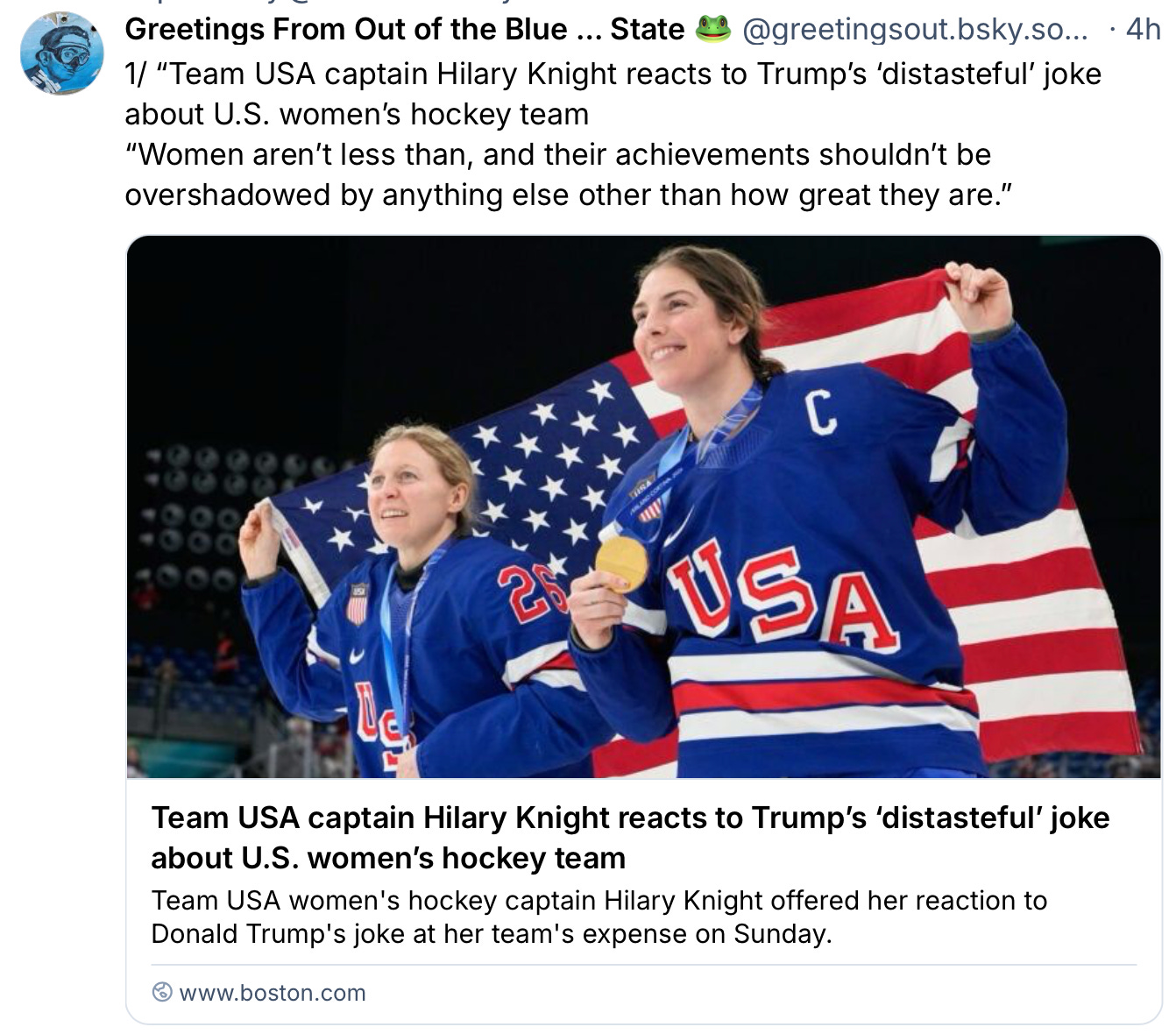
In the US, misogyny is running rampant in the hearts of men…and the women who’ve internalized it.
Most egregiously, the revelations in the Trumpstein (Trump and Epstein) files about the rape of children (boys and girls) uncovers a widespread sex trafficking and abuse ring enabled by coverups, power and money.
The US men’s hockey team laughed at the president’s comments about the women’s team highlighting once again that men are expected to and supported when they demean women. Once again, dismissed as “…just locker room banter.”
While both are appalling, these two misogynistic situations are not the same. This led me to the realization that misogyny is analog not digital. It’s not that we are or are not misogynist. Misogyny exists on a continuum.
That being the case, I’ve begun to think about the various positions on a scale, the question, “How misogynistic are you;” and what the continuum itself and one’s placement on it means in practical terms.
Now, I say “we” and “us” because while it’s true that men’s misogyny is the foundation of the patriarchy - the systems that damage, subjugate, confine and restrict women - women ourselves internalize misogyny. One personal example from just the other day: I found myself surprised that a professional being lauded in a news story - and whose foreign name I didn’t recognize - was a woman!
You might wonder why I’m writing about misogyny when patriarchy is a more familiar term describing the system of social, political, and economic structures that places men at the center of power and authority. Well, misogyny is its fuel. Where patriarchy describes the architecture of inequality, misogyny describes the belief system that builds and maintains it: the deeply held, often unconscious convictions about what women are, what we are worth, and what we deserve. You can’t dismantle the structure without understanding the beliefs holding it up. That is what this continuum attempts to do.
A Continuum of Beliefs

I was motivated to write about this because Kimberley Johnson’s post on Bluesky hit me so hard. It is so obvious that the atrocities by the men of the Trumpstein cabal were only possible because of their belief that women are “less than.” (I couldn’t imagine how “less than!”) And the crimes were enabled by women who drew on their own internalized misogynistic beliefs or colluded with the men.
Here’s what I’ve come up with to illustrate the points on a scale of misogyny. There’s nothing scientific about this. It’s drawn from my lifetime of experiences. The order might not be accurate, but it’s one way to think about why women are treated as we are. NOTE: when I write “Women,” I mean girls, women and anyone presenting as a woman.
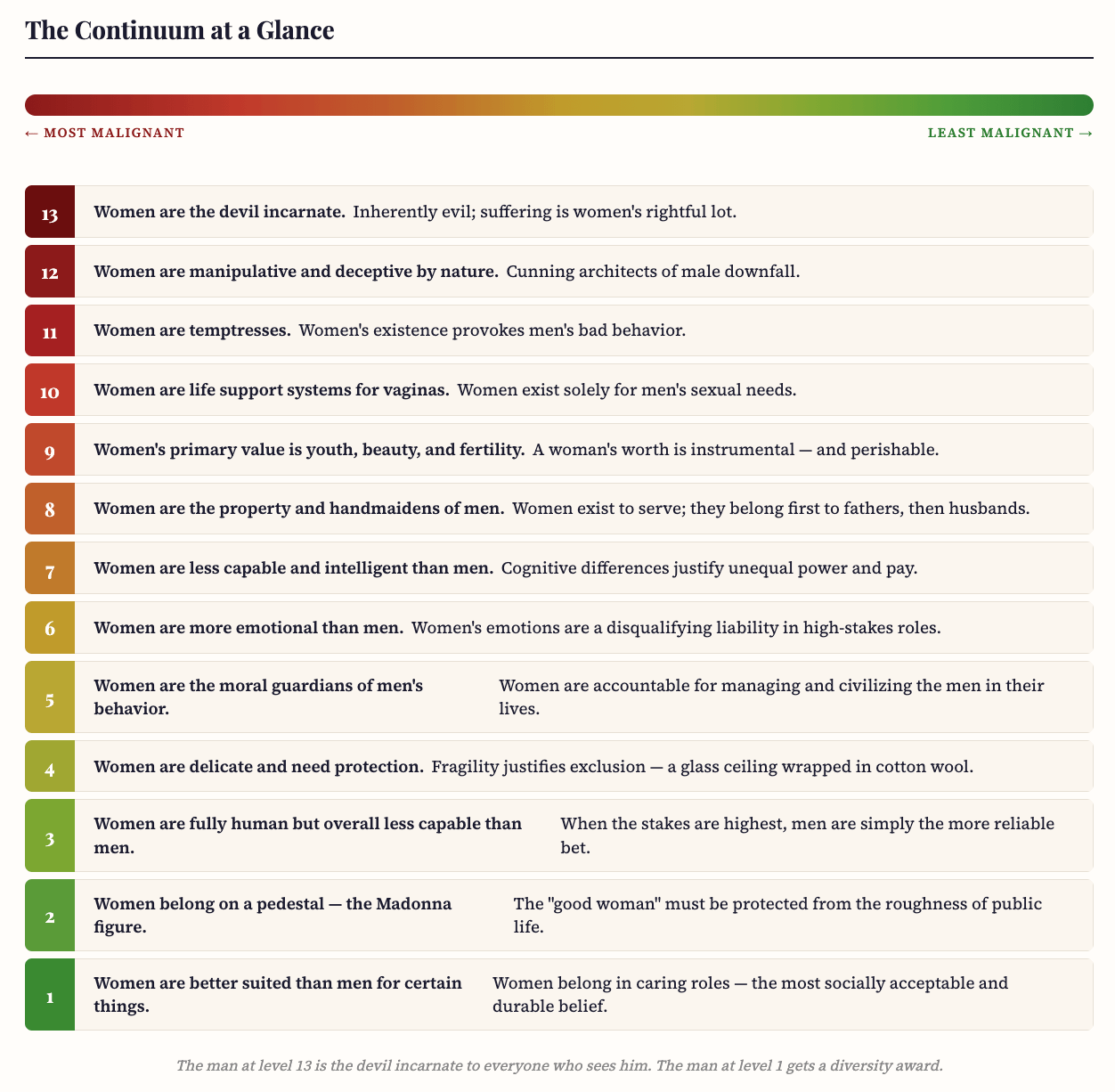
On a scale of 1 - 13, 13 is the most malignant and 1 is the least malignant.
13. Women are the devil incarnate. People at this level believe that women are inherently evil, corrupting forces — the source of mankind’s downfall. Pregnancy is punishment for women’s sins, and suffering is women’s rightful lot. In practice, this belief drives the most extreme forms of religiously-justified brutality: female genital mutilation, honor killings, witch trials (historical and contemporary), the criminalization of miscarriage, and the denial of medical care in obstetric emergencies on the grounds that the woman’s suffering is deserved or divinely ordained.
12.Women are manipulative and deceptive by nature. People at this level believe that women are actively dangerous — cunning architects of male downfall. Think of Eve, Delilah, Jezebel and the femme fatale. Women's intelligence is framed as a weapon rather than an asset. In practice, this is one of the oldest and most toxic beliefs because it reframes men as victims of women rather than perpetrators against them. It fuels the systematic disbelieving of women who report abuse, harassment, or assault — "she's lying," "she has an agenda," "what does she want out of this?" It is the engine behind rape myth acceptance, the vilification of women who speak publicly about powerful men, and the cultural reflex that treats a woman's ambition as scheming while a man's identical behavior is called strategy. It also shows up in the courtroom, where a woman's past, appearance, and motives are routinely put on trial alongside her attacker's.
11. Women are temptresses. People at this level believe that women’s physical existence — their hair, their bodies, their voices — is a provocation that causes men’s bad behavior. Women are responsible for the weakness of men. In practice, this belief is the engine behind dress codes that punish girls for “distracting” male classmates, laws requiring full body covering, the judicial tradition of blaming rape victims for their own assault, and the cultural reflex of asking “what was she wearing?” It also drives institutional tolerance of sexual harassment, framed as an inevitable response to women’s presence.
10. “Women are life support systems for vaginas.” People at this level believe that women exist solely to satisfy men’s sexual needs and appetites. Women have no interior life, desires, or rights that supersede male sexual access. In practice, this belief is the foundation for rape culture, sex trafficking, child marriage, and the normalization of pedophilia. It drives legal systems that historically treated rape within marriage as a contradiction in terms and cultures that punish women for being assaulted while protecting their assailants. It is also the belief quietly operating when pornography depicting violence against women is treated as entertainment rather than harm.
9.Women's primary value is youth, beauty, and fertility. People at this level believe that a woman's worth is not intrinsic but instrumental — and perishable. She is valued for what she produces: attraction, children, aesthetic pleasure. In other words, a woman's entire social currency is tied to her body's capacity to please and reproduce. In practice, this belief has an expiration date built into it, which is what makes it particularly cruel. It drives the workplace ageism directed almost exclusively at women, the cultural obsession with female celebrities' appearance as they age, and the invisibility that many accomplished women describe feeling after fifty regardless of their achievements. It is the belief operating when a woman's professional decline is attributed to her looks fading while a man's equivalent decline is attributed to market forces or bad luck. It also fuels the multi-billion dollar anti-aging industry, which is not merely vanity at work — it is women spending enormous resources to delay the moment when this culture decides they no longer matter.
8. Women are the property and handmaidens of men. People at this level believe that women exist to serve — domestically, sexually, socially — and that this service is the natural order rather than an imposition. Women belong first to their fathers, then to their husbands. In practice, this belief drives coverture laws (historically stripping married women of legal personhood), bride price and dowry systems, the denial of women’s rights to own property or open bank accounts, marital rape exemptions, and the ongoing expectation that women perform the vast majority of unpaid domestic and caregiving labor regardless of their professional contributions.
7. Women are less capable and intelligent than men. People at this level extend some humanity to women but genuinely believe that cognitive differences justify an unequal distribution of power, opportunity, and compensation. They may point to pseudoscientific studies or simply to “common sense.” In practice, this belief drives the systematic underfunding of girls’ education, the devaluing of women’s professional credentials, the pattern of men speaking over and around women in meetings (and being perceived as more authoritative for doing so), the persistent wage gap, and the assumption that a woman in a senior role got there through connection or affirmative action rather than merit.
6. Women are more emotional than men. People at this level acknowledge women’s intelligence but believe that our emotions are a disqualifying liability — that we are ruled by feeling rather than reason and therefore unsuited to high-stakes decision-making. In practice, this belief is weaponized in boardrooms and politics constantly: any woman who expresses passion, frustration, or strong conviction is “hysterical” or “difficult,” while the same intensity in a man reads as leadership. It justifies dismissing women’s pain (medical studies consistently show women’s reported pain is taken less seriously than men’s), disbelieving women’s accounts of their own experiences, and excluding women from negotiations, crisis management, and any role framed as requiring a cool head.
5.Women are the moral guardians of men’s behavior. People at this level believe that women, by virtue of their supposed moral superiority, are responsible for managing, moderating, and civilizing the men in their lives. Women don’t merely influence men — they are accountable for them. When a man behaves badly, the first question is: where was the woman in his life, and why did she fail him? Freudian psychology institutionalized exactly this belief — women’s “failure” to manage male desire and anxiety became a clinical diagnosis rather than simply a personal shortcoming. The damage from that framing is still working its way through our culture. In practice, this belief blames wives for husbands’ infidelity, mothers for sons’ criminality, and holds Hillary Clinton responsible for Bill Clinton’s behavior. In organizations it shows up every time a man “jokes” that he has to behave because there’s a woman in the room — a comment that sounds like a compliment while making her responsible for his conduct. Its insidiousness lies precisely in that embedded compliment: women are cast as morally elevated and indispensable while being handed an impossible responsibility — the lifelong behavioral management of grown men. Like the fragility belief, it is a cage dressed as an honor.
4.Women are delicate and need protection. People at this level believe their restrictions on women are “acts of care.” They don’t deny women’s humanity or intelligence, but use our supposed physical and emotional fragility to justify exclusion. In practice, this belief fuels paternalism, gatekeeping from leadership, exclusion from combat roles, and the assumption that women can’t handle hard feedback, difficult negotiations, or high-stakes environments. It’s a “glass ceiling wrapped in cotton wool” belief. Its insidiousness is that women often internalize it and even appreciate it in the moment.
3. Women are fully human but overall less capable than men. People at this level would never call themselves misogynists. They respect women, have women they admire, perhaps even champion “the right women” for certain roles. But they carry a quiet, default assumption that when the stakes are highest — war rooms, operating theatres, trading floors, corner offices — men are simply the more reliable bet. In practice, this belief drives the “glass ceiling” in its most sophisticated form: the informal networks that exclude women, the performance reviews that praise men for confidence and penalize women for the same behavior, the assumption that a woman with children is less committed while a man with children is more stable, and the reflexive surprise — like your own recent moment of honest self-reflection — when excellence turns out to have a woman’s name attached to it.
2.Women belong on a pedestal — the Madonna figure. People at this level often believe they are honoring women. The "good woman" — pure, self-sacrificing, morally elevated — is to be protected, cherished, and kept safe from the corrupting roughness of public life. This is the velvet-gloved face of misogyny, and its holders are frequently the most difficult to reach because they experience their own beliefs as reverence rather than restriction. In practice, the pedestal is simply a more aesthetically pleasing cage. This belief has historically been used to bar women from voting ("politics is too dirty for women's purity"), from higher education ("their delicate constitutions can't withstand rigorous study"), and from professional life ("why would she want to leave the sacred sphere of home?"). Today it shows up as the discomfort many people feel — including women — when a woman is nakedly ambitious, openly competitive, or simply excellent without also being warm, humble, and grateful. The woman on the pedestal is expected to stay there. The moment she steps off to claim space in the world on her own terms, she becomes, in the eyes of this belief system, something fallen.
1. Women are better suited than men for certain things. People at this level often consider themselves progressive and pro-woman. They celebrate women — enthusiastically, even — in their “natural” domains: nurturing, teaching, caring, detail-oriented operational work. Their misogyny is the most socially acceptable and therefore among the most durable. In practice, this belief creates a velvet-lined box. It keeps women concentrated in lower-paid caring professions, positions the ambition required for leadership as unfeminine, and ensures that when women do break through, they are expected to lead with warmth and service rather than authority. It also drives the “mommy track” — the quiet professional sidelining of women once they become mothers — and the persistent cultural discomfort with women who are simply excellent rather than excellent and warm, approachable, and grateful for the opportunity.
What About Equality/Equity/Egalitarianism?
What about the belief that women and men are equally entitled to be and do anything that we choose? It’s not on the scale because it’s not misogyny. And to be real, very few people both hold and act on this belief. Even I, who have been working toward this my entire life, realize that I’m a work in progress.
Which brings me to another point. There is a second important scale to be created for people who most often find themselves adhering to the belief that women and men are equally entitled to live life as they choose. There’s a difference between holding the belief and acting to manifest it in the world. We need a scale that relates to what we do to create the conditions where all humans live lives they choose.
Better the Devil You Know
It’s important to highlight that the progression from 13 down to 1 (as imperfect as it might be) is actually a movement from active malevolence to what Claude.ai1described as smiling confinement. Or put another way, benevolent confinement.
The man at level 13 is the devil incarnate to everyone who sees him. The man at level 1 gets a diversity award. We recognize the evil of those at the malevolent end - think about what’s happening to girls and women in Afghanistan. But, to our detriment, we may not recognize that the beliefs at the lower end of the scale cause enormous cumulative damage precisely because they are so socially invisible and even celebrated. As a matter of fact, it is at this end of the continuum that we most often find ourselves. We limit our own aspirations and those of others.
I wrote above that the placement isn’t scientific. It was hard deciding where to place some of the beliefs on the continuum precisely because the beliefs are not mutually exclusive. A single person — or institution — can operate from multiple levels simultaneously depending on context. Here’s another personal example, I fully support a woman’s right to choose a career in the military (off the scale as an egalitarian), but I’m not so sanguine about the idea that women might be drafted and sent to the front lines (on the scale at #1).
How does this knowledge protect & empower us?
The first and most powerful thing this framework does is name what is often deliberately kept nameless. Misogyny thrives in vagueness — in the gap between what is done to women and what it is called. When a woman is passed over for promotion, it’s called “culture fit.” When her pain is dismissed, it’s called “patient presentation.” When her ambition makes people uncomfortable, she’s called “a lot.” Naming the belief operating in each situation, placing it on this scale and understanding how it shows up — is itself an act of resistance. You cannot fight what you cannot see.
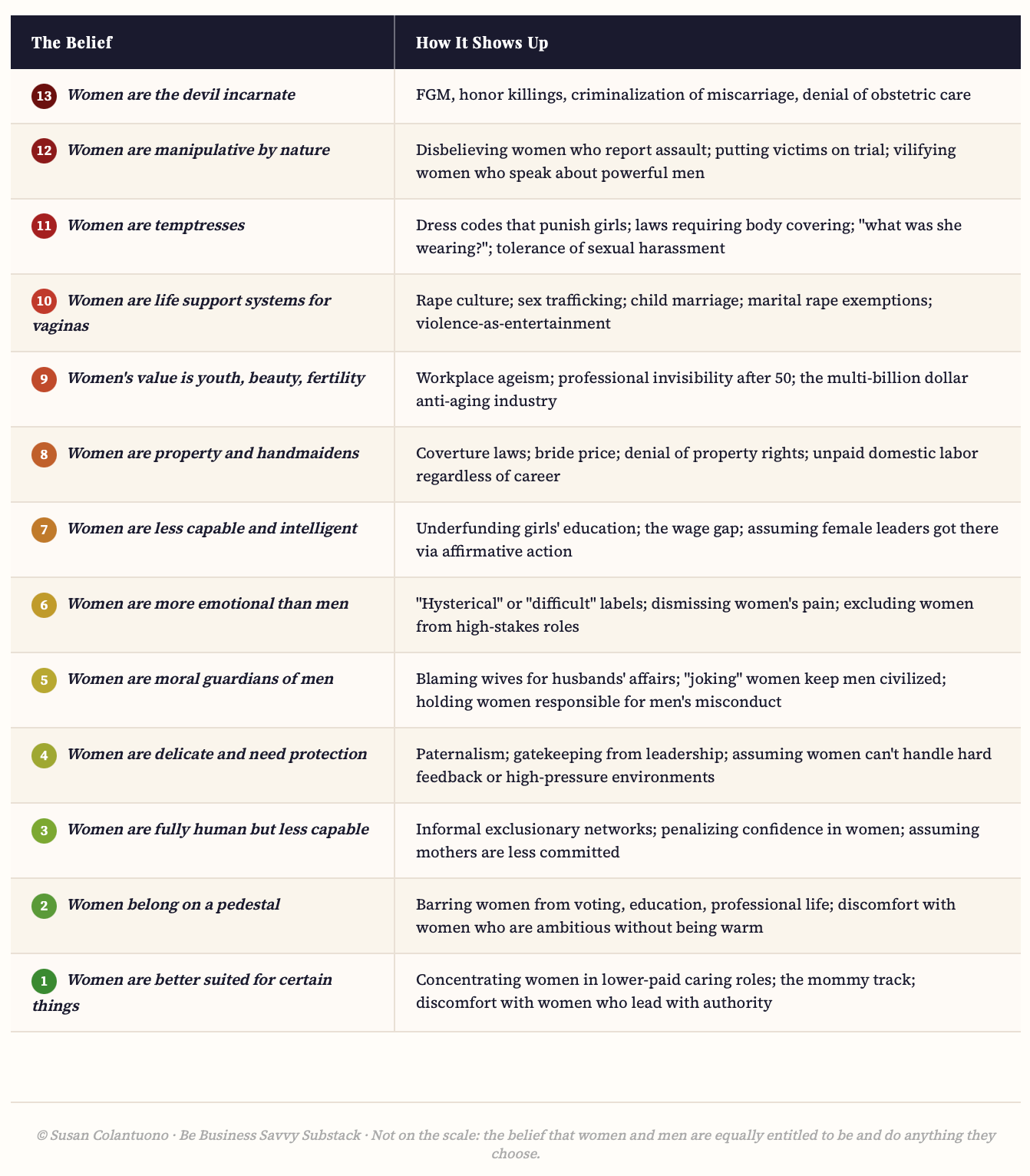
So the first protection is diagnostic clarity. When something happens to you or around you, ask: which belief is driving this? Is this a level 3 (she’s capable but not quite reliable enough for the highest stakes) or a level 1 (she’s wonderful, just not quite leadership material)? Naming it precisely strips it of its camouflage.
The second is strategic response calibration. The continuum matters here in a practical way: the tactics that work against overt malevolence are different from those that work against smiling confinement. Confronting a level 10 or 11 belief head-on in a professional context is unlikely to change minds and may cost you dearly. But the beliefs at levels 1-4 are often genuinely unconscious — in those cases, a well-placed question can do more work than a direct challenge. “What specifically concerns you about her readiness?” forces someone operating from level 3 to articulate something they’ve only felt. Often they can’t, and they know it.
The third protection is building and maintaining community. Isolation is how misogyny consolidates its gains. The women who advance — and who pull others up with them — consistently report the same thing: they had networks of people who named reality with them, who sponsored rather than merely mentored, and who created the conditions for one another’s success. This is not a soft suggestion. It is structural. The informal networks that exclude women are the primary mechanism of the glass ceiling at levels 2-4. The answer to an exclusionary network is an inclusive one, built with deliberate intention.
The fourth is protecting your own internal scale. Every woman reading this has absorbed some of these beliefs — about herself and about other women. The most insidious damage misogyny does is internal: it gets us to do its work for it. The woman who doesn’t negotiate because she doesn’t want to seem aggressive. The woman who undercuts another woman’s credibility before a man can. The woman who is surprised when excellence has a woman’s name. Regular honest self-examination — the kind you modeled in this very piece — is not self-flagellation. It is maintenance.
Truth Out

The other day, Allison Gill (the amazing @muellershewrote)2 posted on Bluesky that she’s thinking beyond a quest for equality and toward a quest for revenge. I concur.
In just 14 months, the war on women in the US has erased five and a half decades of progress towards equality3. These are not random or unrelated attacks. They are the direct policy consequences of the beliefs you've just read about. They are what the continuum looks like when it holds political power.
States continue to restrict the right to abortion care - and women are dying from ectopic pregnancies and arrested and imprisoned for miscarriages.
We are at risk of losing access to birth control. Just this week hearings were held on the influencer nominee to the position of Surgeon General. She is anti-birth control. NOTE: Access to birth control was cited years ago by the Federal Reserve Bank of Boston as one of the most important factors in women’s participation in the US economy.
Proposed nation-wide voting legislation (SAVE act) will disenfranchise women who’ve taken their husbands’ names.
Diversity, equity and inclusion (DEI) initiatives in organizations have largely ended under threat of loss of government contracts.
The US Office of Civil Rights is shuttered - we have no recourse to sue for discrimination.
Protections for students in sexual misconduct cases have been reduced.
Teaching about gender inequality has been restricted (I guess the history of the Suffragettes is now not to be taught)
Funding for Violence Against Women initiatives has been cut 30%
and the disenfranchisement and discrimination goes on.
All of these actions and the misogynistic beliefs behind them will now and in the future be restricting career opportunities for women. We can’t be blind to this. We must take actions as, where and when we can.
Show Up
Finally, and most urgently given today’s landscape, civic and collective action is not optional. Individual clarity and community are necessary but not sufficient when the losses are structural and legislative. The right to sue for discrimination, access to birth control, protection from sexual misconduct — these are not abstract. They are the real-world consequences of beliefs along the continuum. Knowing where someone sits on the misogyny continuum matters most when there are systems in place to constrain what that belief can do. When those systems are dismantled, the belief becomes policy.
That is where we are. And that requires showing up — in elections, in courtrooms when they’re still open, in school boards, in corporate governance, and in the public conversation this piece is entering.

I’m Susan Colantuono, best known for my TED Talk, “The Career Advice You Probably Didn’t Get.”
I’ve devoted most of my working life to supporting the career advancement of women.
Now my work is exclusively focused on offering women tools for developing and demonstrating Business Savvy - the business, financial and strategic acumen we need to succeed and to close The Missing 33% of the career success equation for women.
That includes offering my groundbreaking course in a self-paced version (with coaching support) right here at Be Business Savvy. Check it out!
You will find additional useful and actionable content in my books and other online resources:
No Ceiling, No Walls ebook
No Ceiling, No Walls soft cover
Make the Most of Mentoring soft cover
Coaching Executive Women (occasional) newsletter
Lead ON!
Susan
Because I’m not a researcher on misogyny, only a victim/survivor of it, I worked with Claude.ai to refine my original draft.
Allison Gill is the creator of The Daily Beans, Clean Up on Aisle 45 and the Unjustified podcasts. Also the BeansTalk and The Breakdown vlogs/pods. I highly recommend them all. The Breakdown | Allison Gill, Mueller, She Wrote (@muellershewrote.com) — Bluesky, MSW & The Daily Beans Podcast (@muellershewrote) - Instagram, MSW Media - YouTube
https://now.org/wp-content/uploads/2025/04/APPROVED-PENDING-PUBLICATION-Trump-Fact-Sheet-April-22.pdf