
Fashion Has Never Been About YOU!
Knowing This Makes Everything Easier"

The confidence you carry into a room starts before you arrive - and an entire industry has spent a century quietly working against it.
I’ve stood in more fitting rooms than I can count, clicked “return” on more online orders than I’d like to admit, and stared in the mirror at something that looked nothing like it did on the hanger - or the model - and had exactly one thought: what is wrong with me?
And then there’s the other version. It looks great on the rack. It looks awful in the fitting room. But the saleswoman says, “that looks great on you” and I’m so eager for someone to tell me I’ve got it right that I buy it anyway. It hangs in my closet, unworn, because every time I put it on I feel like my worst self, not my best.
Nothing is wrong with me. Nothing is wrong with you either. I do have a best self - and so do you. But it’s taken me a long time to understand why we keep asking the question and feeling the feeling, and who benefits from that.
We also know the other side of this. Those moments when the clothes we don, like magic, give us the greatness boost we need to face the world. We may not always know what it is about the clothes, but there are likely common elements that work - and those that don’t. We’ll get to that.
This isn’t my usual territory at Be Business Savvy. But Personal Greatness - showing up as your best self, with confidence you didn’t have to manufacture - is very much my territory. And something has been undermining that for women for over a century. It’s time to name it.
This isn’t about “dress for success.” It’s not “dress to impress” or “dress for the job you want.” It’s not even about dressing to look slimmer or taller. It’s about something simpler and more powerful than any of that: when we love who we see in the mirror, the world beyond it is easier to navigate.
The ideal has never been stable - because it was never about you
If the fashionista’s ideal body shape were based on real women, it would stay consistent. It doesn’t.
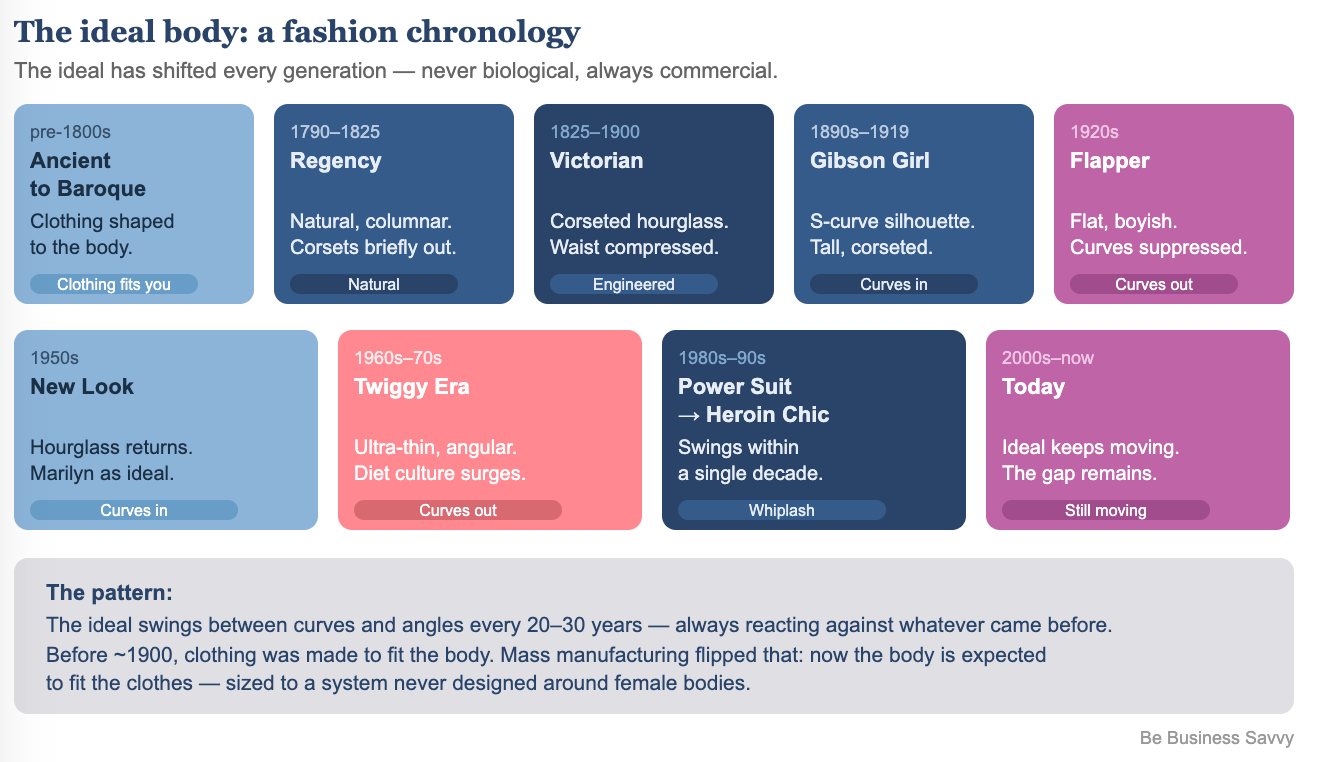
The Gibson Girl of 1900 gave way to the flat-chested flapper of the 1920s. The 1950s celebrated Marilyn Monroe’s curves; the 1960s installed Twiggy as the standard. The 1980s brought the athletic, broad-shouldered power silhouette; the 1990s replaced it with heroin chic. Each era defined the ideal as a rejection of whatever came before.
Fashion dictates beauty, then changes its mind the moment a new season needs something to sell.
The closed loop
Here’s the mechanism that makes it work against you.
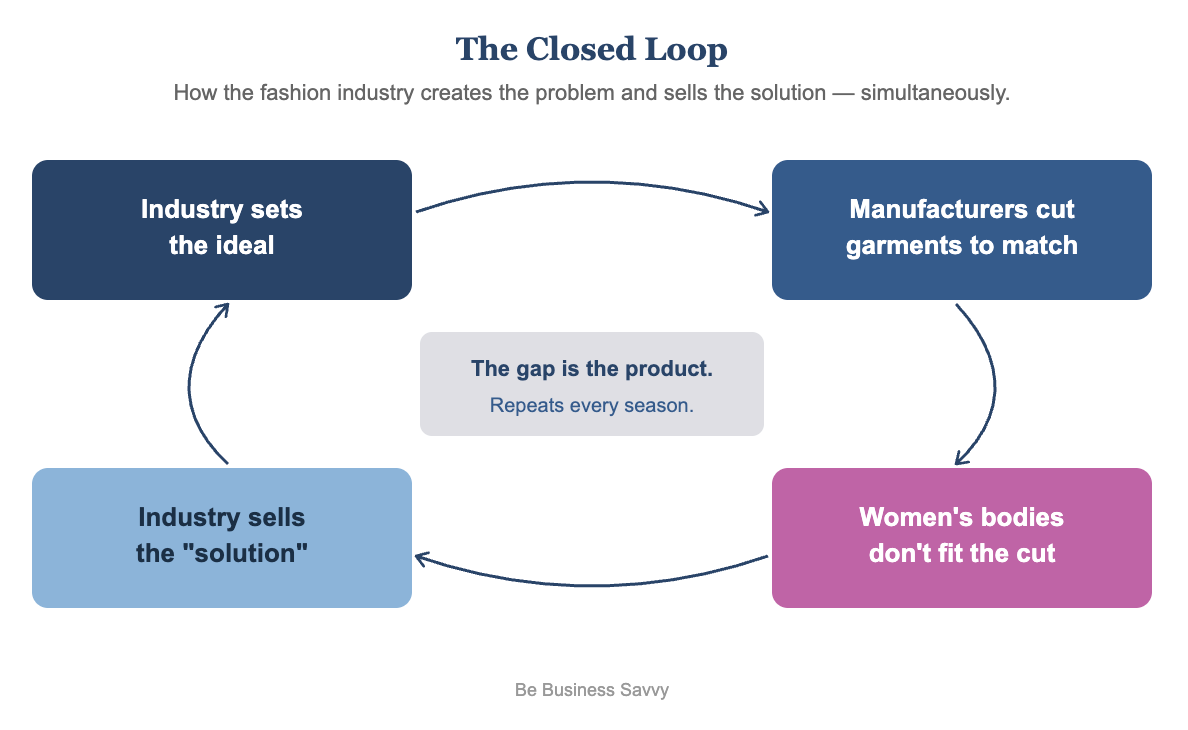
The industry sets the ideal. Manufacturers cut their garments to reflect it. When our bodies don’t match the current ideal, clothes just don’t fit. Not because our bodies are wrong, but because the manufacturing decision was made without us. Then the industry offers the solution: shapewear, “flattering” cuts, the vocabulary of “minimizing” and “camouflaging.”
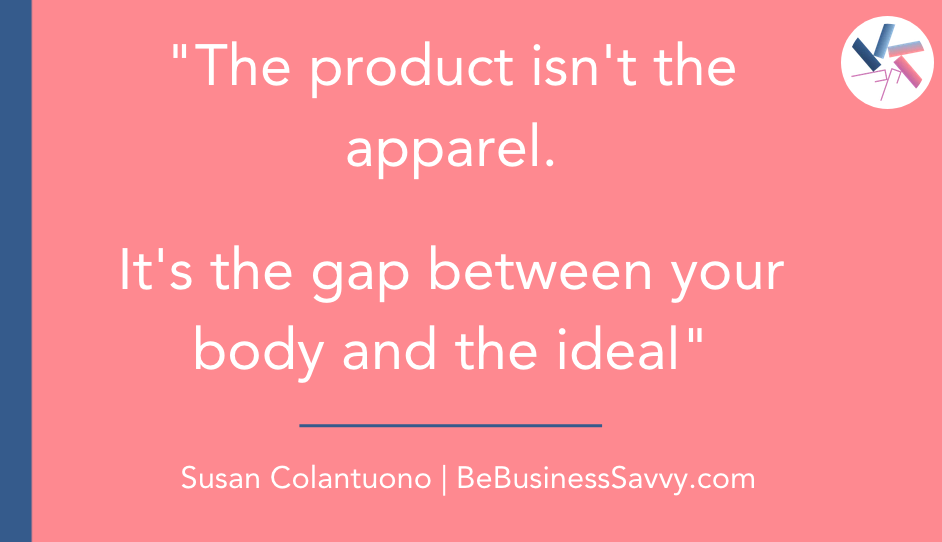
The product isn’t the apparel, it’s the gap between your body and the ideal. The industry creates it and sells the answer to it simultaneously.
And that word “flattering” - it sounds like a compliment. It isn’t. Flattering means “this will make you look more like the current ideal.” It’s the industry’s most polite way of telling you that you, as you are, need correcting.
Popular media has noticed the shifting ideal - there are chronologies, videos and academic studies. But none of them make this connection. None of them link the shifting ideal to the gap women actually live with at the rack. The reason isn’t hard to find: they don’t dare critique the industry that pays them through advertising. Be Business Savvy has no such constraint.
Why this matters at work
When you walk into a room - a meeting, a presentation, a performance review conversation - how you feel in your body is a leadership variable. Not vanity. Not distraction. A real factor in how much of your attention is available for the work, and how much confidence you’re leading with versus how much is spent wonderng, “How do I look?”
The fashion industry has been making that harder, not easier. For a century, it has been building a system designed to make you feel like you are the problem to solve.
You’re not the problem.
What’s a Woman to Do?
Stop using the word “flattering” as a compliment -- to yourself or others. Notice what it’s actually saying.
When something doesn’t fit, name what it is: a manufacturing decision, not a body failure.
Start from your actual form - not the season’s ideal. Dress to feel like yourself, not to approximate someone else’s standard.
Stay tuned. There’s a different framework coming -- one that starts exactly where you are.
Speaking of staying tuned, this is also Part 1 of the Personal Greatness series.
You’ve spent years trying to make yourself fit a system that was never designed to fit you. That ends here.
I’m working on an app that starts from a completely different premise: your form, named and honored, with style guidance built around who you actually are.
Last call: Be Business Savvy pricing moves to $8/month and $80/year on July 1st. If you’ve been thinking about subscribing, now is a good moment.
Lead ON!
Susan

You are not the problem. You are working inside a system that withheld something from you. I’m not here to change the system. I’m here offer you what it can’t or won’t.
If you’re ready for the business, financial and strategic acumen it never gave you, the Be Business Savvy Course is where you get it. Self-paced, coaching-supported, no finance background required.
I welcome your next step:
❤️ Like, share or restack this post - it’s the best way to help other women find it
📘 Explore the Be Business Savvy Course
Susan