
Does the Workplace Toolbox (including AI) Fit Your Mind?
When work feels like a pinch, don't wait to exhale. Add different tools.

The workplace tools that you use every day may have been built for a mind that doesn’t work like yours - and that is a very big thing
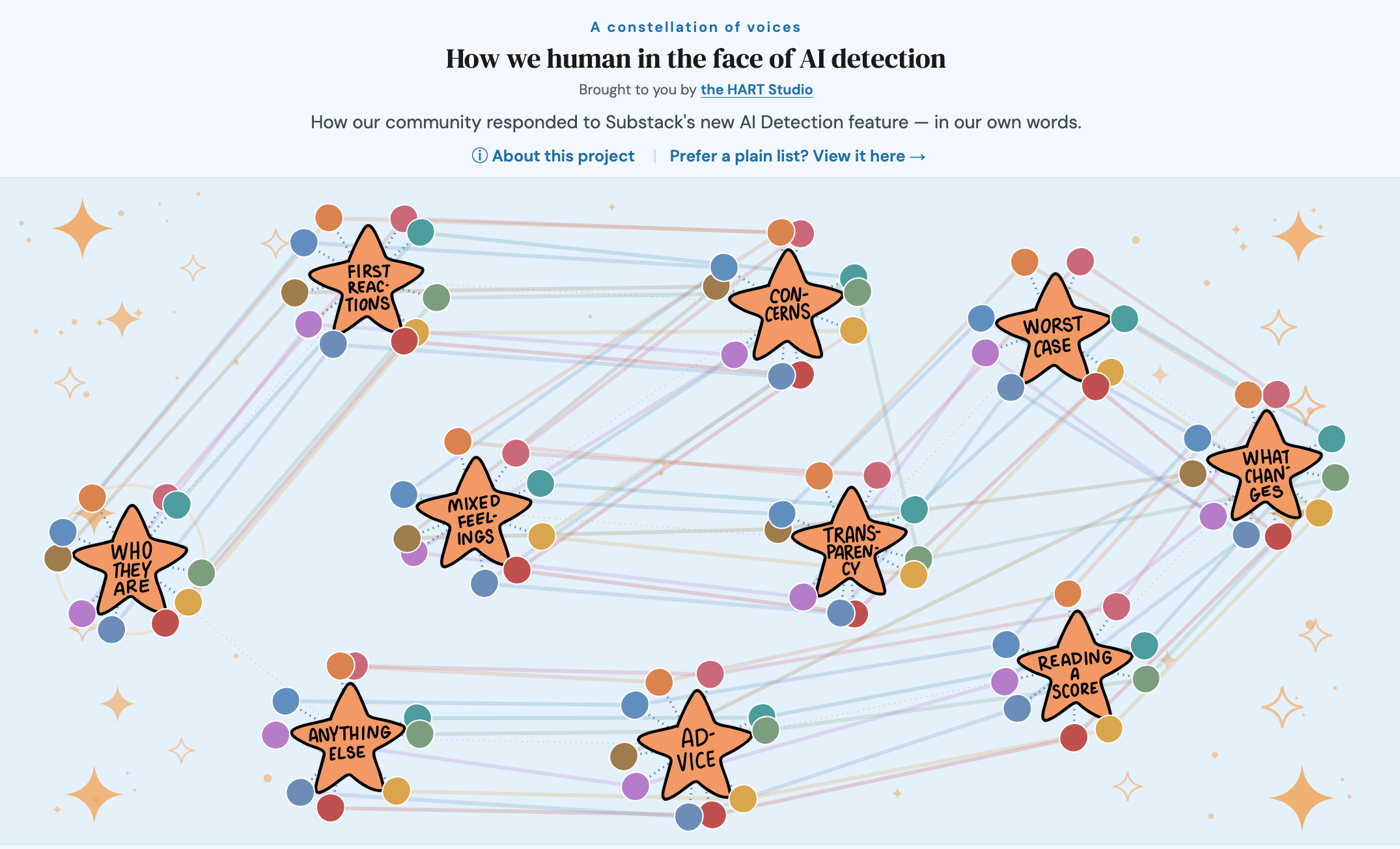
Does this image lift your spirits or scramble your brain?
Your answer just told you something important about how your mind works.
If you felt a little rush of recognition - the web of connections, the clusters, the way meaning lives in the relationships between things rather than in a list - keep reading. This one’s for you.
If it made you long for list, spreadsheet or a hierarchy of relationships instead, that’s equally useful information. There’s a link for that too. And you might still find something here worth sitting with.
(Find more info about HART Studio/Alyssa Fu Ward’s constellation and the problem it solved at the end of the article.)
Last Sunday morning I was hand-grazing my mare Bella. Phone in my pocket, Claude in my ear, thoughts tumbling out the way thoughts do when your hands are occupied and your inner editor is off duty.
We started with a question about how my mind works. We ended somewhere I never expected - with insight into why the tools we work every day might feel like struggling into too tight jeans.
The conversation itself answered the first question. My mind doesn’t move in a straight line. It follows what’s interesting, circling back, making connections the straight path would have missed.
If yours does too, this one’s for you.
Do you ever feel like you’re forced to perform in a linear system that doesn’t fit your relational mind?
You’re in a meeting and someone says keep it brief, strip the context, just give us the facts. So you do. And you walk out feeling like you handed them a skeleton when you had a whole living thing to offer.
Or you open your laptop to start a project and the first thing the system asks is to create a folder. Name it. File things inside it. And you sit there knowing the thing you’re working on doesn’t live in a folder, it lives in a web of relationships between ideas that don’t have names yet.
Or someone asks for an outline before you’ve done any thinking. And you want to say: the outline is what I build from what I created. It can’t come first.
You’re not alone, you’re not the problem and these are not productivity failures. They are ergonomic mismatches. The tools were built for a different kind of mind.
Here’s what the research says — briefly, because you already know this in your body.
Women’s brains show meaningful differences in what researchers call the default mode network — the system involved in making connections, generating ideas and thinking across domains simultaneously. Not better or worse. Differently wired. Which means tools built without that wiring in mind will always feel like the wrong size shoes. They pinch and aggravate.1
Two tools in my own career gave me something beyond useful — they gave me a visceral exhale because they fit. A mind map that can map relationships between ideas. And a sociogram that maps relationships between people. Neither a list. Both a web. The first time I saw each one I recognized my own thinking looking back at me.
There are dedicated mind mapping tools available today — MindMeister, Ayoa, XMind. I had never heard of any of them until I went looking. I assumed they didn’t exist because the linear-thinking based tools are thrust in my face every minute of every day.
That invisibility is not an accident. It’s a story — and it belongs in a follow-on piece of its own.
Have you ever wondered why so few women are shaping the automated and AI world engulfing us?
You might feel it as a vague alienation. Or as a damning indictment. The tech world being built around you doesn’t seem to be built for you.
It isn’t. The reasons are many - and you’ve met my articles and book about several here. There’s another one that gets too little attention
In the 1960s, women made up between 30 and 50 percent of computer programmers. By the early 1980s, 37 percent of computer science graduates were women. Then it reversed. By 2010 that share had been cut in half - and has never recovered.
The story you’ve heard is about marketing - personal computers sold to boys, the nerd stereotype and cultural narrative. All true. And there’s an angle that hasn’t been explored to the same depth - I suggest because it’s a critique of the professions that are doing the examination.
As computing professionalized, it moved from inside companies into engineering departments. Taught by male engineers who brought not only their linear thinking but also their gender biases. Researchers confirm this shift happened but the implications have never been fully explored. My experience indicates that the engineering frame didn’t just change who was allowed into and succeeded in the programs. It changed whose mind was treated as the standard.
If you’re one of the women who fought her way through that environment, you know what I’m talking about. And if you aren’t, ask anyone you know who was.
The women who thrived in early computing weren’t thinking like engineers. They were thinking like problem solvers, relationship builders, context holders. Grace Hopper’s entire genius was connecting abstract theory to real-world problem solving - bridging the machine and the human. She believed most problems have more than one solution. 2That’s not engineering dogma. That’s a relational mind at work.
I wonder and invite you to imagine, what if computing had never been framed as an engineering challenge? What if it had been housed in communications, design, social systems. Somewhere the question was not can you think like a machine, but what human problem are we solving?
That framing would have welcomed the relational mind. I hypothesize today’s world would be the better for it.
When work feels like a pinch, don’t wait to exhale. Add different tools.
What gets built reflects who builds it. What’s lost reflects who isn’t in the room.
Consider AI. Underneath, it works through associative pattern matching - more like a relational mind than a Gantt chart. But it’s delivered through a linear interface. One message, then the next. No branching, no simultaneous threads held open.
Deeper still, it was trained on text and text is linear by nature. Words follow words. Sentences follow sentences.
AI is a relational mind in a linear house, built on a linear foundation and served up through a linear interface. Most commonly prompt → output.
And yet, talk to text changes something. You don’t have to organize before you speak. You don’t have to type. You can think out loud, follow the tangent, circle back. As one user put it recently and as La Claude and I can attest: you say the complexity of what you actually mean before your inner editor cleans it up.
The inner editor is the linear gatekeeper. Talk to text removes it.
This article began exactly that way. I walked alongside Bella, thoughts tumbling out unedited and unoutlined. The hypothesis about engineering schools selecting out the relational mind came from that twisting and turning talk-to-text conversation.
None of it was outlined first.
If you identify with the relational mind, organizations, their tools and the rooms where decisions are made were all built without you. Nevertheless, here you are. Thinking in webs. Making connections the straight path misses. Succeeding in a system that was never intended to fit. In fact, one that is barely aware that there is a different way.
Your success is a reflection of your ability to broaden your skill sets. The builders should be required to broaden theirs as well.
What’s a Woman to Do?
Notice the mismatch. When a tool frustrates you, ask whether it’s a skill gap or an ergonomic one. Often it’s the latter. Offload the sense that you’re the problem.
Try one tool from the relational toolkit (see related article). Mind mapping software costs nothing to explore. A whiteboard and sticky notes costs even less.
Use talk-to-text for your next complex thinking task. Go for a walk. Let the inner editor go quiet. See what comes out.
Share this with a woman you know who’s being told she needs to get more organized. She’s not disorganized. She is working in the wrong toolbox.
About the constellation. Alyssa Fu Ward, PhD, one of the women I subscribe to on Substack wrote a brilliant article (link below) in which among other things she described her struggle to report rich data she received from 10 writers answering 9 Qs.
Her solution is a perfect example of a relational mind at work and I’m honored and delighted to bring it to you.

Lead ON!
Susan

If you’re following all the advice and it still feels like something’s in the way, I’m telling you, you are not the problem. You are working inside a system that’s withholding something from you. And now AI is making it permanent.
I’m here to offer what that system and embedded AI won’t and can’t: the business, financial and strategic acumen that keeps you visible and opens doors. I do that through the complete 6-part ecosystem that is being built for you here.
❤️ Please like, share or restack this post — it’s the best way to help other women find it
📘 Explore the ecosystem:
Your Business Savvy Coach - the only AI tool that coaches you on developing and demonstrating your business savvy as you engage with it on projects, pitches and priorities. Its Coaching Integrity layer guards against the embedded bias that generic AI tools carry in unchecked.
Built Without You: How AI is Hardening the Glass Ceiling and What to Do About It
The AI Intercept Pack - tool for working efficiently with AI while guarding against its embedded biases. (coming soon)
They Never Told You There Was a Horse in the Barn: The Business Savvy They Never Taught You. Why It Changes How You Work and How Far You Go
Be Business Savvy Course - self-paced, online course equipping you with the business, financial and strategic acumen skills you need to succeed and outrun the ways AI is hardening the glass ceiling.
Be Business Savvy articles here on Substack.
Ryali, S., Zhang, Y., de Los Angeles, C., Supekar, K. & Menon, V. (2024). Deep learning models reveal replicable, generalizable, and behaviorally relevant sex differences in human functional brain organization. Proceedings of the National Academy of Sciences, 121(9), e2310012121. https://doi.org/10.1073/pnas.2310012121
American Philosophical Society; MIT Press; Encyclopedia.com — Grace Hopper biographies.