
Do You Invest in Everyone's Development But Yours?
Your not alone.

I’ve been watching this pattern for twenty years and I still find it startling.
The woman who pays for her kids’ tutoring without blinking. Who organizes a team lunch to celebrate a colleague’s promotion. Who forwards every professional development opportunity she finds to someone else who might benefit — and quietly archives the ones meant for her.
She’s not careless about her career. She thinks about it strategically. She just doesn’t spend money on it. Not her own money, anyway.
I want to talk about why — because understanding it is the first step to doing something about it.
A Budget that Exists for Everyone Else
There’s a version of this that’s purely logistical. Many organizations have professional development budgets, but they’re unevenly distributed, require manager approval, or feel like a limited resource that shouldn’t be “wasted” on the wrong thing.
Women — who are more likely to be evaluated on likability and less likely to feel entitled to advocate loudly for themselves — often self-select out of that process before anyone tells them no. I found myself stuck in this mindset for years - to the detriment of my career.
But the pattern I see most often isn’t about organizational budgets or lack of self-advocacy. It’s about a personal dynamic.
When we reach into our own wallets for professional development, something different happens. The money feels more real. The justification feels harder to make. And beneath that is a belief, rarely spoken aloud, that I should be able to figure this out on my own — that paying to develop a professional skill is an admission I don’t already have it.
That’s the trap. And it’s one that men, in my experience, fall into far less often.
An Irony Hiding in Plain Sight
Here’s what I’ve found in my research and in years of working on myself and with women in organizations: the very qualities that hold women back from investing in our own development are the ones that leadership development is designed to address.
The confidence gap. The tendency to self-silence in strategic conversations. The discomfort with financial and business-level discussions that gets quietly labeled as “not being a numbers person.” The sense that if you haven’t mastered something already, maybe it’s not really your territory.
These aren’t character flaws. They’re entirely predictable outcomes of working in systems that have, for decades, sent women mixed signals about where we belong and what we’re worth.
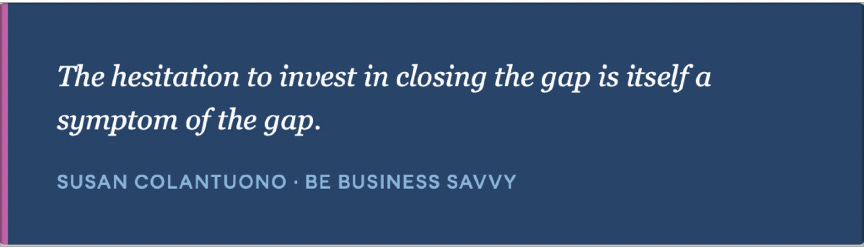
But they create a painful irony: the hesitation to invest in closing a gap is itself a symptom of the gap.
The Change When Treating Development Like a Business Decision
The shift I’ve seen — in myself and in the women I’ve worked with — happens when professional development stops being a luxury purchase and starts being treated like any other sound investment.
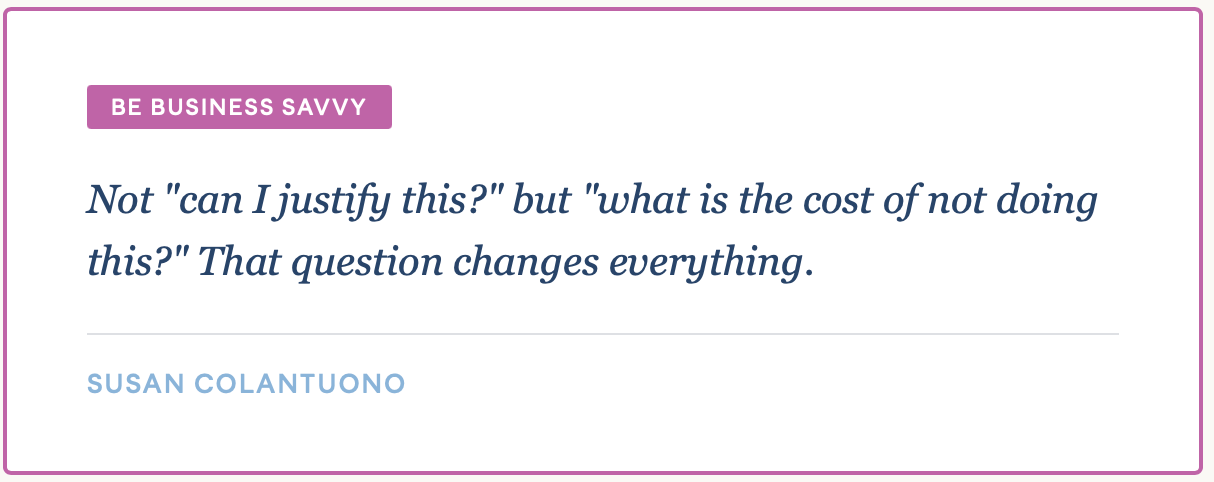
Not “can I justify this?” but “what is the cost of not doing this?”
One missed promotion cycle?
One year of watching a less-qualified peer get tapped for the project that could have changed my trajectory?
One more budget conversation where I let someone else own the numbers?
When we start doing that math, the calculation quickly changes.
I’ve made this calculation myself and benefited in ways I never imagined. I’ve watched other women do the same — in coaching sessions, in workshops, in quiet moments at the end of a conversation when something finally clicks. The shift isn’t dramatic. It doesn’t announce itself. It looks like a woman deciding, maybe for the first time, that her own advancement is worth treating as seriously as everyone else’s. And for all its subtlety, it’s life changing!
If this resonates, the work of Be Business Savvy is built around exactly this gap — and what to do about it.
Start anywhere in the archive, or begin with the TEDTalk that brought my research to the world.
What I’m NOT Saying
This is not an argument that women need to be fixed.
It isn’t a suggestion that individual investment is a substitute for organizations doing the structural work they need to do. They absolutely MUST.
But I’ve also spent too long watching talented women wait for someone to invest in them — and lose years of momentum in the process.
You can believe the system needs to change and decide not to wait for it.
In fact, the women I’ve watched advance most effectively almost always do both.

If this sparked something for you...
You’re reading Be Business Savvy — where women get the tools to develop and demonstrate the business, financial, and strategic acumen that turn “she’s great at her job” into “she’s ready for more.”
It’s what I call The Missing 33% of the career success equation — the subject of my TED Talk watched by millions.
I welcome your next step:
❤️ Like or restack this post — it’s the best way to help other women find it
📘 Go deeper:
No Ceiling, No Walls (ebook)
No Ceiling, No Walls (softcover)
Make the Most of Mentoring (softcover)
Make the Most of Mentoring (ebook)
Be Business Savvy Course — self-paced, with coaching support
Coaching Executive Women (occasional) (newsletter)
Lead ON!
Susan