
Your Turn: What's Been Opening Doors for You? What Hasn't?
Thanks to Michelle Redfern for her frequent acknowledgement of how privilege shapes her perspectives and work

The advantages and disadvantages we are born with shape our trajectories in a system that was built without us. Seeing that clearly can help you plan your next move.
My brilliant colleague Michelle Redfern does something I’ve admired for years. When she speaks, writes or leads a program, she acknowledges the privilege from which she does her work.
Every single time I see her do it, something in me resonates because I hold that same awareness internally. I just haven’t never named mine out loud.
Until today.
This morning I started cataloging mine because I know it shapes how I show up for you. And because I’ve spent decades helping women see the system clearly and seeing the system clearly has to include seeing ourselves clearly first.
Here’s my audit. I’m sharing it as an invitation to build yours.
SECTION 1: Circumstances of birth and upbringing
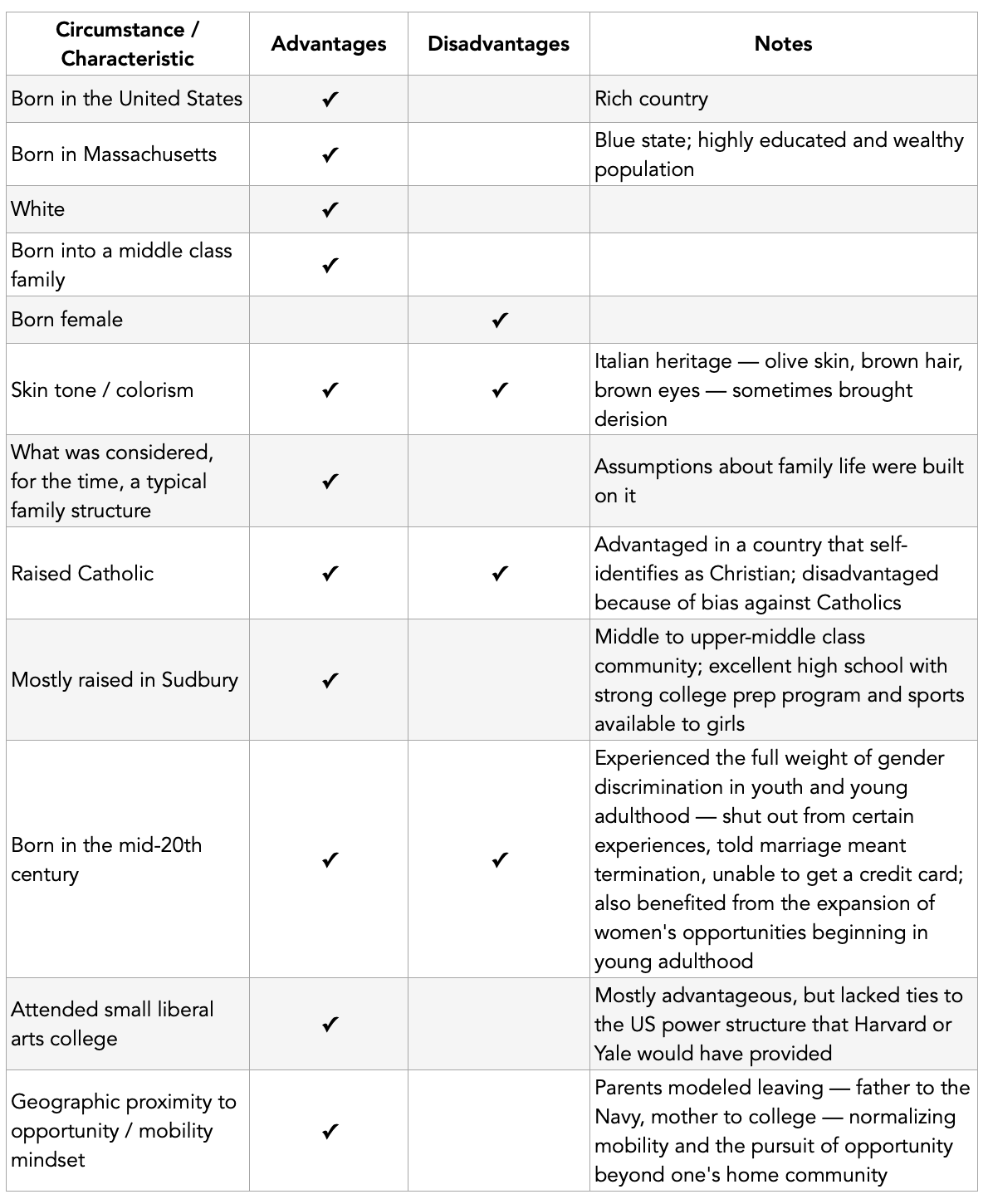
All of these carry forth. In addition:
SECTION 2: Characteristics that shaped both early life and work
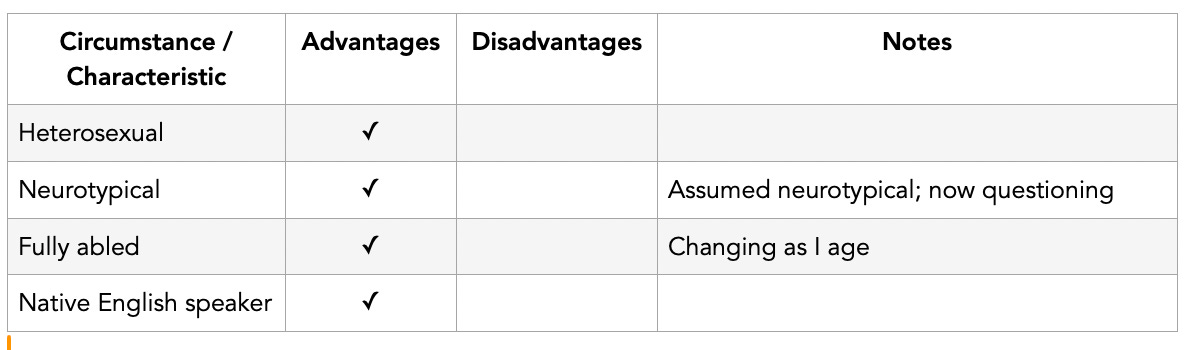
Again, all of the above carry forward.
SECTION 3: Career and adult life
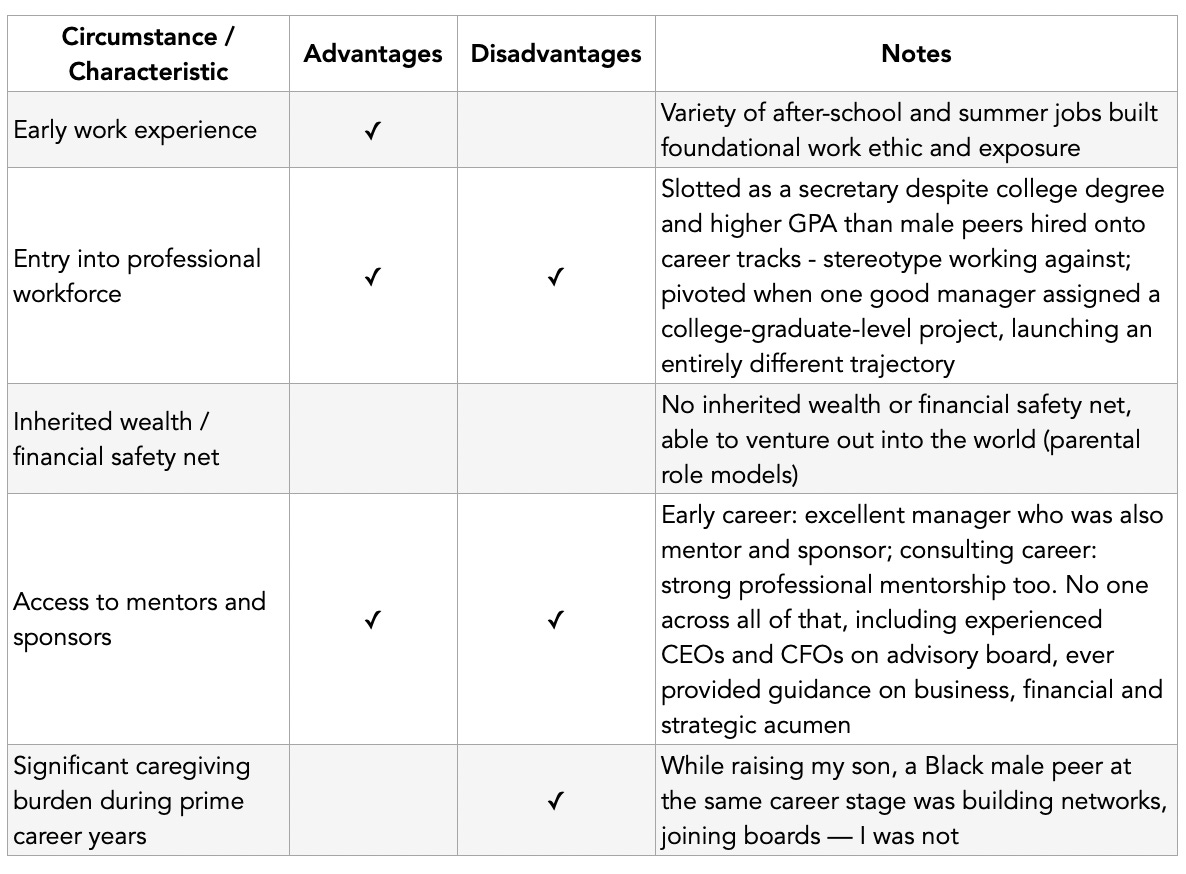
Privilege and disadvantage contain layers. Some of what shapes us opens doors. Some of it is closing them. And some do both simultaneously, depending on the room we’re in.
A table full of advantages won’t protect you from a system designed to withhold something specific. In my case, that something was business, financial and strategic acumen. The mentors were there. The sponsors were there. The smart manager who pivoted my career from secretary to business analyst was there. But not one of them - not my mentors, not my sponsor, not even the CEOs and CFOs who sat on my advisory board - ever handed me that.
A table full of apparent disadvantages doesn’t mean there won’t be a special advocate who recognizes your talent, encourages you and helps lift you to your destiny. I can think of hundreds of people whose disadvantages made the journey difficult and still managed to prevail.
One good person is not a remedy for a bad system.
And a bad system can be thwarted by your talent and those who see it.
I encourage you to build your own table, going section by section and thinking honestly about what helped and what didn’t. Add factors that I may be blind to.
Then consider the question that matters: what’s my next move?
For some of us that’s finding the advocate who sees us. For others it’s filling the specific gap the system has been withholding.
For all of us it starts with seeing the whole picture.
Lead ON!
Susan
PS Comments are open and I’d love to hear from you.