
Why You Need a Slice of PIE
Celebrate National Mentoring Day with PIE Mentoring


PIE Mentoring equips you with an understanding of the Performance of the business (among other things). Here’s why that matters and 10 questions that will help you get PIE Mentoring.
For decades, women have been told to get a mentor (and/or a sponsor, but that’s for another post). You’ve probably heard that yourself.
What you might not realize (and can see from the illustration below) is that advice to “get a mentor” first appeared in books in the mid to late-1970s – the time when women first began entering the workforce with the expectation of building careers.
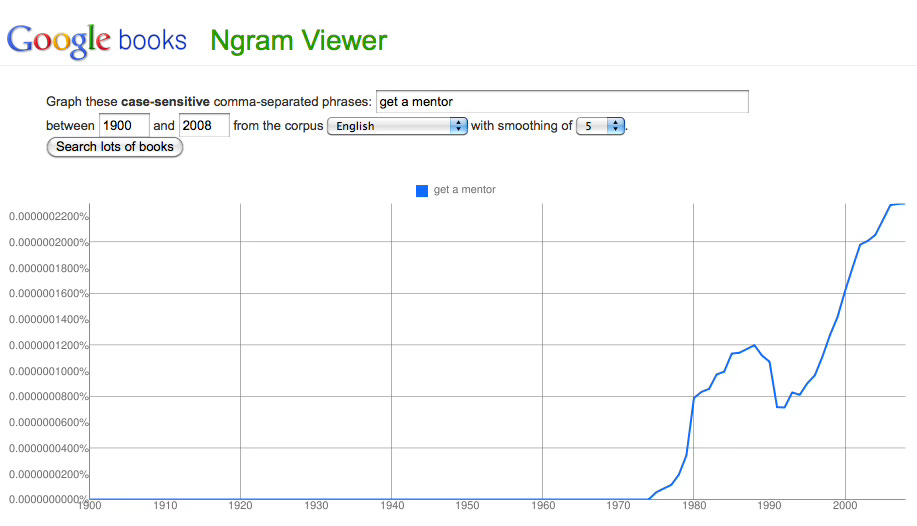
This is when the relationship between having a mentor and advancing in a career was first noted. People researching career advancement noted that successful men reported having had mentors. Women didn’t have mentors. Therefore, the advice to women was, “in order to get ahead, get a mentor.” This advice created fertile ground for action.
Programs Proliferate in the 1980s
In response, progressive organizations created formal mentoring programs as one strategy to help women (and other underrepresented groups) advance into senior positions. An Ngram search on the phrase “mentoring program” will show that it first appeared in books in the early 1980s. Decades later, the World Economic Forum reports that 59% of the companies it surveyed have formal mentoring and networking programs.
Your organization might have (or have had) such a program, and unless you work for one of the exceptional companies with women proportionately represented at all levels of management, you might look around and ask this question, “If we have such a progressive formal mentoring program, why are there still so few of us at the top?”
Programs Designers Weren’t Informally Mentored
Most of the professionals (including myself) who were tasked to develop formal mentoring programs were never informally mentored. We looked at men’s mentoring relationships from the outside and without the perspective of the importance of having Business Savvy. Mentors looked like trusted confidantes that build confidence, help develop skills and guide the steps in a protégé’s career.
What we couldn’t easily see was that men with mentors advanced not simply because they had mentors, but more importantly because of what they were mentored on. Through conversations about the business, experiences (e.g. opportunities to attend industry events, meet key clients, etc.) and coaching to take positions in the heart of the business, men were (and are) mentored on Business Savvy.
As a result much of the advice developed for formal mentoring programs focused on what we could see or surmise: the phases of mentoring, building a trusting relationship and the etiquette of mentoring. It did not focus on replicating what the protégé did to earn informal mentoring or on the substance of the mentoring relationship.
That’s why today there is so much useful information available on the steps in a mentoring relationship, the characteristics of a mentoring agreement, dos and don’ts of mentoring and the like. That’s also why there has been so little written about how to use the mentoring relationship to gain business, financial and strategic acumen.
If we knew then what we know now about the importance of Business Savvy, we’d be in a very different place today. Why?
PIE Mentoring, Business Savvy and The Missing 33%
I first stumbled upon the importance of The Missing 33% during my research to help prepare women to take on leadership roles in organizations. It’s described in detail in my book, No Ceiling, No Walls: What women haven’t been told about leadership from career-start to the corporate boardroom.
If you haven’t read No Ceiling, No Walls, here’s a short summary of what you need to know about The Missing 33%:
“Leadership is using the greatness in you to achieve and sustain extraordinary outcomes by engaging the greatness in others.” Therefore there are 3 components to leadership:
Using personal greatness (e.g. attributes and strengths)
To achieve and sustain outcomes (requiring business, strategic and financial acumen)
By engaging the greatness in others (e.g. interpersonal skills)
Conventional wisdom about leadership over-focuses on 2 of the 3 components: interpersonal and team skills to engage others and attributes of personal greatness.
Over decades, studies have reported that women outshine men in these two areas. In other (and in general – descriptive average, not individual prediction), we’ve nailed 66% of the components of leadership.
The same studies report that men outperform women 1 of the 3 components – outcomes. This is The Missing 33% of the leadership success equation for women. It comprises business, financial and strategic acumen - or what today I call Business Savvy.
Most leadership definitions, models and programs totally ignore or give only minimal attention to The Missing 33%.
Most women aren’t told the importance of The Missing 33%.
Most women aren’t able to demonstrate business, strategic and financial acumen because they don’t speak the Language of Power™ (which is the language of outcomes).
And, our more recent research indicates that business, strategic and financial acumen account for 50% of the skills that executives seek in high potential candidates and that boards seek in C-suite executives.
A while ago I moderated a panel of men who were C-suite executives or senior managers. One of the questions I asked was what they look for in high potential candidates. They went on and on about looking for good interpersonal skills, someone who is trustworthy and ethical, a bias for action, an innovator, etc. Knowing that there was something they weren’t saying, I asked, “What about demonstrated business, strategic and financial acumen.” To a man, they replied, “That’s a given.”
Yet, even in F50 companies, leadership competency models and performance systems significantly under-emphasize these skills.
CAKE vs PIE Mentoring
Which brings us to PIE Mentoring. Most mentoring is CAKE mentoring. This is mentoring that focuses on helping women
build Confidence,
gain Advice on careers and life/work balance,
providing Konnections (sic) to people and resources and
giving Exposure to career
PIE Mentoring is different. It focuses on gaining and understanding of the:
Performance of the business, your
Image as a leader, and your
Exposure to how decisions are made at higher levels and in other functions.
In other words, it closes the gaps in the leadership competency models and performance systems that leave women out of the advancement pools.
While CAKE Mentoring can be useful and helps us feel good, we need PIE Mentoring to power up our leadership skills and earn sponsorship.
How can you use mentoring relationships to get PIE Mentoring for enhanced Business Savvy and leadership success?
Below are 10 questions you can ask an internal mentor and why they matter.
