
What is Business Acumen Really?
And a 10-question quiz to find out if you have it

In my recent article, We Don’t Know What We Don’t Know, I wrote:
“Many of the women I work with are accomplished... They know their field deeply. They’ve led teams, managed complexity, delivered results. And so when someone suggests they need more business acumen, the response — understandably — is: I’m an expert in my field. I know my company. I’m respected. I’ve advanced in my career.
That’s not wrong. It’s just not the whole picture.”
So if business acumen is more than expertise, more than results, more than a strong track record — what exactly is it?
What Is Business Acumen, Really?
I define Business Acumen as: understanding your business, where it’s headed and your role in taking it there.
That's a deceptively simple definition. What it requires in practice is understanding what I call the Charan Virtuous Business Cycle — a framework that captures how executives think about organizational health and direction. Ram Charan's model describes four interconnected drivers that leaders use to assess whether a business is performing and where it's headed:
Return
Cash
Growth
Customer/Consumer
Understanding these four elements alone isn’t enough. True business acumen means you also understand:
The relationships between Return, Cash, Growth, and Customer/Consumer
Which functions directly impact each driver
Where you and your team(s) fit in
The outcomes you’re expected to meet or exceed
Why those outcomes matter — in the short term and the long term
Why You Need Business Acumen
Demonstrating Business Acumen means consistently acting on that knowledge. Having business acumen equips you to demonstrate that you have it. It elevates your performance from a “heads down” focus on doing your job to an “eyes wide” focus on your/your team(s) role in driving organizational success.
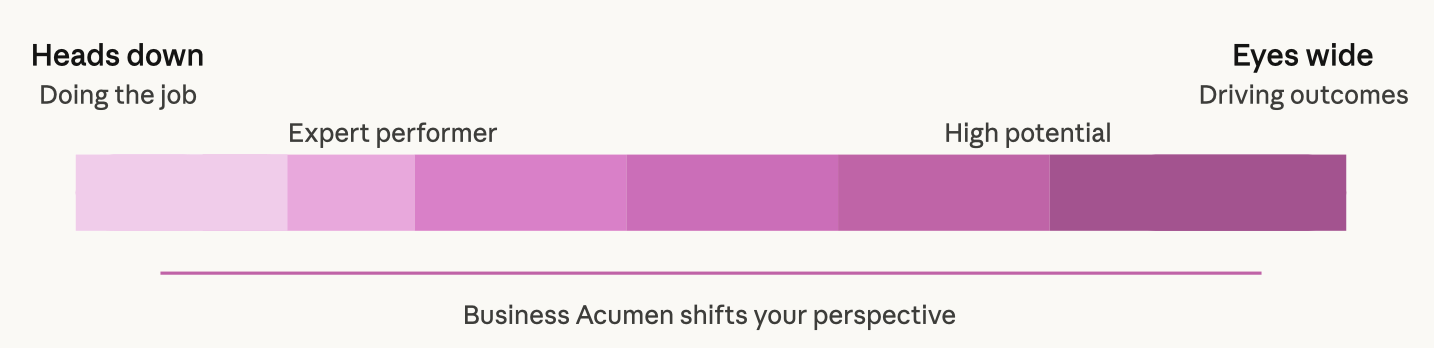
Business acumen shifts your perspective. It moves you from:
“What I do and how well I do it” to
“Why my job exists and how I’m expected to move this organization forward.”
That shift is consequential: as one of the three components of Business Savvy, business acumen is a primary reason “high performers” get — or don’t get — seen as “high potential.”
How’s Your Business Acumen?
Here are 10 questions to find out. Answer them honestly — not what you could look up, but what you actually know right now.
Cash as a tracked business outcome is different than revenue. Can you explain why?
Which functions directly influence your company’s cash position?
Customers are different than consumers. Can you explain why?
Which functions inside your company directly impact customer metrics? Which impact consumer metrics?
There are three major ways companies grow. What are they?
Which functions in your organization directly impact growth?
What are the three elements of Return?
Which functions directly impact Return?
Describe the relationship between Cash, Growth, Return, and Customer/Consumer.
In relation to those four drivers — why does your job exist, and what business outcome is your organization primarily paying you to achieve or exceed?
How did you do? Paying subscribers: scroll on for the answer key and scoring guide.
Take Your Next Steps
Starting next week, paying subscribers will benefit from a short course in Business Acumen. And in April gain FREE access to a 28 Day Leadership Boost.
Quick Start Business Acumen - Launches 16 March
Starting March 16th, paying subscribers receive seven focused articles:
Introduction,
one each on Cash, Growth, Return, Customer/Consumer,
a Wrap
and one on Your Positional Purpose.
Each article goes deeper than the overview above — covering what executives really track, which functions matter most, and how to connect your specific role to each key outcome.
By the end, you’ll be able to answer every question in this quiz with confidence, and more importantly, you’ll be able to use that knowledge in the room where it matters.
All articles are available anytime, but do read before April 6th to be prepared to get the most from your 28 Day Leadership Boost.
28 Day Leadership Boost - Starts 6 April
Small daily actions over 28 days make you a more comfortable, confident, credible, and competent leader — no matter your level.
Leadership is using the greatness in you…
To achieve and sustain extraordinary outcomes…
By engaging the greatness in others.
Here’s how it works:
Each day you receive a prompt — your leadership focus for the day — drawn from business savvy, engaging others, or your personal greatness.
A daily inspiration enriches the challenge. Exclusive course content instructs and engages.
A personal journal lets you document and review your progress. The investment: 5 to 15 minutes a day.
I know how easy it is to get trapped in the hamster wheel of activity — buried under an endless to-do list, losing sight of the bigger picture. As CEO of Leading Women, I was falling into that trap myself. I didn’t have a hierarchy above me pushing for results, but I had people counting on me for their livelihoods.
When I learned to use my leadership definition to give each day a clear focus, it became easier to set priorities, distinguish what was essential from what was merely easy, and keep my eyes on what mattered. My firm grew 1,400% in six years.
Unlike me, you don’t have to figure this out for yourself.
“Every day I use the 28 Day Leadership Boost — with pen and paper. The results I achieved across Europe? Susan, that’s for us to celebrate together.”
Johanna T., Sr. Commercialization Manager
You just did something most professionals never do — you stopped and honestly asked: do I really understand the business I work in? That question alone puts you ahead. Paying subscribers: your answer key and scoring guide are waiting below.
Starting March 16th, paying supporters receive the Quick Start Business Acumen course: five focused deep-dives — one each on Cash, Growth, Return, Customer/Consumer, and Your Positional Purpose — to close any gaps with confidence.
Lead ON!
Susan
The Answer Key
1. Cash vs. Revenue Revenue is what a company is paid by its Customers. Cash is what it actually has available to operate, invest, and grow. A company can be profitable on paper and still run out of cash — which is why executives track them separately. Cash flow determines whether a business can meet financial obligations, fund growth, and survive a downturn.
2. Functions that influence cash Accounts Receivable, Accounts Payable, Treasury, Operations and Procurement directly impact Cash. AR and AP because they actually manage the inflow and outflow of money. Treasury because it determines how best to invest cash for highest returns and required liquidity. Operations and Procurement because a tight supply chain ensures that cash isn’t tied up in inventory. And Sales through payment terms and collections. If your function touches costs, contracts, or revenue timing, you’re in the picture.
3. Customers vs. Consumers Customers are those (people or organizations) that actually pay your organization for its product(s). Consumers use your product(s). In many industries they’re the same — but often they’re not. A parent buying cereal is the consumer; the big box or corner grocery store buying cereal from General Mills (for example) is the customer. Strategy, messaging, and metrics differ for each.
4. Functions that impact customer and consumer metrics Customer metrics (acquisition, retention, satisfaction, lifetime value) are most directly influenced by sales, marketing, customer service, and account management. Consumer metrics (usage, experience, loyalty) are shaped by product, UX, quality assurance, and product safety. The cleaner your understanding of these connections, the more clearly you can articulate your team’s direct contribution — if any.
5. Three ways companies grow
Acquiring/merging with another business
Entering new markets
Launching new products/services to acquire new customers
Every growth strategy traces back to one or a combination of these three.
6. Functions that impact growth Mergers/acquisitions, research & development, strategic planning (new markets) and product development are the functions most directly impacting growth. Marketing, sales and operations matter too — a company can’t grow what it can’t deliver.
7. Three elements of Return The simple equation for Return on Assets is the one I find most helpful. The 3 elements of ROA are: revenue, expenses and velocity. Revenue is the money earned from customers, expenses are all of the costs of doing business, (revenue minus expenses = margin/profit). Multiplied by velocity (the speed with which things are done) is the 3rd element.
8. Functions that impact Return Revenue is most directly by sales (or automated functions equaling the function of sales). Expenses are owned by everyone. Each person impacts the cost of doing business and velocity through their efficient (or inefficient) work. Functions include: process design/Lean/Agile (velocity), sales (margin), procurement (cost of goods), and IT (velocity).
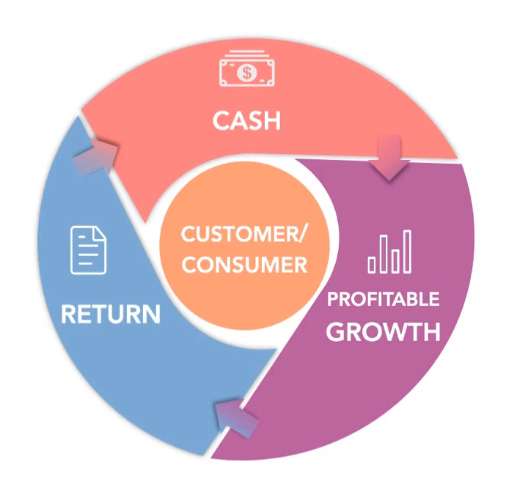
9. The relationship between the four drivers This is the crux of business acumen. Cash funds the operations that enable Growth. Growth generates Revenue, which — managed well — builds Return. Return attracts and retains the capital that sustains Cash. A business can only create this virtuous cycle by attending to its Customers (and Consumers if it has them). When one driver weakens, the others feel it. Executives who run healthy businesses are managing all four simultaneously — and so should you.
10. Your Positional Purpose This is the most important question — and the one most people can’t answer precisely. Every role exists because it contributes to at least one of the four drivers. Your Positional Purpose describes the specific business outcome you/your team(s) is/are primarily paid to achieve or exceed. Not your job description. Not your deliverables. The outcome(s) — and how it connects to Cash, Growth, Return, or Customer/Consumer.
Your Score
9–10: You’re operating with genuine business acumen. The Quick Start course below will sharpen and systematize what you already know.
6–8: Solid foundation with real gaps. The course will fill them in ways that will change how you show up.
Fewer than 5: This is exactly where most talented women are — and exactly what the next four weeks are designed to address.
Before you go: which of the ten questions surprised/stumped you most? Drop it in the comments — your answer will help me tailor the course content to what matters most to you.
See you next week!
Susan