
The Language That Opens Doors Isn't About How Hard You Work

The way we describe our work determines whether the people who make advancement decisions see us as high performer or as high potential.
The keynote speaker paused before she said it.
“My mother sent me to law school to learn the language of power.”
I have thought about that line for years. She was right. There is a language of power - I had never thought of that. And she was right that the language of power in government might be the law, but it wasn’t the language of power in business. And most of us were never taught what it is.
In business, the language of power is not jargon. It is not confidence, and it is not credentials. It is the language of outcomes.
Here is what I mean.
Every function has its own vocabulary. HR talks about time-to-fill and retention. Marketing talks about campaigns and awareness. Legal talks about contracts and compliance. Engineering talks about error rates and release timelines.
None of that is wrong. But none of it is the language of power either.
The language of power connects what we do to why the organization needs it done. What is it trying to achieve in terms of: revenue, growth, customer retention, cost, risk, and competitive position? When we make that connection visible, how we talk about our work lands differently.
Here is the contrast, using an example most of us would recognize:
HR language: “Our new talent acquisition process went live on time and under budget.”
Language of Power: “We reduced time-to-fill by 15%, which means revenue-generating roles are productive sooner. Revenue from the Southeast region increased 150% once staffing reached 100% .”
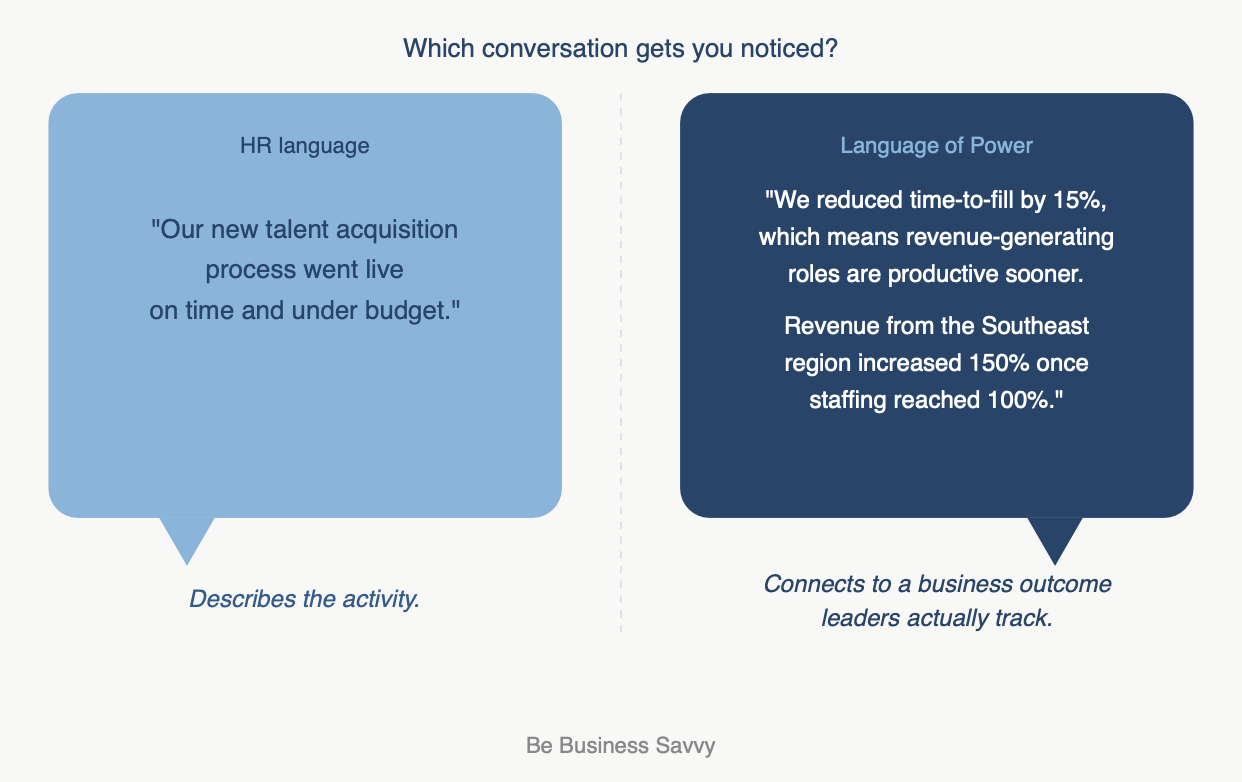
The first sentence describes an activity and result. The second connects the activity to a business outcome that executives and investors actually track. Same fact. Completely different conversation.
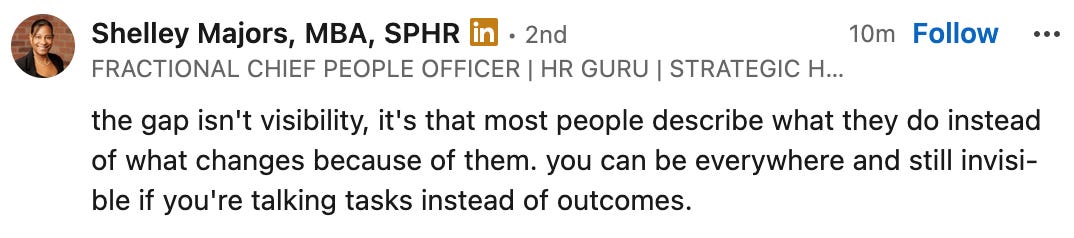
I am not the only one noticing this. Shelley Majors, owner of Boardwalk Human Resources Consulting put it plainly in a recent LinkedIn post: “…most people describe what they do instead of what changes because of them. You can be everywhere and still invisible if you’re talking <activities and results> instead of outcomes.”
She is right. And the women who figure this out early are the ones who stop being overlooked.
Below, I have translated the same pattern across five functions where women are well-represented: HR, Marketing, Legal, Organizational Development, and STEM. I chose four of these functions because women are among the most highly represented in each of them, and STEM because so many women in STEM ask me for exactly this. If you are not in one of these functions, rest assured, the pattern works in any function, for any woman.
But before you get to the examples (below the paywall), here’s what’s important to understand.
The translation is a skill. And like any skill, it requires a foundation.
Speaking the Language of Power is not just about swapping out words. It requires understanding how a business actually works: how cash moves, how growth is generated, how decisions at the function level connect to outcomes at the enterprise level. Without that foundation, the translation feels forced. Experienced executives will notice.
That foundation has a name, and paid subscribers can access it any time through the Quick Start Business Acumen course, which is part of your Be Business Savvy membership. If you are not yet a paid subscriber, this is a good moment to consider it.
