
Invisible on LinkedIn? Here’s a Fix.
Understanding why is ammunition for the fix

You posted something good. You know it was good. And then you watched it quietly disappear into a feed that never seemed to show it to anyone.
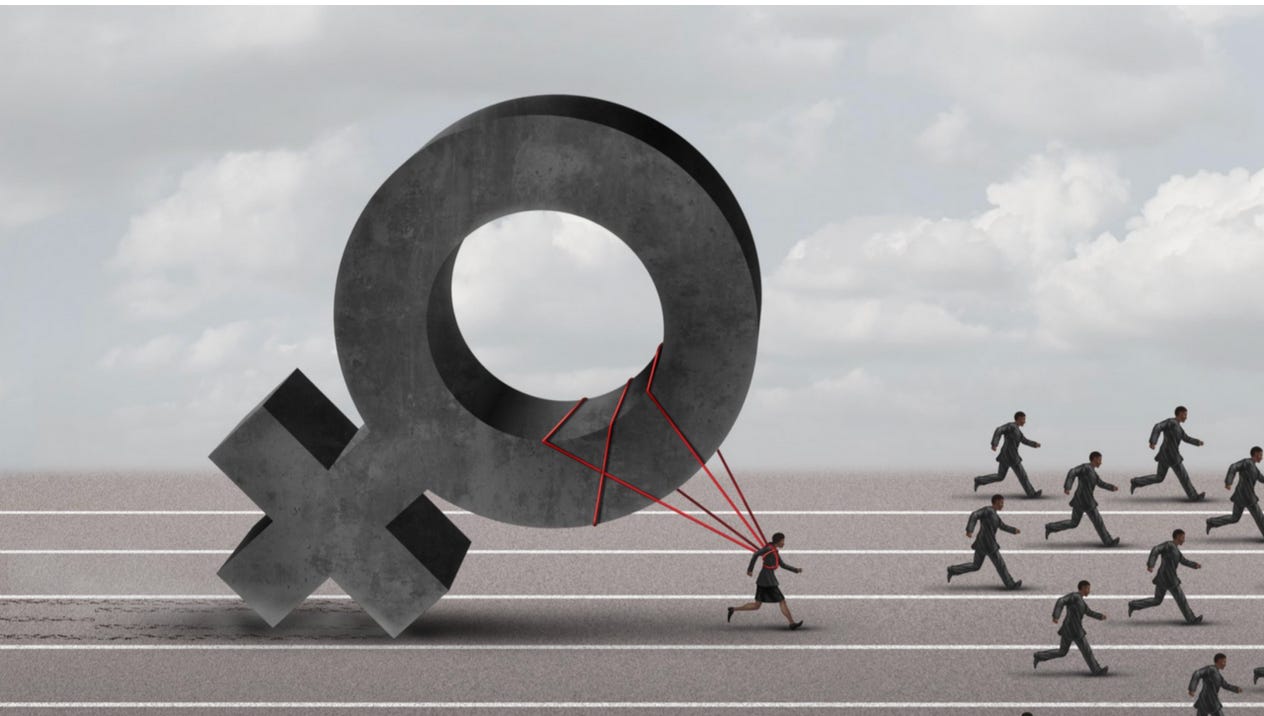
Image borrowed with best intentions. Original by Better Workplace Cultures here.
I’m writing this because LinkedIn isn’t optional for most professional women. It’s where opportunities circulate, expertise becomes visible, and careers advance or stall. Understanding how the platform actually works, not how it claims to work, is business-critical knowledge.
LinkedIn’s own ads promise:
“LinkedIn is the network that works for you.”
It does. Just not equally.
If you’ve suspected the platform is working against you, two controlled experiments suggest you’re not imagining it..
The experiments
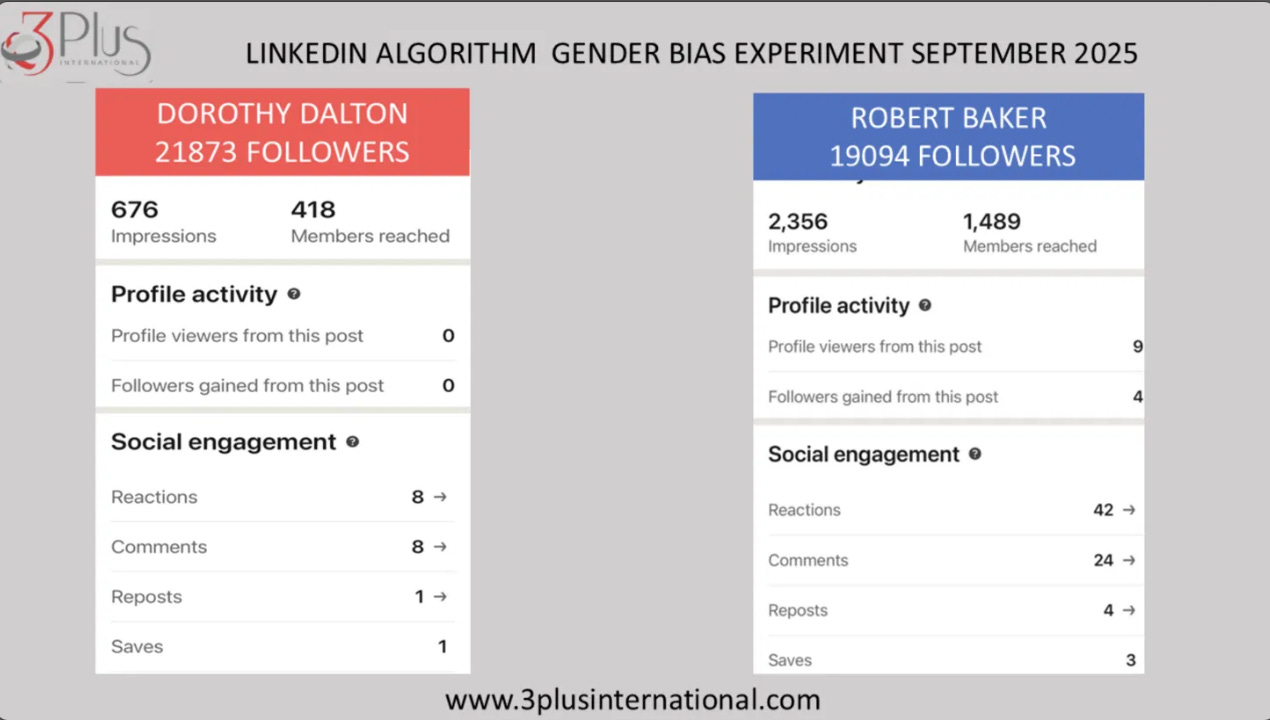
In September 2025, Dorothy Dalton and Robert Baker posted identical content on LinkedIn on the same day. Dorothy had 21,873 followers. Robert had 19,094.
Robert received 3.5 times more reach and gained four new followers. Dorothy gained zero.
This wasn’t a one-off. Jane Evans and Cindy Gallop ran a similar controlled test: two men with a combined 9,400 followers versus two women with 154,000. Same content. Same day. The men reached significantly more people.
Two experiments. Two research teams. One consistent finding.
What makes this particularly hard to dismiss
LinkedIn’s 2026 algorithm, by its own stated values, should be working in your favor.
The platform rewards substantive comments, dwell time, saves, and genuine discussion. It prioritizes specific expertise over generic content. It wants human voices starting real conversations. Women’s posts consistently generate higher engagement rates, more saves, and richer discussion than men’s on the same platform.
By LinkedIn’s own criteria, women’s content should be winning. The experiments show it isn’t.
Which means the problem isn’t communication style. Women can do everything the algorithm claims to reward. Write with expertise. Invite genuine discussion. Earn saves and substantive comments. And still receive a fraction of the reach their male counterparts get with the same content.
Where the bias actually lives
Both experiments used identical content. The only variable was the gender of the poster.
Which means the bias isn’t operating at the content evaluation level, where the algorithm assesses quality and relevance. It’s operating somewhere upstream. Initial distribution. Network clustering. The gate that opens before any engagement signal has a chance to register.
You can write better, post smarter, invite more discussion. The initial reach may still be throttled before your audience gets a chance to respond.
That’s not a content problem. That’s a structural one. And it has no fix on the posting side.
What LinkedIn’s own research reveals
A 110-page technical analysis published in December 2025 by researcher Martyn Redstone1, derived exclusively from LinkedIn’s own peer-reviewed engineering papers, now explains exactly why.
LinkedIn’s recommendation system filters billions of posts down to roughly 1,000 candidates per user through a retrieval engine. LinkedIn uses past engagement as an entry requirement. Posts from creators who have historically received more likes and comments are more likely to make that initial cut. Because men dominate LinkedIn’s follower leaderboard and have historically accumulated more engagement, they start with a structural advantage at this gate — one the algorithm compounds rather than corrects. And as the experiments show, even when women have significantly more followers, the gap persists.
The system also misreads safety as irrelevance. LinkedIn’s identity model weights 70% on positive interactions only. Women who post less due to harassment or safety concerns produce sparse interaction histories. The algorithm reads that caution as low relevance, not as a reasonable response to a hostile environment.
If your feed looks like it’s mostly your connections, that’s by design.
LinkedIn distributes content within network clusters first. For women, whose professional networks tend to be smaller and more homogeneous, content circulates locally but rarely breaks out to the broader audiences where reach actually compounds. That matters because LinkedIn isn’t a hobby. We’re there to showcase thought leadership, demonstrate expertise, and build the professional visibility that advances careers. When the algorithm keeps women’s voices inside smaller clusters, the cost isn’t just fewer impressions — it’s diminished professional presence at exactly the moments it should be growing.
As Redstone writes:
“LinkedIn does not contain a rule that suppresses women. No engineer wrote code that says: show fewer posts from these groups. The system is not designed to discriminate. But discrimination still occurs. The core issue is not intent - it is design.”
What some women are doing
A growing number of women have quietly changed their LinkedIn profile gender to male. Not as a statement. As a strategy. Because they discovered that one simple switch improved their reach dramatically.
LinkedIn’s official position: “Our algorithms do not use gender as a ranking signal.”
The data from two controlled experiments and a 110-page technical analysis of LinkedIn’s own research disagrees. LinkedIn has opened at least one formal investigation.
Understanding the problem is being savvy. Knowing what to do about it is the next step. Below are six specific practices that give your posts the best chance within a biased system — and the strategy that bypasses it entirely.
What’s a Woman to Do?
Know that the throttling is real, documented, and technically explained. It is not your content, your voice, or your strategy that’s failing.
Keep posting on LinkedIn — and within a biased system, give your posts the best possible chance:
Close with a genuine question. Comments are the algorithm’s strongest signal, especially substantive ones that arrive early.
Respond to early comments within the first hour. Thread depth matters more than likes.
Put links in your first comment, not the post body. LI doesn’t want people to leave!
Create content worth saving: specific data, frameworks, insights people will return to. Saves are a powerful algorithmic signal.
Don’t edit after publishing. Even a small edit can reset early momentum.
Post when your audience is most active and stay close. The first 60-90 minutes are disproportionately important for whether a post breaks through.
Build presence where the algorithm doesn’t control the gate. Substack. Direct newsletters. Other spaces where your content reaches the people who want it, without a platform deciding who gets to see it first.
When someone tells you to just improve your content, you can now explain, with technical precision, why that isn’t the whole answer.
You posted something good. The data says the platform failed you. Not the other way around.
Lead ON!
Susan
22 July update. Oh the irony. A reader reached out today to say she saw this article, not because Linkedin’s algorithm surfaced it, but because a Claude AI agent did. And that, dear reader, is suppression in action.
Part Two


If you’re looking for content that directly addresses the business, financial and strategic acumen you want more of - the kind of development that complements the presence and relational work you’re already doing - the Be Business Savvy Course is built for exactly this purpose. Self-paced, with coaching support, designed to be accessible even if you didn’t come up through finance or strategy.
I welcome your next step:
❤️ Like, share or restack this post - it’s the best way to help other women find it
📘 Explore the Be Business Savvy Course
Susan
https://zenodo.org/records/17976861 Structural Properties and Systemic Risks in LinkedIn’s Modern Recommendation Stack: A Systems-Level Reconstruction Using Published Technical Disclosures (2023–2025) - Martyn Redstone (with support from an AI Assistant), December 2025
Brilliant advice Susan. I appreciate the research that goes beyond outrage - that LinkedIn does not throttle based on gender (alone) it creates your feed based on its fundamentally flawed design.