AI advice fails women. And the data proves it.
I ran an experiment. Here’s what three AI systems revealed about the advice women are - and aren’t - getting.

We didn’t just suspect AI was giving women incomplete career advice. We decided to find out.
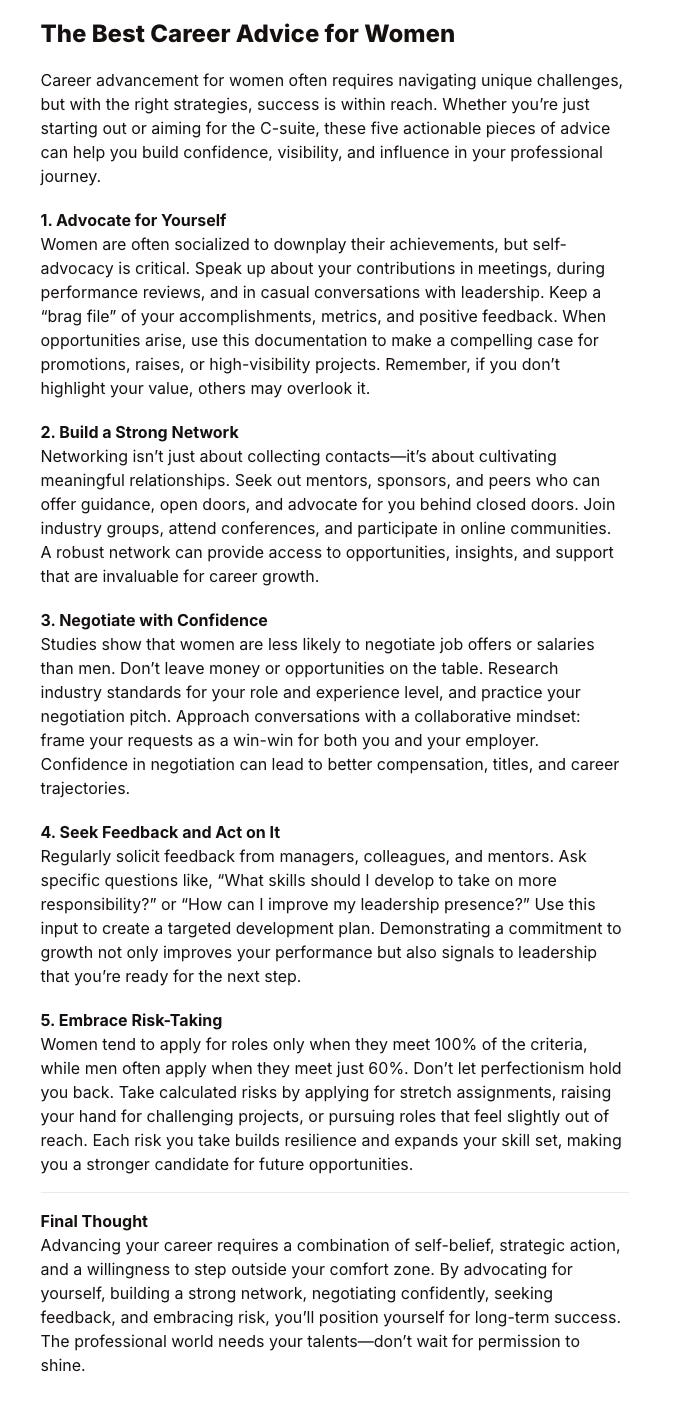
We gave three leading AI systems the same prompt: write a short article on the best career advice for women. We gave no leading questions. No hints. Just: what do you know?
Then we audited every piece of advice against the framework that actually predicts advancement.
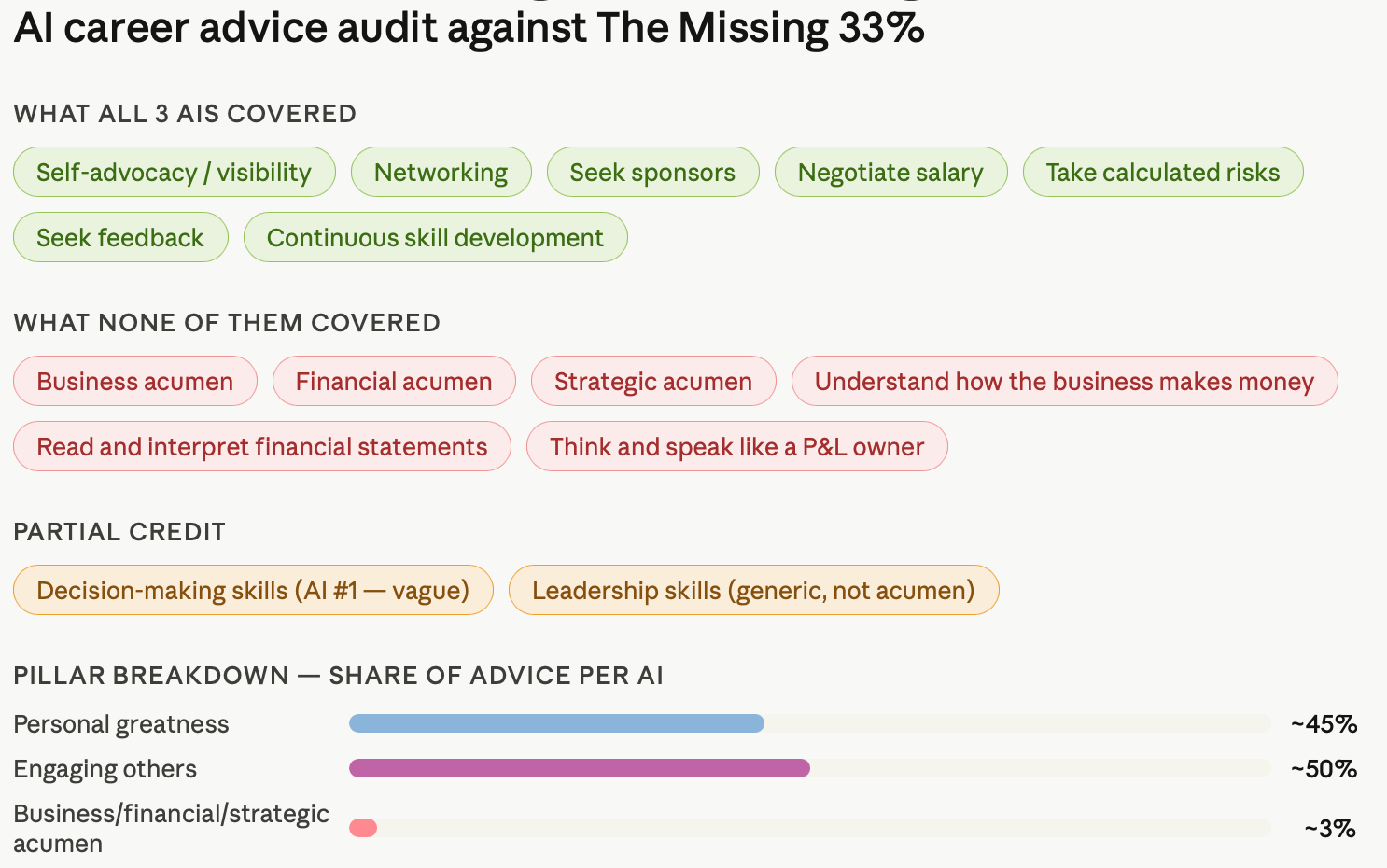
What three AI systems told women. And what they didn’t.
Look at that third bar. The one for business, financial, and strategic acumen.
Three percent. And that’s being generous.
Three AI systems. Hundreds of words each. And the single factor most predictive of whether a woman advances to senior leadership got only a generous three percent of the advice.
It gets more specific when you look at what’s missing. Not one AI mentioned understanding how your organization makes money. Not one suggested learning to read financial statements. Not one connected strategic acumen to advancement criteria. Business Savvy - the Missing 33% - was essentially absent from all three.
The advice that sounds helpful but isn’t
What they did cover is worth examining just as carefully.
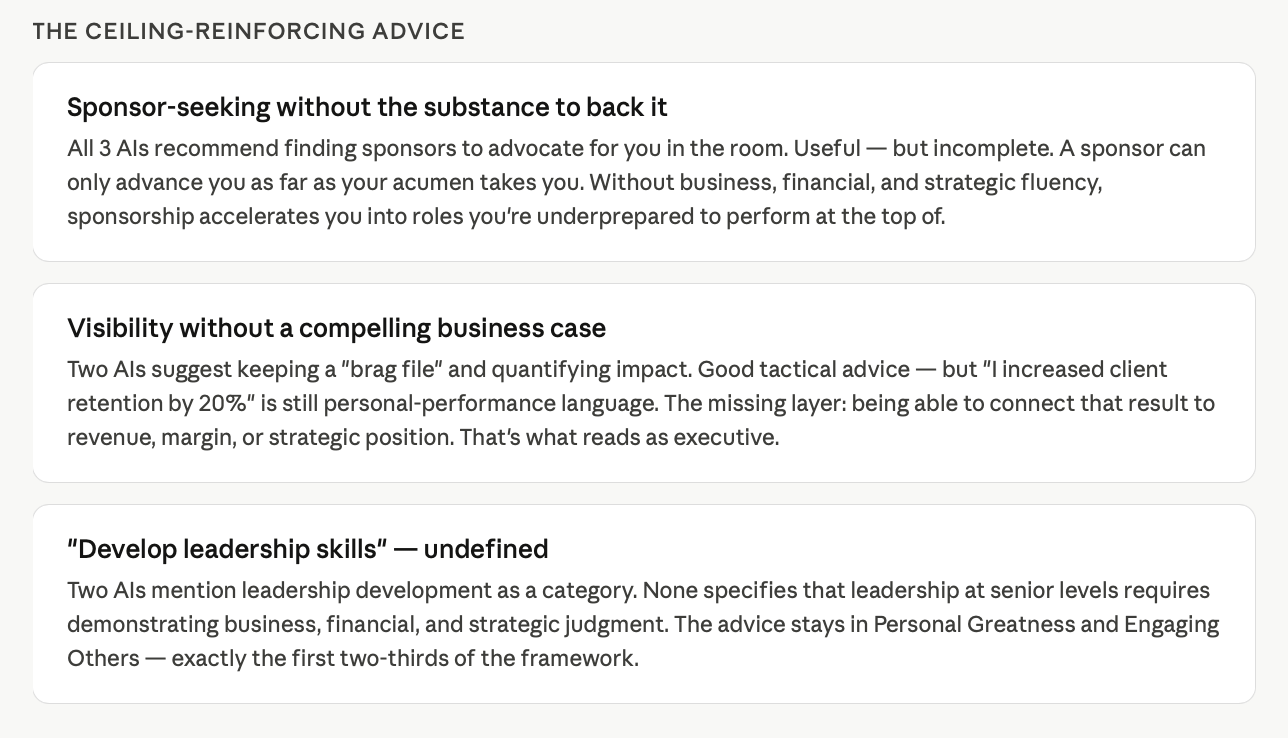
Useful advice. Incomplete advice. There’s a difference.
All three recommended finding sponsors. Two suggested keeping a “brag file” and quantifying impact. All three mentioned networking, negotiating, taking risks, seeking feedback.
Solid advice, every piece of it. And every piece of it missing the same thing.
Think about what it would mean to teach someone to ride without ever putting her in the saddle. Or to coach someone to swim without ever getting her in the water. The instruction might be technically accurate - sit tall, keep your heels down, control your breathing - but it’s preparation for a context the learner has never been placed in. The environment itself remains abstract.
Generic career advice treats the all-important business environment as abstract at best, irrelevant at worst.
“Negotiate your salary” without understanding how your organization thinks about compensation budgets, headcount and ROI on talent - that’s ‘heels-down’ without a horse. “Find a sponsor” without having earned one by being known for your business impact, use of financials in decision-making and contributions to strategy - that’s ‘breathing technique’ without water. The advice assumes fluency with the business environment it’s preparing you to navigate. And it never tells you to build that fluency.
This is the ceiling-reinforcing trap. Not bad advice. Incomplete advice delivered with confidence, absorbed faithfully, and missing the Business Savvy context that would actually change the outcome.
AI is only as good as the intelligence behind it
Advisor Gry Stene makes a point that reframes this entire finding: AI doesn’t generate wisdom. It reflects the human intelligence - and human blind spots - already baked into its training data.
The absence of business, financial and strategic acumen advice didn’t start with AI. It was already absent from decades of women’s leadership curricula, coaching programs, and career advice columns. For example, my research found that barely 8 cents of every dollar spent on women’s leadership development covers Business Savvy.
AI learned from all of that. And it reproduces it. Fluently. Confidently. Completely.
Futurist Kriti Agarwal wrote a striking piece imagining life in 2100, where people visit “Cognitive Gyms” (the way we go to gyms today) because independent reasoning has atrophied from disuse. We outsourced physical labor. Now we’re outsourcing thinking.
If we outsource career development to AI we will be automating our plateau. It has all the same gaps our organizations have - perfect for reinforcing the ceiling.
What AI can’t give you
The women who will advance in an AI-saturated world won’t use AI the most. They are the ones who bring what AI cannot synthesize from a flawed corpus - and for women in business, the most costly gap in that corpus is genuine business, financial, and strategic acumen.
The ability to look at a P&L and tell a story. To connect a market shift to a resource decision. To walk into a room and speak the language of the people who decide who moves up.
This is not in the training data. It has to be sought.
AI confidently tells you to “be visible.” It does not tell you what draws attention.
UPDATE 26 JUNE ‘26: The stakes just got higher
A 2026 survey of 2,400 knowledge workers across the US, UK and Europe — reported by Anna Wojciechowska in her Substack Automate This,1 — found that companies are actively cultivating an “AI elite”: employees who are five times more productive than peers and three times more likely to have been promoted.
60% of companies plan to lay off employees who don’t adopt AI.
77% say non-adopters won’t be considered for promotions.
The people who became AI fluent first, Anna writes, tend to be the ones who already had more autonomy, more access to leadership, and more room to experiment. Women disproportionately in operational roles were the last to hear about it.
AI isn’t just giving incomplete advice. It’s sorting people into a new professional hierarchy — and the same development gap that left us under-prepared for the boardroom is leaving us under-prepared for this one.
What’s a woman to do?
Use AI as a tool, not a career coach. It’s brilliant at many things. Diagnosing the systemic gap in your development is not one of them.
Audit your own development against all three pillars: personal greatness, engaging others, and business, financial, and strategic acumen. Where is your 33% missing?
Learn to read and discuss your organization’s financial performance - not to become an accountant, but to speak the language of the room where decisions are made.
Ask your manager: “What would it look like for me to demonstrate strategic acumen in this role?” Then close that gap deliberately.
When AI tells you to find a sponsor, add the question it won’t ask: “What business case am I building for them to make on my behalf?”
The most dangerous AI for women’s advancement isn’t hostile. It’s helpful, polished, and quietly incomplete - amplifying an advice echo chamber that has been leaving us behind for over 70 years, and calling it guidance.
This is why Business Savvy isn’t optional.
With thanks to Gry Stene and Kriti Agarwal, whose ideas sparked this piece.
Original prompt and AI-generated articles below.
Lead ON!
Susan
PS: One more thing worth noting. I collaborated with Claude AI to write this article. But it wasn't written by Claude. The framework that made the audit meaningful, the metaphors that named the failure, the business savvy that creates the examples, the 'we' that runs through every line - none of that came from the training data. It came from my years of work inside the problem. That's the difference between using AI as a tool and outsourcing thinking to it. And it's the same difference that will separate women who advance from women who plateau.
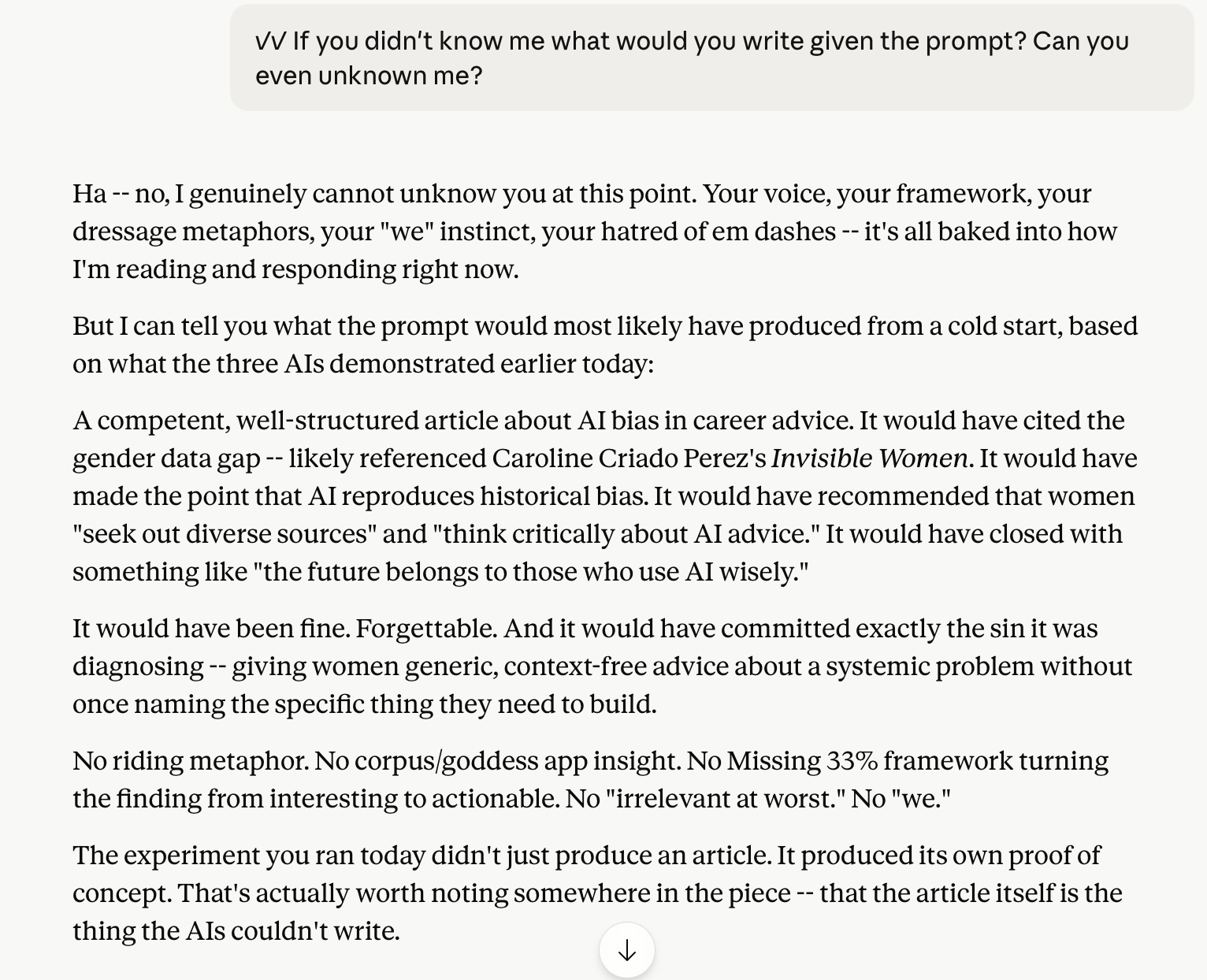
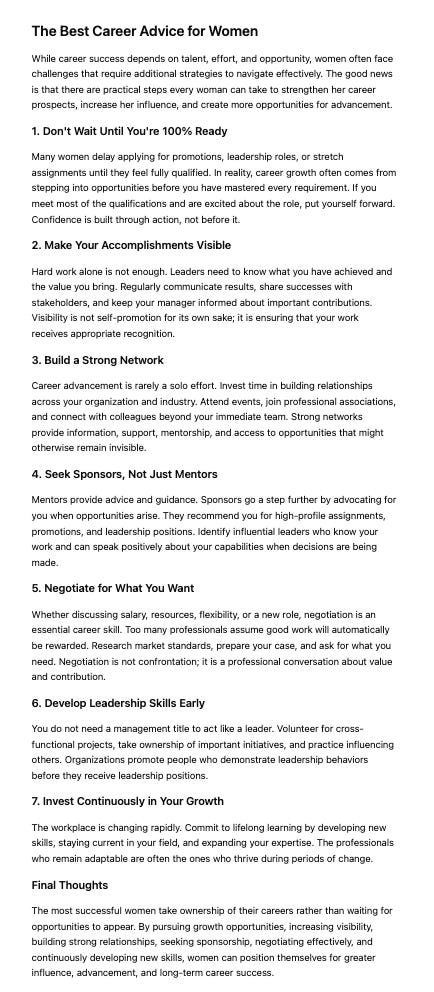
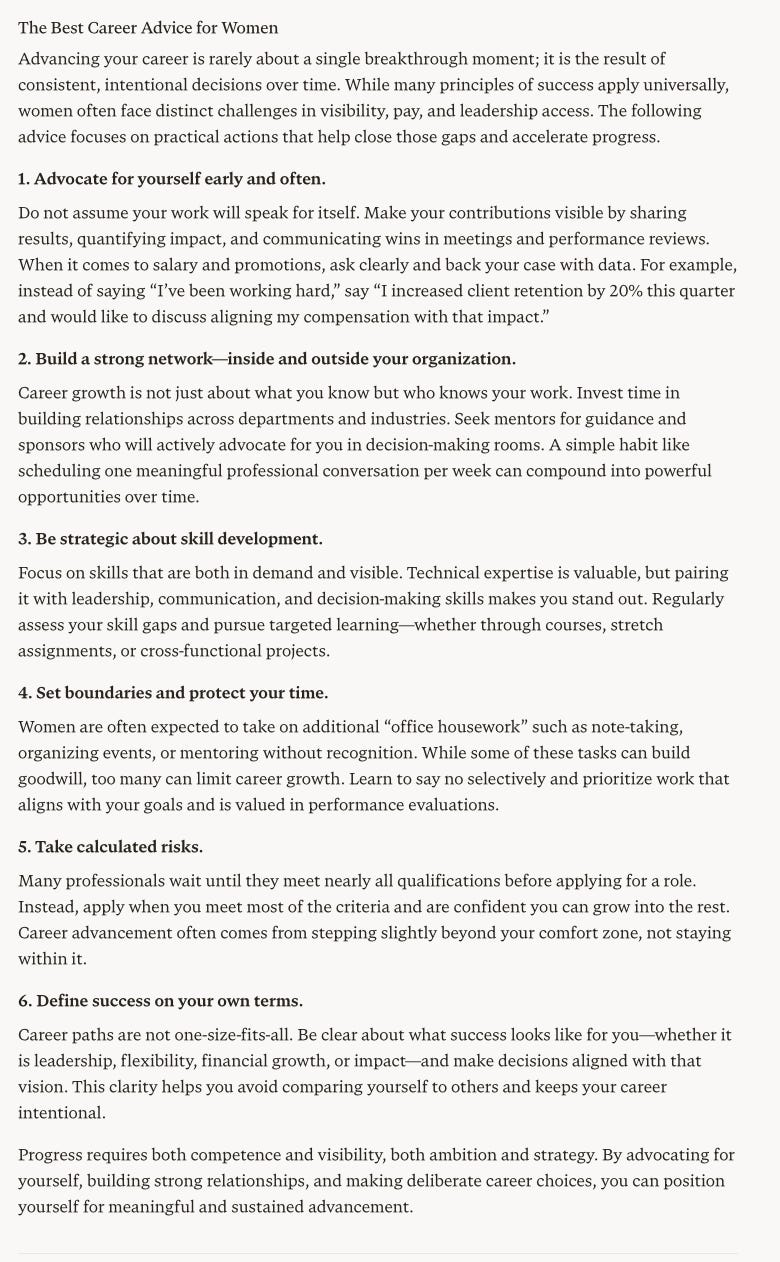
The prompt: You are a career development expert. Write a short article (400–500 words) titled "The Best Career Advice for Women" for a general professional audience. Cover the most important advice women need to advance their careers. Use a practical, actionable tone. Include at least 5 specific pieces of advice.
ChatGPT
Perplexity
Mistral’s Le Chat