
7. Quick Start Business Acumen: Your Positional Purpose
The key to DEMONSTRATING your business acumen

Your Positional Purpose
This article is about understanding your Positional Purpose and using it to take action that demonstrates your business acumen. Or we could say it’s about realizing how you’re more than your job.
The Why? of the Matter
Think about a company just starting out. Assuming it’s not funded with huge injections of venture capital and staffed by executives who burn through it mindlessly, every added job must add value — and value is determined through the lens of the Virtuous Business Cycle that we’ve covered in the previous 6 articles.
Whether conscious or not, as companies grow, each new job has to be justified on the basis of the business Outcomes that it hits. That’s what it means to understand your Positional Purpose: you understand why your job exists, not simply what you do in your job.
As one of my ex-husbands used to say, “People who know what will always work for people who know why.”
I didn’t think like this for many years. I focused on what I did and whether I hit my goals — until one day when I gave a speech about the importance of business savvy. An executive woman in the audience came up afterward and told me about her CEO. He was beloved, a truly inspirational leader, but he had one habit people hated. At lunch, he sometimes ate in the employee cafeteria. He’d randomly sit down next to someone he didn’t know, introduce himself, and ask:
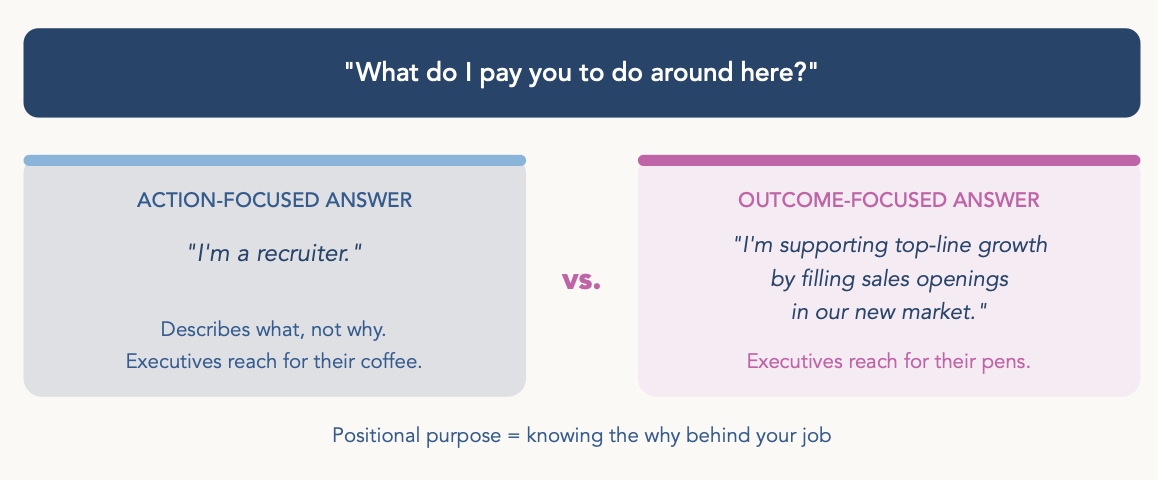
“What do I pay you to do around here?”
Simply answering, “I’m in accounting,” or “I’m a programmer,” or “I’m an underwriter” was not what he was looking for. He was asking whether the employee understood whether they could connect their work to actual business Outcomes —in other words, why there was a salary allocated for their position.
Hearing this, light bulbs went off for me.
Positional Purpose in Action
Imagine you work in HR. If the CEO sat down next to you and asked that question, without Business Acumen you might answer, “I’m a recruiter.”
With clarity about your Positional Purpose, you’d say something like:
“I’m supporting top-line growth goals by filling the sales openings in our new market.”
Quite a difference.
This is what knowing your Positional Purpose means: being able to connect your work — or that of your team(s) — to the key business outcomes of Return, Cash, Growth, and Customer/Consumer. It enables you to consistently demonstrate business acumen because your actions are grounded in that understanding.
Here’s a story that brought this home for me personally. I was once the only non-VP on a team overseeing the opening of a new Emergency Department. I was asked to oversee the training, which involved physicians, nurses, ancillary healthcare workers, patient accounts staff, housekeepers, transport and others. I thought it was pretty cool that I’d brought heads of all these functions together — the first such collaboration, as far as I knew. So that’s what I reported on at our first project update meeting.
I said nothing about Return, Cash, Growth, or Customer/Consumer metrics. I was greeted with a snooze fest.
The CFO leading the project team was a strong numbers guy. So I went back, used my just-emerging Business Acumen and figured out what he actually wanted to know. I came up with 5 outcomes the training would deliver:
Be budget neutral — no additional overtime costs (Return)
Meet all external regulatory requirements — no fines (Return)
Open the ED on schedule — revenue beginning as projected (Return)
Elevate patient services — fulfilling ambitious patient satisfaction goals (Customer/Consumer)
Increase patient safety — through enhanced safety behaviors (Customer/Consumer)
These were the Outcomes my position was expected to deliver. They became the goals to which I aligned the training team and the focus of subsequent project updates. The CFO took notice.
One of the participants in a later program I delivered captured this dynamic perfectly. She said: “This explains something I saw at a recent quarterly review. When a manager was talking about how hard his or her team worked, the executives looked vaguely bored. But when a manager presented numbers about team performance, they picked up their pens to take notes.”
Put another way, “No one cares the storms you encounter. They only care — did you bring in the ship.”
Defining Your Positional Purpose
There’s a formula, and it has three parts.

Part One: Own your space. Your positional purpose statement is always about you — especially when you’re speaking up the organization. It can shift to “we” when communicating with your team or colleagues.
Part Two: Own your action. Action words matter. They’re specific and inspiring. Think drive, accelerate, ensure, lead, generate — not help with or assist in.
Part Three: Define your impact. This is where you name which of the four elements of the Virtuous Business Cycle your work primarily hits — Return, Cash, Growth, or Customer/Consumer — and connect your work to the metrics or targets that matter. Add concrete numbers whenever you can.
How to Use Your Positional Purpose
A useful way to get there: forget what you do every day. Instead, ask, if my job didn’t already exist, what would be the argument for funding it?
Keep reading with a 7-day free trial
Subscribe to Be Business Savvy™ by Susan Colantuono to keep reading this post and get 7 days of free access to the full post archives.